Ready to Build Something That Lasts?
We meet companies where they are, whether they’re navigating rapid growth, a transaction, a leadership gap, or an operational rebuild. Let’s talk about what you are solving for.


A few weeks ago, I sat down with a private equity firm to discuss AI capabilities for their portfolio. Ten minutes in, as we were talking about use cases, one of the managing partners stopped me mid-sentence and said, “Rob, we’re not interested in task automation. The benefits are too small. We need innovation that helps companies leap forward.”
I’d heard variations of this before, but something about how directly he said it made me realize: PE firms aren’t looking for faster data entry or automated report generation. They’re asking a fundamentally different question: How does AI create transformational—or at least bigger—value—not incremental efficiency?
And here’s what I’ve learned from conversations with PE firms: Many AI vendors calling on PE firms and PortCos are still answering the wrong question.
If you’re evaluating AI solutions right now, chances are you’re seeing pitches like this:
These aren’t bad capabilities. They’re useful. But here’s the problem: PE firms don’t win on efficiency. They win on transformation.
And the data backs this up.
Recent research from FTI Consulting found that while 59% of PE firms now view AI as a key driver of value creation, AI remains one of the least frequently used and most challenging levers to implement. Why? Most AI investments have “emphasized point solutions to serve singular use cases and bring incremental revenue or cost improvements.”
Translation: Lots of tools that make things faster, but nothing that fundamentally changes the game.
The same research found that PE executives are actively shifting their focus from incremental improvements to business model evolution. But they’re finding this transformation “challenging to implement.”
The gap isn’t in the technology. It’s in the approach.
Here’s a sample of the ever-expanding set of tools and data sources available for PE firms:
Each one of these generates insights. Each one produces reports. Each one creates… another data silo.
A former PE professional I spoke with recently described this problem perfectly: “What matters isn’t having these tools. It’s synthesizing the insights into cohesive stories and narratives. The insights need to be integrated with current performance and market conditions to be relevant and usable.”
More AI tools aren’t solving the problem. They’re making it worse.
According to PwC research, 54% of PE firms still rely on spreadsheets or static email reports to monitor their portfolio companies. Why? Despite having multiple sophisticated AI tools, they can’t aggregate the insights into a coherent view that actually informs decisions.
Instead, you end up with:
And when the investment committee asks, “What should we do about Company X?”—you still end up building a deck manually, hunting for numbers across systems, and synthesizing insights the old-fashioned way.
Let me share what I’m hearing in conversations with PE firms who are thinking about this differently:
It’s not enough to know that Company A’s revenue is down 8% (portfolio monitoring tool), or that competitor B just raised $50M (market intelligence), or that industry trends suggest consolidation is coming (due diligence research).
What matters is: Given all of this, what should we do? Double down? Prepare for exit? Pivot strategy? Make an add-on acquisition?
That synthesis doesn’t happen automatically. And it certainly doesn’t happen when each piece of intelligence lives in a different system.
Right now, FTI Consulting research shows that 40% of PE firms are managing AI investments at the portfolio company level—what they call a “Decentralized AI Operating Model.”
The problem? What works at one portfolio company doesn’t easily transfer to others without major modifications. Each company battles for scarce AI talent, deploys tools on different timelines, and develops unique strategies that don’t scale.
As one PE leader told me: “We don’t need each portfolio company to figure out AI on their own. We need a common language, a shared framework, and learnings that transfer across the portfolio.”
This is the insight I opened with: Task automation delivers small benefits. Business model transformation is what creates the step-change in value that matters at exit.
The research shows this clearly. PE executives want to focus on:
These aren’t efficiency questions. They’re strategic questions. And they require a fundamentally different approach to AI.
There’s not a shortage of data, and there’s certainly not a shortage of AI tools—but there is definitely a synthesis problem. And that’s where Decision Intelligence comes in.
Decision Intelligence isn’t another AI tool. It’s the layer that sits above your existing tools and investments—synthesizing siloed information into integrated, actionable insights.
Let’s make this concrete with a real scenario.
You’re managing a mid-market industrial distribution company in your portfolio. Here’s what your various AI tools might tell you:
Now answer this: What should you do?
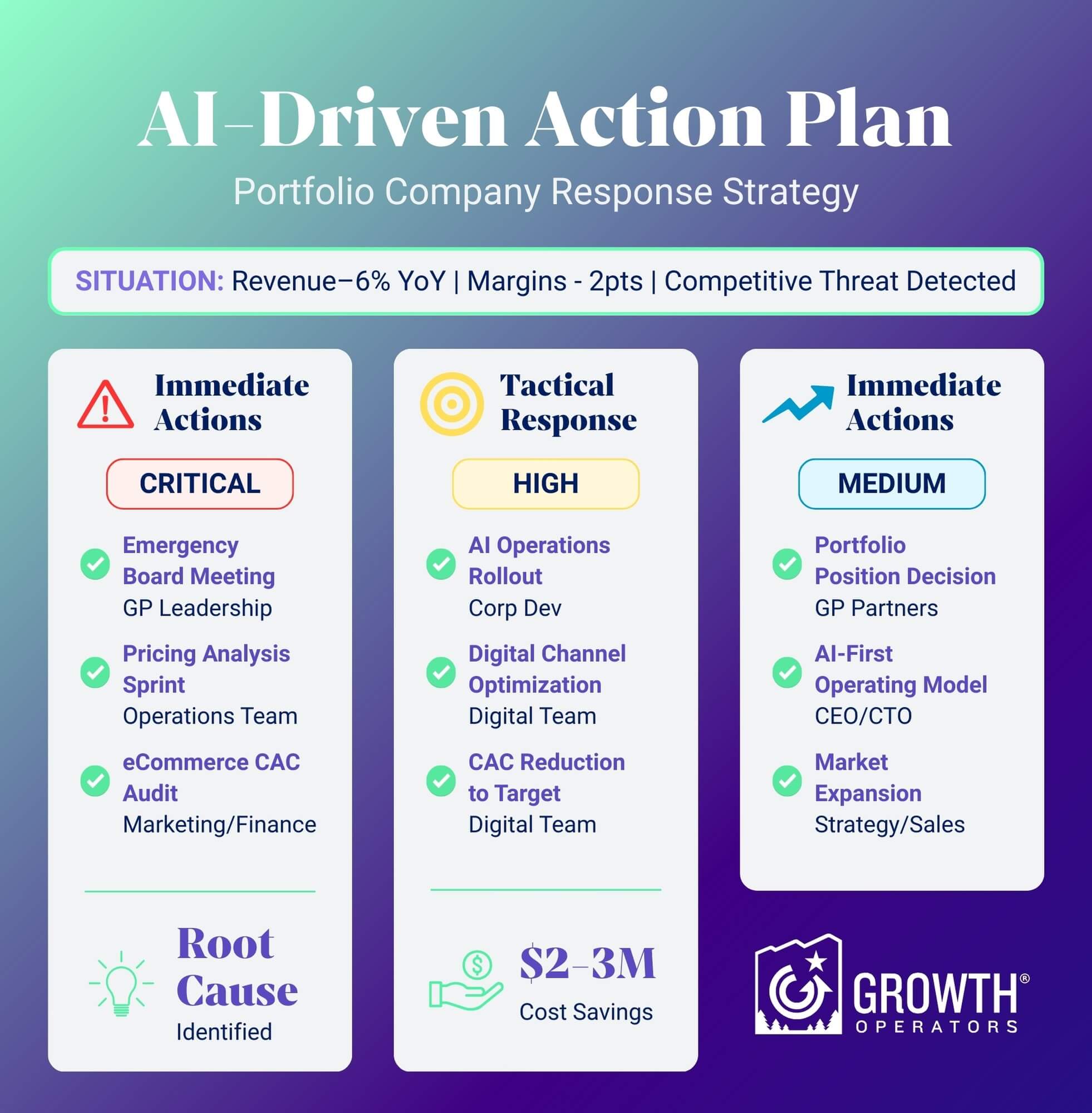
Today, you might spend 3-5 days building a deck to present options, manually pulling data from each system, reconciling discrepancies, analyzing implications, and developing recommendations.
Decision Intelligence does this differently. It automatically synthesizes these signals into an executive narrative:
This isn’t a dashboard. It’s not a report. It’s decision-ready intelligence.
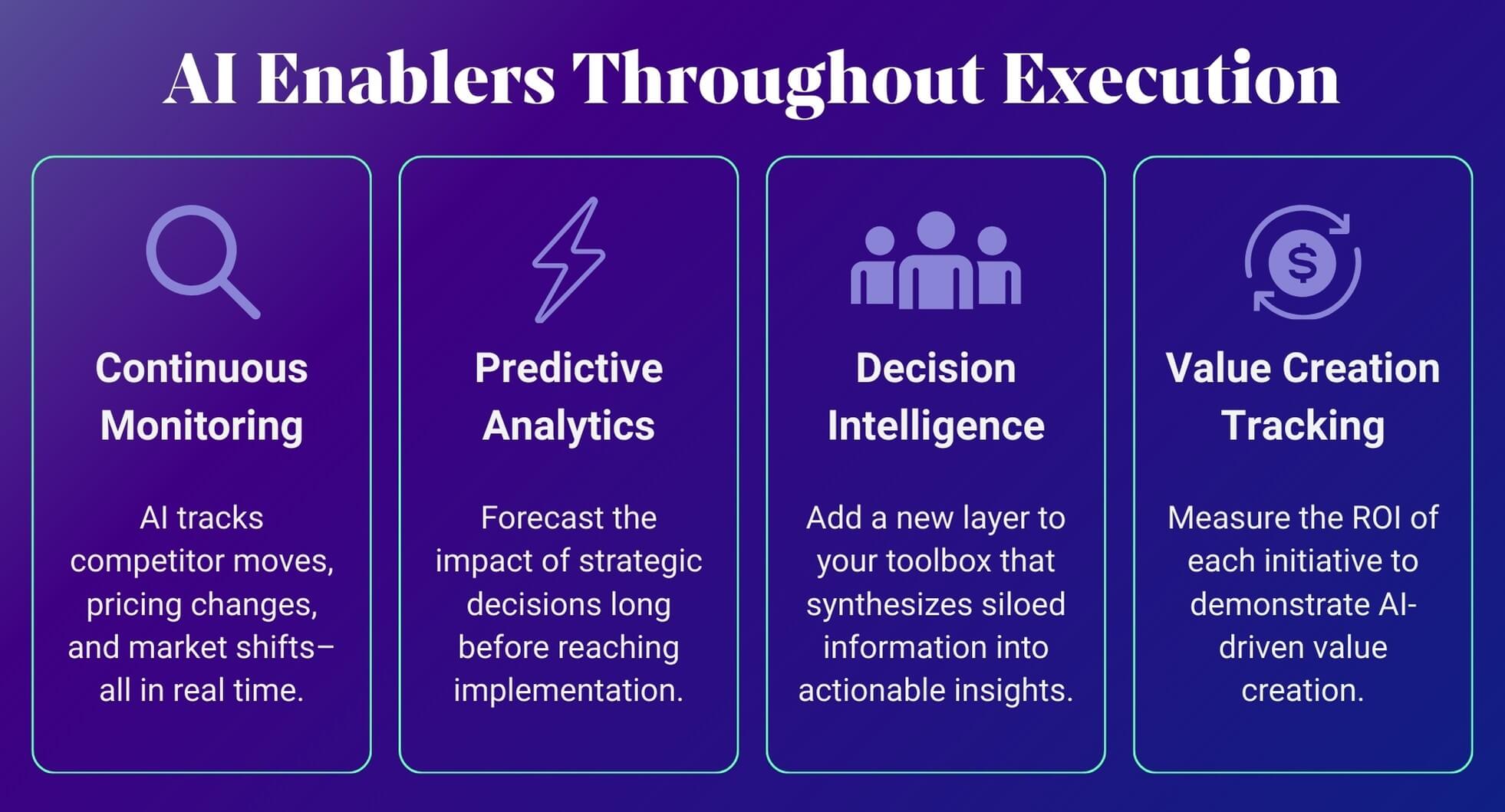
If you’re a PE firm evaluating AI investments right now, here are the questions you should be asking:
This is where competitive advantage lies, not because of better AI tools, but because you’ll have the capability to synthesize AI insights into decisions that drive transformational value.
AI point solutions are necessary but not sufficient. You need due diligence tools. You need portfolio monitoring. You need market intelligence. You need operating dashboards.
But what you really need is the layer that connects them all—that turns isolated insights into integrated intelligence, and intelligence into decisions.
That’s Decision Intelligence.
And the PE firms that figure this out first won’t just make better investments. They’ll transform their entire value creation model. Because in the end, this isn’t about having the most sophisticated AI. It’s about making the best decisions, faster.
________________________________________
Rob Silas
Managing Director of Decision Intelligence & AI
Growth Operators
Helping PE firms move beyond AI point solutions to integrated decision intelligence across their portfolios.
________________________________________
Want to continue the conversation? If you’re a PE firm wrestling with how to move from AI experimentation to execution, or struggling to synthesize insights from multiple tools into coherent decisions, let’s talk. The firms winning with AI aren’t the ones with the most tools—they’re the ones with the clearest framework.
No matter where you are in the process, we can help you develop an Exit Readiness plan to maximize the value of your company and bring you to closing.
"*" indicates required fields