AI-Powered Decision Intelligence: The Highest-Value Use Case No One’s Talking About
|
Share:

There’s a reason we’ve focused our AI practice on Decision Intelligence: it’s where mid-market companies get the most value for their investment.
AI can drive value in two ways. First, it reduces costs—automating tasks, streamlining data prep, and eliminating manual work that used to eat up analyst time. Second, it improves decisions—surfacing insights faster, modeling scenarios that weren’t feasible before, and ensuring the right information reaches the right people at the right time.
Decision Intelligence sits at the intersection of both. You get the efficiency gains from automation and the top-line impact from better decisions. For mid-market and lower mid-market companies without enterprise-scale budgets, that dual payoff matters.
But here’s the problem: most companies can tell you exactly how much they’ve spent on data infrastructure over the past five years. What they can’t tell you is how many decisions that investment produced.
Not reports. Not dashboards. Not the insights someone mentioned in a meeting. Actual decisions—with clear owners, specific actions, and measurable outcomes—that happened because analytics surfaced something that required a choice.
The connection between data investments and decision-making is surprisingly thin. This is the gap that Decision Intelligence exists to close.
The Pattern We See Everywhere
When we map an organization’s analytics maturity—what we call a Decision Map—we consistently see the same pattern:
Green at the bottom. Red at the top.
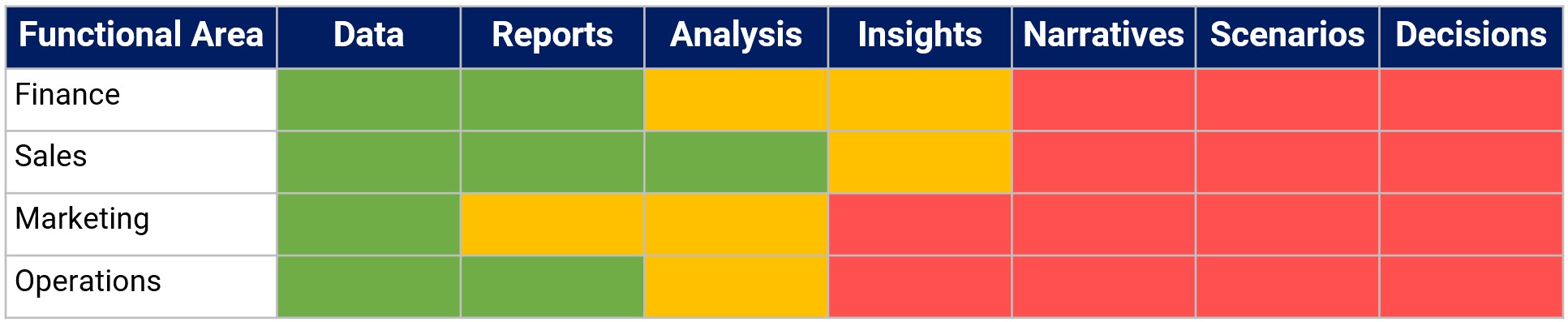
Companies invest heavily in data infrastructure. They build reports. They even do analysis. But the value evaporates before it reaches the decision layer.
The insights exist; they’re just trapped in someone’s head. The narratives never get written. The scenarios never get modeled. And the decisions? Those still happen in hallways, based on gut feel and whatever someone can remember from the last meeting.
Why This Happens (And Why It’s Rational)
This pattern isn’t laziness. It’s economics.
Moving from “data” to “reports” is cheap—you buy a tool, connect it to your systems, and dashboards appear. Moving from “reports” to “analysis” costs more—you need someone who can interpret what the numbers mean. But moving from “analysis” to “decisions”? That requires synthesis, judgment, and communication skills to translate complexity into action.
That’s expensive. So, companies rationally stop at “reports” or “analysis” and hope the humans in the room will do the rest.
Sometimes they do. Often they don’t. And the investment in data infrastructure never fully pays off.
What’s Changed
AI has rewritten the math on what’s possible.
The synthesis work that used to require a senior analyst spending two days on a board deck can now happen in hours. The scenario modeling that required a dedicated FP&A resource? That can now be systematized. The translation from “here’s what the data says” to “here’s what we should do”? AI can draft that—and a human can refine it.
This doesn’t mean AI replaces judgment. It means AI handles the assembly so humans can focus on the judgment.
The moves that used to be too expensive are now viable. The gaps that used to stay red can turn yellow. The yellows can turn green.
But Here’s What Most People Miss
Most AI implementations fail because they add AI to the bottom of the stack—better data pipelines, faster reports, more automated dashboards. That’s useful, but it doesn’t close the decision gap. You just get to “analysis” faster and still stop there.
The real opportunity is using AI to build the missing layers: the narratives that explain what matters and why, the scenarios that model what could happen next, and the decision frameworks that identify what to do about it.
But here’s the critical insight: AI is only as good as the framework in which it operates.
AI can synthesize data, surface patterns, and even recommend actions—but it needs humans to define what a good decision looks like, what trade-offs matter, and what context is essential. The companies getting real value from AI aren’t just deploying tools; they’re building decision architectures that tell AI what to optimize for and how to structure its thinking.
When you get this right, AI becomes a genuine partner in the decision process—not just providing information, but guiding leaders through a systematic approach to making better choices.
We’ve found that good decisions consistently move through the same stages, whether you’re aware of it or not. We call this The Five Lenses:
- Frame: What are we actually deciding? (Not the surface question, but the real one underneath)
- Diagnose: What led us here?
- Uncover: What assumptions are we making?
- Explore: What are our real options? (Not just the obvious ones)
- Stress-Test: What kills this?
Most executives skip at least two of these steps when they’re moving fast—which is exactly when they need them most. AI can ensure these steps happen, without slowing you down. But only if the framework exists for AI to follow.
Where to Start
Every cell on the Decision Map is an investment decision.
Red means you’re flying blind—this analysis isn’t happening. Yellow means it’s inconsistent—sometimes you see it, sometimes you don’t. Green means it’s working reliably.
The question isn’t “how do we turn everything green?” That’s expensive and slow, even with AI.
The question is: which cell, if we fixed it, would change the most decisions?
That’s where you start.
Maybe it’s the cash flow analysis that’s stuck at “reports”—if it got to “scenarios,” you’d catch liquidity issues two weeks earlier. Maybe it’s the customer analysis that isn’t being done at all—if it existed, you’d see which customers are profitable. Maybe it’s the KPI dashboard that everyone looks at, but nobody acts on—if it came with narratives and decisions attached, the monthly review would produce action items.
The highest-value gap varies by company. But there’s always one cell that matters more than the others.
The Payoff
When you close the right gap, decisions get faster. Not because people are rushing, but because the work that supports the decision is already done. The narrative is written. The scenarios are modeled. The trade-offs are clear. And the thinking process is structured, not ad hoc.
That’s what Decision Intelligence delivers—not more data, but more decisions. Better decisions. Faster decisions.
We take clients through a structured process to identify where their highest-value gaps are and quantify what closing them is worth. Because the goal isn’t to improve analytics for its own sake—it’s to improve the decisions those analytics should be driving.
A Question Worth Asking
If you mapped your organization’s analytics the way we do, what would the heatmap look like?
My guess: green at the bottom, red at the top. The same pattern we see everywhere.
The question is whether you’re okay with that or whether you’re ready to close the gap.
Rob Silas is Managing Director of Decision Intelligence & AI at Growth Operators, where he helps mid-market companies and PE portfolio companies turn data into decisions. Connect with him on LinkedIn or reach out to discuss how Decision Intelligence might apply to your business or investment.