Ready to Build Something That Lasts?
We meet companies where they are, whether they’re navigating rapid growth, a transaction, a leadership gap, or an operational rebuild. Let’s talk about what you are solving for.

A new type of storm is forming.
It won’t show up on your weather tracking app. It won’t arrive all at once. And it won’t announce itself with a single headline.
But across the middle market, its effects are already taking shape in ownership conversations, succession planning gaps, buyer activity, leadership transitions, and the growing urgency around exit readiness.
Economists and market analysts are calling it the Silver Tsunami.
The silver tsunami is a colorful term for the wave of Baby Boomer business owners approaching retirement and preparing to transfer ownership, leadership, or control of the companies they built. Baby Boomers, the roughly 73 million Americans born between 1946 and 1964, are continuing to move into retirement age.
According to Kiplinger, 2025 marked the “Peak 65” phenomenon, with roughly 4.18 million Americans turning 65 and 11,400 reaching that age each day. Investopedia also notes that since the 2010 census, roughly 10,000 people per day have been crossing the traditional retirement-age threshold. By 2030, all Baby Boomers will be age 65 or older.
Zoom out to the next decade, and the scale comes into focus. McKinsey’s 2026 Great Ownership Transfer research projects that nearly six million small and mid-sized U.S. businesses will face an ownership transition by 2035, with more than one million of those businesses viable for sale, representing up to $5 trillion in enterprise value. At roughly 10,000 Baby Boomers reaching retirement age every day, this isn’t a future event. It’s already underway.
The challenge is that many companies are not built to transfer smoothly.
Some are still highly dependent on the founder. Some lack clean financial reporting. Some have limited leadership depth. Others rely on tribal knowledge that has never been documented, shared, or built into repeatable processes. Many have HR and finance functions that work well enough for the current owner but not for buyer diligence, institutional capital, or the next stage of scale.
A company can be profitable and still be difficult to sell. It can have strong customer relationships and still carry operational risk. It can have a compelling growth story and still lose value if the buyer cannot clearly understand how the business runs, who owns key relationships, and whether the team can perform after the transaction.
For middle-market companies, this is more than a demographic shift. It’s a transaction-readiness test.
Many of the businesses affected by this “wave” are privately held, founder-led, or family-owned companies where enterprise value is closely tied to the owner’s relationships, institutional knowledge, financial discipline, leadership team, and operating rhythm. AP News reports that more than half of small business owners in the United States are over the age of 55, which means many companies are approaching a point where ownership transition, succession planning, or sale preparation can no longer stay on the “someday” list.
Add in the market dynamics noted by Westlake Securities — an estimated $5 trillion in private business assets expected to change hands, record private equity dry powder, increasingly favorable credit conditions, and the most constructive lending environment the middle market has seen since 2022 — and the message becomes clear: well-prepared companies may have a real opportunity ahead. Underprepared companies may see value leak before the process even begins.
That’s why exit readiness matters now.
Not when the buyer appears. Not when the owner decides it’s finally time. Not when diligence requests start arriving. Now.
Too many companies treat exit readiness as something that begins when the owner decides to sell. By then, the timeline is often compressed, the diligence burden is high, and the business has limited time to correct issues that could affect value.
The better approach is to build readiness before the market asks for it.
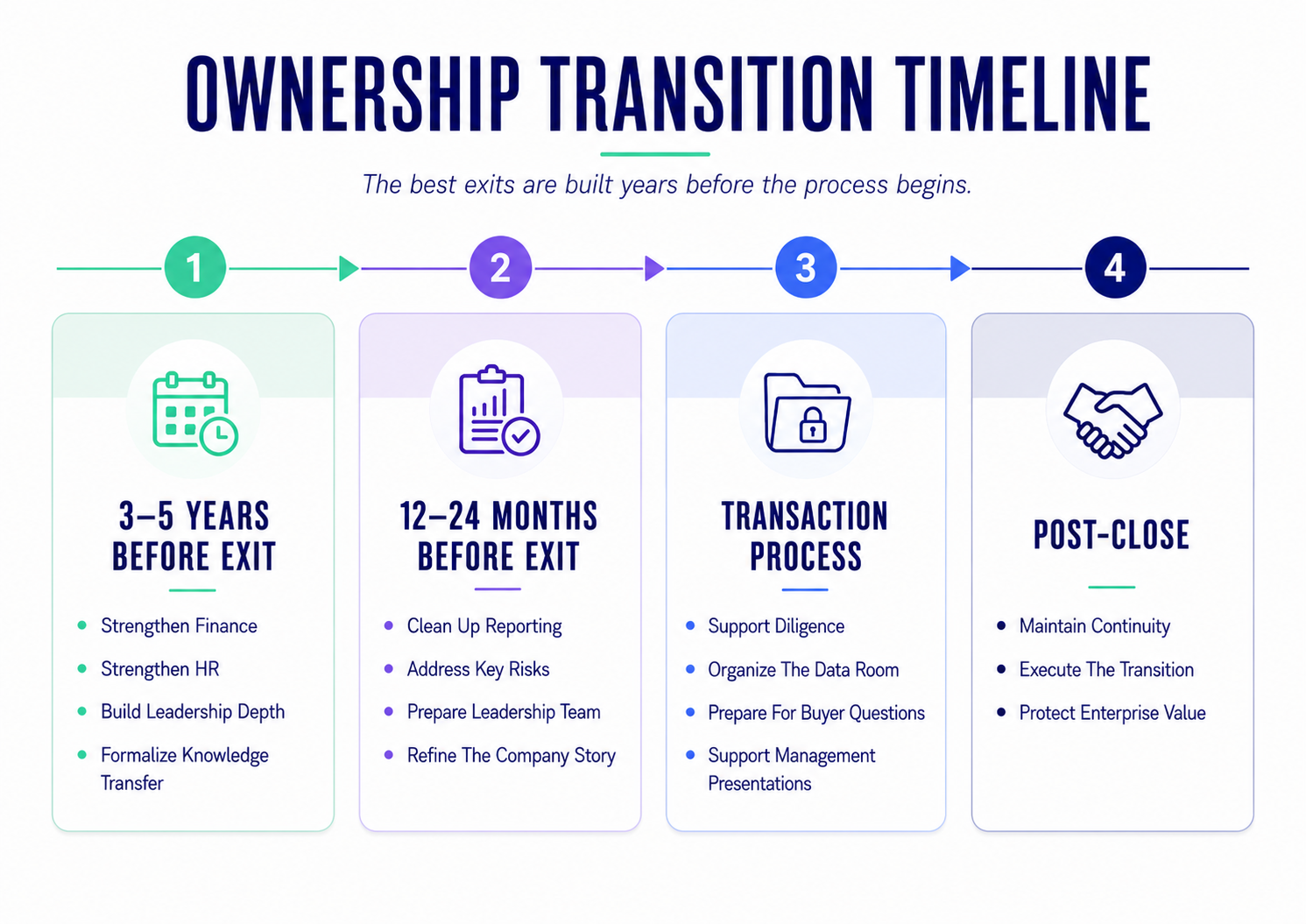
Exit readiness is the process of ensuring a business can withstand scrutiny from buyers, lenders, investors, and advisors. It’s not only about preparing documents for a data room. It’s about creating confidence that the business is durable, transferable, and ready for its next chapter.
For owners and CEOs, that means clarifying the company’s growth story, leadership structure, key risks, and future path. For CFOs, it means building financial visibility, credible reporting, forecasting discipline, working capital insight, and clean data. For CHROs, it means strengthening leadership continuity, employee retention, talent strategy, culture, compliance, and knowledge transfer.
For private equity firms and advisors, exit readiness creates a clearer view of whether the business can support the deal thesis and where operational work may be needed before or after close.
The goal is not to dress the business up for a process. The goal is to build the infrastructure required to perform under scrutiny and sustain value after the transaction.
Buyers don’t want to guess. They want confidence. That starts with finance.
Finance excellence isn’t a back-office nicety; it’s one of the most measurable drivers of enterprise value a middle-market company controls. Strong finance infrastructure helps middle-market companies prove performance, explain trends, support projections, and move through diligence with fewer surprises. Weak financial infrastructure creates friction. It raises questions about data quality, reporting consistency, EBITDA adjustments, working capital, customer profitability, cash flow visibility, and the reliability of management’s forecast.
Finance excellence doesn’t mean every company needs enterprise-level complexity. It means the finance function is mature enough for the business’s stage and the next owner’s expectations.
That may include:
For owners preparing for the Silver Tsunami, this work isn’t optional. The more value expected to change hands, the more scrutiny buyers will apply. Companies that can clearly demonstrate performance, risk, and opportunity are better positioned to compete for attention and confidence.
Finance proves the numbers. HR helps demonstrate that the business can continue operating after ownership changes.
Like finance, HR is a measurable value driver, not a soft consideration reserved for the culture deck. Buyers price in leadership continuity, retention risk, and bench strength just as readily as they price in EBITDA. That’s often where succession planning and exit readiness intersect.
Many middle-market companies depend on long-tenured leaders, informal decision-making, and knowledge that lives inside a few key people’s heads. That may work for years, until a buyer starts asking what happens if the owner leaves, the CFO retires, the sales leader exits, or the operations team loses a key manager.
HR excellence helps answer those questions before they become deal issues.
A stronger HR foundation supports leadership continuity, employee retention, culture, compliance, compensation, benefits, workforce planning, and manager capability. It helps the company show that its people infrastructure can scale, withstand transition, and support the next stage of growth.
It also supports knowledge transfer, which is critical during an ownership transition. Middle-market companies can encourage knowledge transfer by identifying critical roles, documenting key processes, building cross-training plans, formalizing ownership of customer and vendor relationships, developing successors, and creating operating rhythms that reduce dependence on any one person.
That doesn’t mean stripping the business of its founder DNA. It means making sure the business can carry that knowledge forward.
The coming ownership wave won’t affect every company the same way.
Some owners will wait too long and discover that the business is not as transferable as they hoped. Some will enter the market with unclear financials, thin leadership depth, weak HR infrastructure, and undocumented processes. Others will take the time to build readiness before a transaction begins.
Those companies will be better prepared to answer hard questions, such as:
These aren’t just diligence questions. They’re value questions.
For private equity firms, advisors, and strategic buyers, the Silver Tsunami may create more opportunities to evaluate founder-led and middle-market companies. But available capital doesn’t remove discipline. Buyers will still reward businesses that are easier to understand, easier to diligence, and better prepared to execute after close.
The Silver Tsunami is not a future issue. It’s already shaping the middle market.
For owners, CEOs, CFOs, and CHROs, the question isn’t, “When do we want to exit?” The better question is, “Would the business be ready if the right opportunity appeared?”
Exit readiness gives leaders a way to answer that honestly. It helps identify gaps in finance, HR, reporting, leadership, knowledge transfer, succession planning, and operational infrastructure before those gaps affect value.
Growth Operators helps companies build the capabilities that make readiness real. Our Growth Pros bring hands-on expertise in finance, HR, transaction advisory, and Talent Intelligence® to help leadership teams strengthen the business before the market tests it.
If you’re thinking about succession, considering a sale, preparing for private equity investment, or simply trying to understand where your business stands today, the best time to start is now. Contact us today to get started.
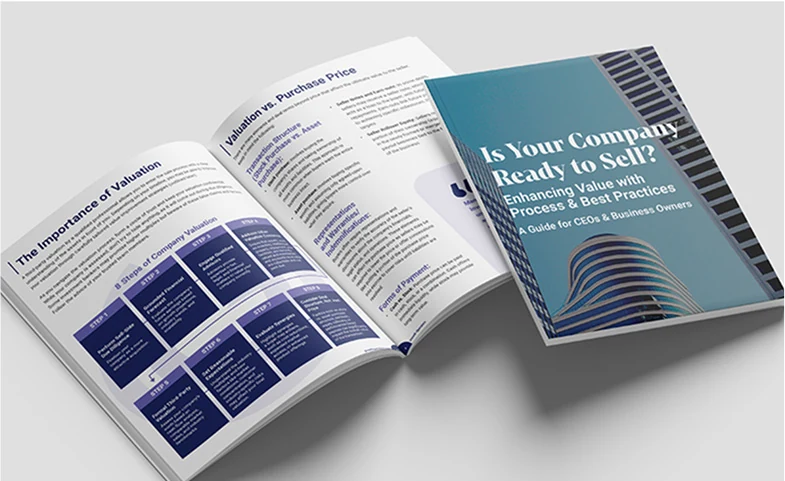
A practical first step: Download our Exit Readiness whitepaper below. It walks owners, CFOs, and CHROs through the financial, HR, and operational benchmarks that buyers and lenders actually use to evaluate a business, so you can see where your company stands today and what needs strengthening before going to market.
No matter where you are in the process, we can help you develop an Exit Readiness plan to maximize the value of your company and bring you to closing.
"*" indicates required fields