Ready to Build Something That Lasts?
We meet companies where they are, whether they’re navigating rapid growth, a transaction, a leadership gap, or an operational rebuild. Let’s talk about what you are solving for.

When markets shift faster than your models were built to handle, cash visibility isn’t just a finance function—it’s a survival competency. This blog post covers the forecasting discipline, working capital practices, and scenario planning approaches that distinguish finance leaders who navigate turbulence from those who react to it.
Growth still matters. Profitability still matters. But in turbulent markets, leadership teams need to know:
That responsibility often sits with the CFO.
For CEOs, boards, lenders, and investors, cash flow is more than a finance metric. It’s a measure of operating resilience. Clear visibility into cash helps leaders make better decisions about hiring, inventory, capital investment, pricing, debt management, acquisitions, and vendor commitments. Poor visibility slows decision-making, increases risk, and leaves the business reacting to pressure instead of planning through it.
That is why CFOs and cash flow have become central topics of conversation for middle-market companies, private equity-backed businesses, and growth-stage organizations navigating economic uncertainty.
The best CFOs are not just reporting cash after the fact. They’re building the systems, cadence, and forecasting discipline that allow the company to see around corners.
In stable markets, companies can sometimes get by with basic cash reporting, monthly forecasts, or static budgets. That becomes dangerous when conditions change quickly.
Inflation can increase input costs before pricing catches up. Interest rate changes can raise debt service costs. Customer payment patterns can shift. Vendors may tighten terms. Inventory decisions become harder. Payroll and benefits costs continue rising. Capital projects may need to be delayed, resized, or reprioritized.
In those conditions, the question is not simply, “Are we profitable?” The more urgent questions are:
The gap between answering these questions in real time versus answering them after the close cycle is where companies lose their options. A company that identifies a liquidity shortfall 12 weeks out can negotiate, adjust, and communicate proactively. A company that identifies it two weeks out has fewer moves and less leverage.
This is where cash flow best practices become a leadership discipline, not just a finance process. The CFO must help the business understand what is happening, why it is happening, and what management can do about it.
CFOs improve cash flow by creating visibility, tightening operating discipline, and helping leaders make better decisions with current data. That work typically includes more accurate forecasting, stronger working capital management, improved collections, better vendor and inventory discipline, scenario planning, and clearer reporting to leadership.
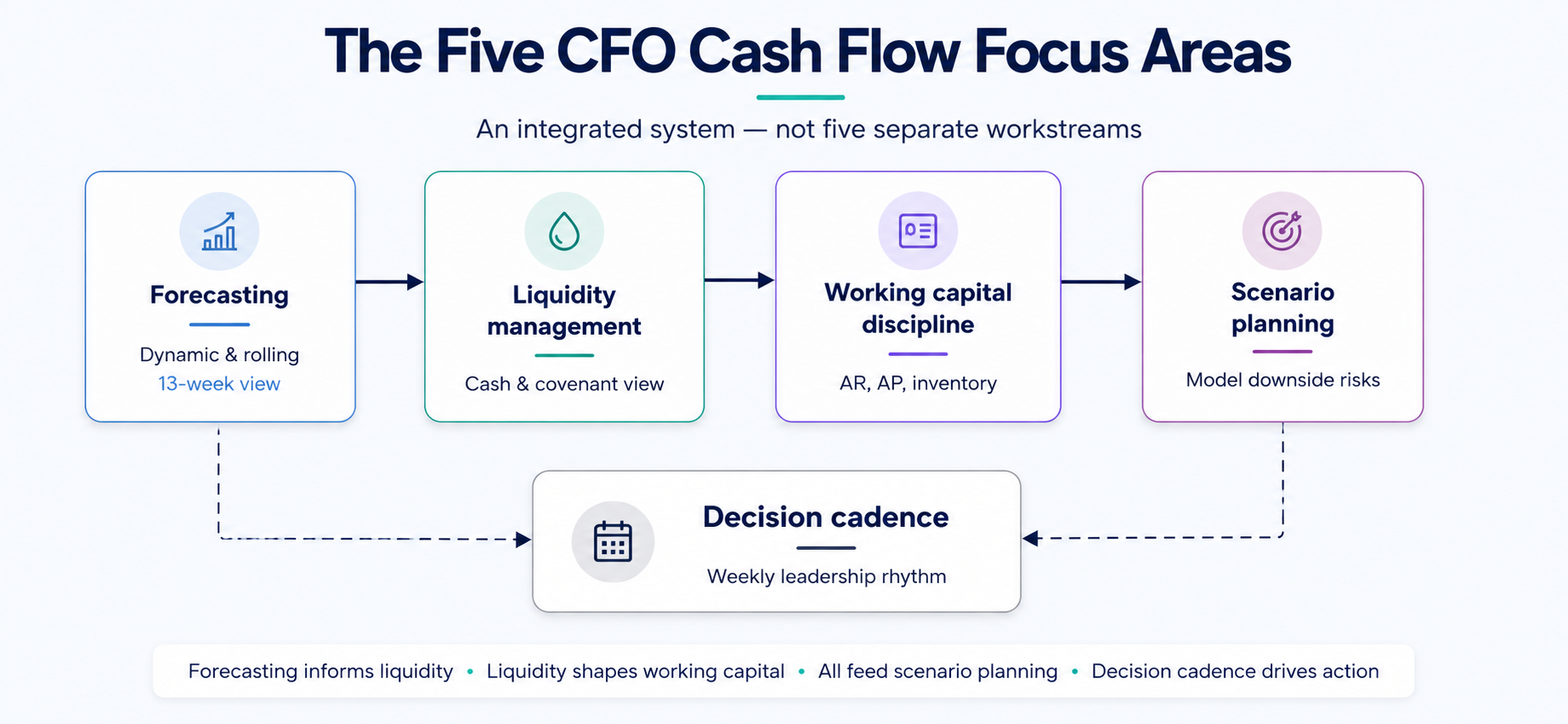
At a practical level, strong CFO cash flow leadership usually focuses on five areas:
The goal is not to create a perfect forecast. No forecast survives unchanged in a volatile market. The goal is to create a reliable operating rhythm that allows the business to adjust quickly as conditions shift.
Each of these five areas reinforces the others. Forecasting without working capital discipline produces a plan with blind spots. Working capital discipline without scenario planning leaves leadership without a playbook when conditions shift. The CFOs who navigate volatility best treat these as an integrated system rather than five separate workstreams.
A static forecast is not enough when markets are moving. CFOs need a dynamic forecasting process that is updated frequently, tied to operating drivers, and flexible enough to support real-time decisions.
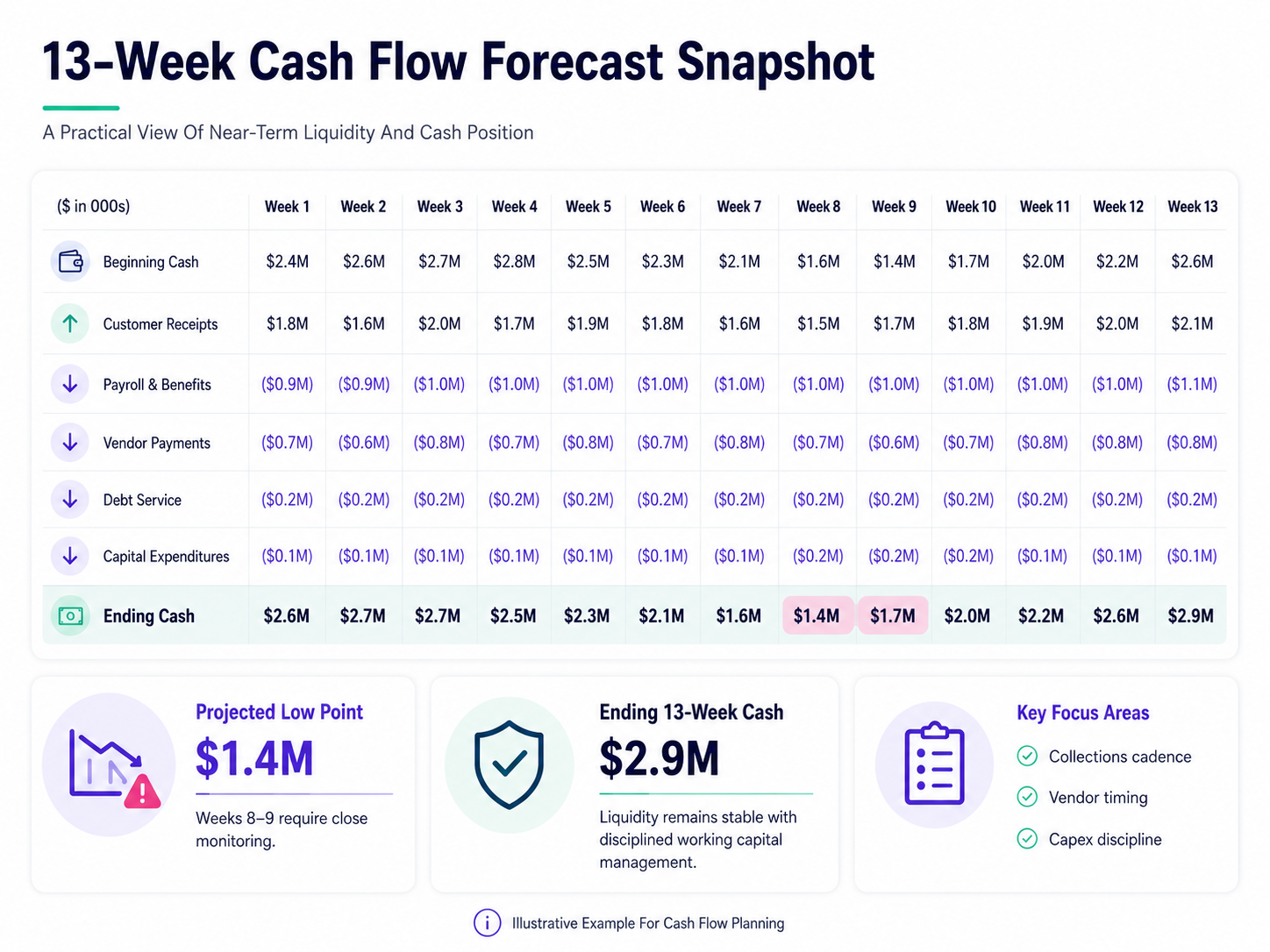
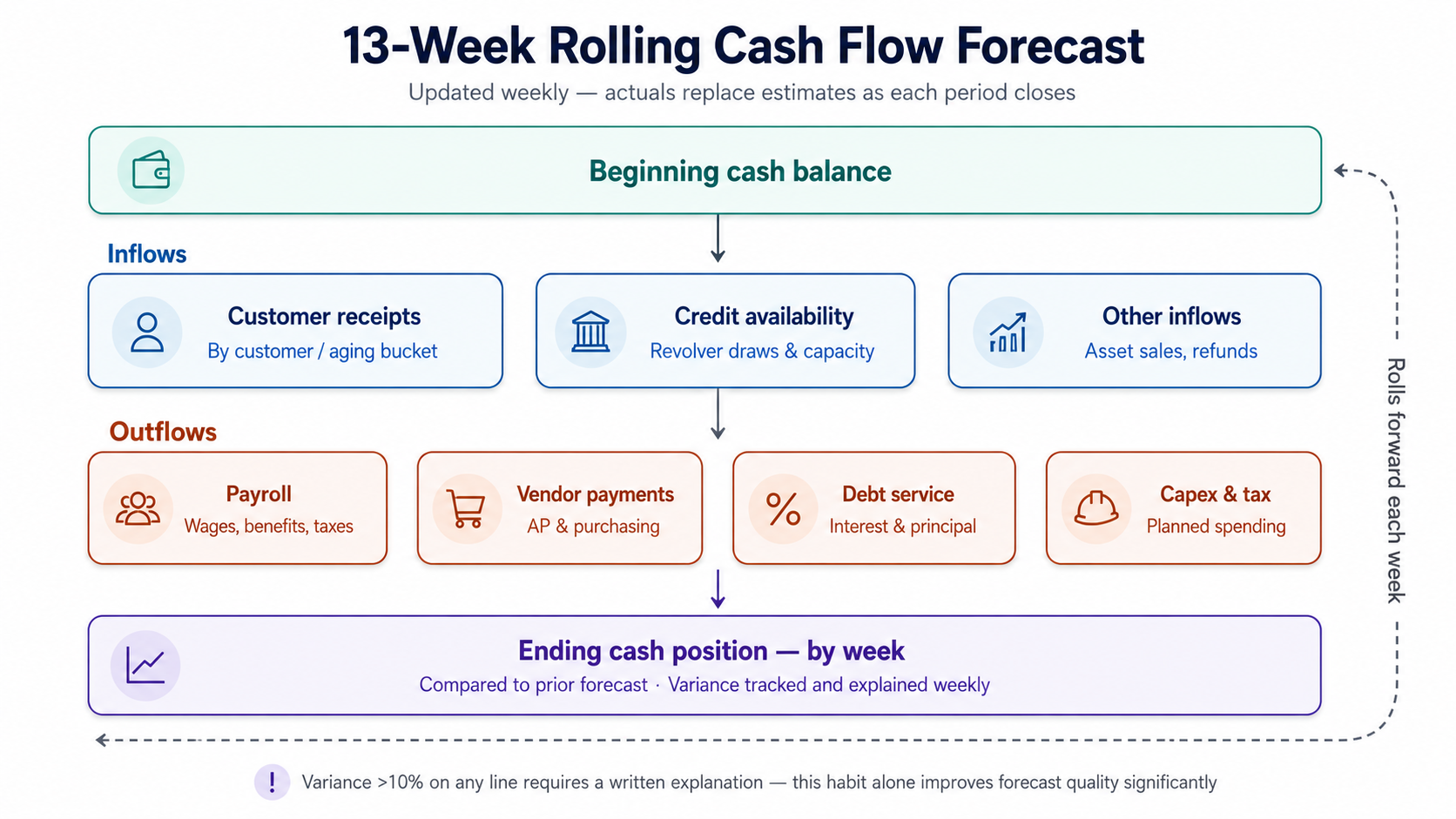
For many companies, the most useful tool is a rolling 13-week cash flow forecast. This gives leadership a near-term view of expected receipts, disbursements, payroll, debt payments, vendor obligations, tax payments, capital spending, and other cash needs. It is short enough to be actionable, but long enough to identify pressure before it becomes urgent.
The 13-week forecast isn’t just a finance artifact. It’s the document that tells your lender you’re on top of it, tells your board you’re not surprised, and tells your team where the real constraints are. It earns its weight every time conditions shift.
A strong forecast should include:
The forecast should also be owned. Finance can build the model, but the inputs often sit across the business. Sales influences collections. Operations influence inventory and purchasing. HR influences payroll and hiring. Department leaders influence spending.
The CFO’s job is to turn those inputs into one shared cash view that leadership can trust.
One practical discipline worth reinforcing: Track forecast-to-actual variance every week, and require a brief explanation when any line item misses by more than 10%. This single habit compresses the feedback loop, improves input quality across departments, and surfaces operating issues before they become cash issues.
For companies that need more structure around forecasting, Growth Operators’ Finance and Accounting Services include FP&A, budgeting, forecasting optimization, liquidity enhancement, working capital optimization, reporting enhancement, and cash flow management support.
Cash flow visibility is only useful if it leads to action. One of the biggest levers CFOs have during inflation and market volatility is working capital discipline.
Working capital is where strategy becomes operational. A company may have strong demand and still face cash pressure if receivables are slow, inventory is too high, billing is inconsistent, or vendor terms are poorly managed. In volatile markets, those issues become more visible and more expensive.
CFOs can improve working capital by focusing on:
The best CFOs do not treat working capital as a finance-only issue. They bring sales, operations, procurement, and leadership into the conversation. They make cash visible at the operating level so the business can understand the impact of everyday decisions.
A useful diagnostic: Calculate your cash conversion cycle—the number of days from when you pay for inputs to when you collect from customers. In a stable environment, a slow cash conversion cycle is a nuisance. In a volatile one, it’s a risk multiplier. Small improvements in DSO, DPO, or inventory turns compound quickly into meaningful liquidity.
For companies looking to go deeper on this topic, our article on treasury management and working capital optimization is a useful companion resource.
Liquidity management is about preserving flexibility. During turbulent times, companies need to know not only how much cash they have, but also how much access they have to capital if conditions worsen.
CFOs should maintain a clear view of:
The earlier these items are visible, the more options leadership has. A company that sees liquidity pressure 12 weeks ahead can negotiate terms, adjust spending, accelerate collections, slow discretionary investments, or communicate proactively with lenders and investors. A company that sees pressure two weeks ahead has fewer options and less negotiating power.
One often-overlooked element of liquidity management: The relationship with your banking partners. Lenders reward proactive communication and penalize surprises. A CFO who calls their banker before a covenant issue surfaces has more options than one who calls after. Building that relationship during stable periods with regular updates, clear reporting, and honest forward-looking communication creates goodwill that matters when you need flexibility.
This is especially important for private equity cash flow management. Sponsors and portfolio company leaders need a reliable view of liquidity throughout the hold period, especially during post-acquisition integration, add-on acquisitions, margin pressure, or exit preparation. Cash flow visibility supports better board reporting and more confident value-creation decisions.
Volatility creates uncertainty, but it does not eliminate the need to make decisions. Scenario planning gives CFOs a way to help leadership make those decisions with more discipline.
Instead of relying on one forecast, CFOs should model a range of outcomes. Common scenarios include revenue slowing, customers stretching payment terms, material costs rising, labor costs rising, interest expense increasing, inventory turns slowing, or a capital project being delayed.
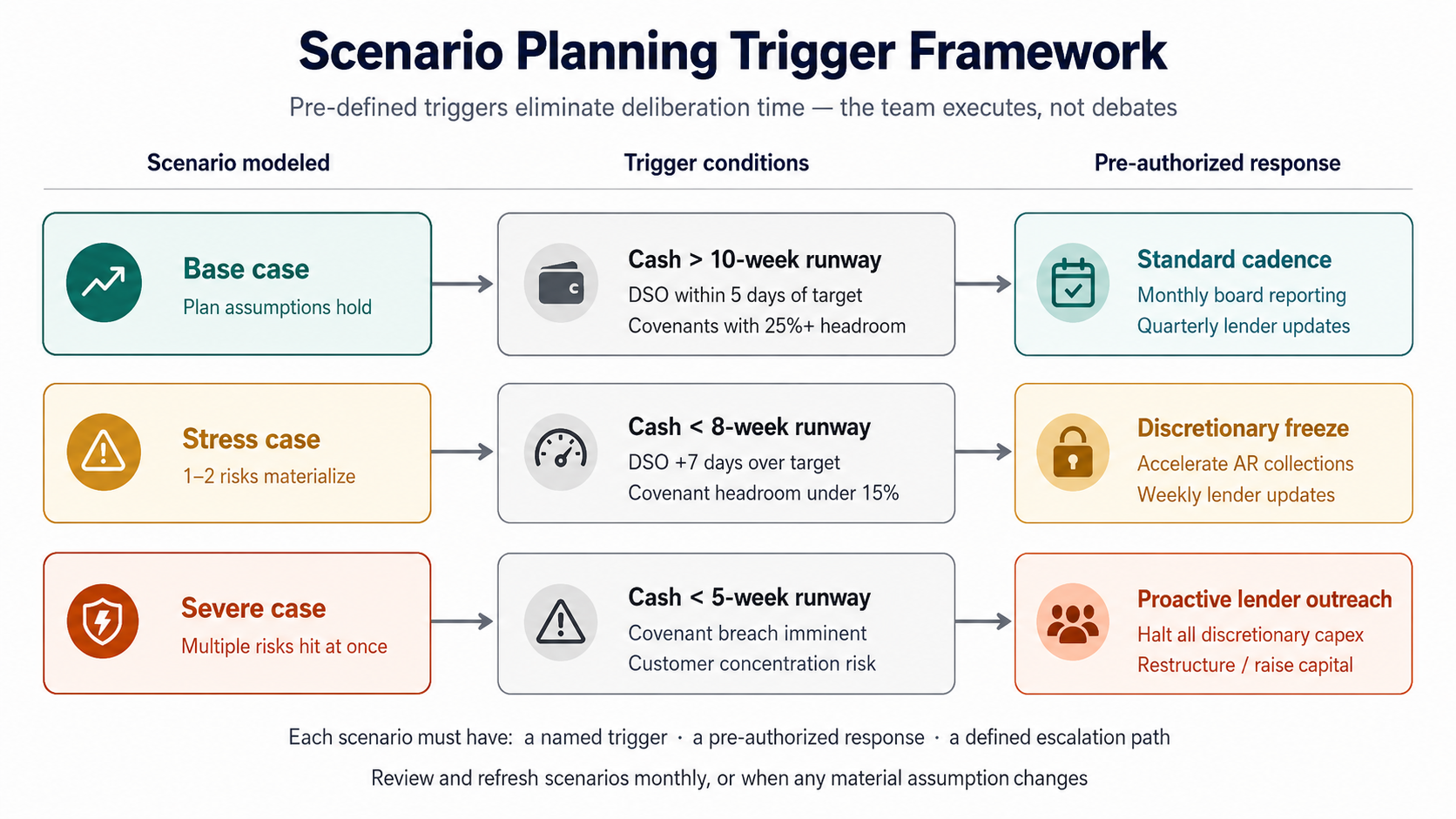
The goal is not to predict the future perfectly. It is to understand which assumptions matter most and what management would do if those assumptions change. A strong scenario planning process should answer:
The most important output of scenario planning isn’t the scenarios themselves, it’s the pre-authorized response playbook. Each scenario should have a defined trigger (a specific metric threshold that activates the playbook) and a predetermined set of actions. When the trigger fires, the team executes—they don’t deliberate. This is what separates companies that manage through volatility from companies that scramble through it.
This is where the CFO becomes a strategic operator. They are not simply presenting numbers. They are helping leadership understand options, consequences, and timing.
In private equity-backed companies, cash flow is typically managed by the portfolio company CFO or finance leader, with oversight and input from the CEO, board, private equity sponsor, operating partners, and sometimes lenders. The CFO is usually responsible for forecasting, reporting, liquidity management, and working capital strategy, while the sponsor and board focus on cash visibility as part of broader value creation and risk management.
In practice, private equity cash flow management requires alignment between the finance function and ownership expectations. Sponsors need accurate reporting. Management needs actionable insight. Operating partners need visibility into risks and opportunities. Lenders may need covenant reporting and proactive communication.
That is why PE-backed businesses often require stronger finance infrastructure than similarly sized privately owned companies. A basic cash report is not enough. The company needs forecasting discipline, board-ready reporting, visibility into working capital, and the ability to link cash flow to value-creation priorities.
In PE-backed environments, the CFO’s credibility is earned through the quality and consistency of cash reporting, not just the numbers, but the narrative. Sponsors and board members want to understand the story behind the numbers: what’s driving the change, what the team is doing about it, and what comes next. A CFO who can deliver that with clarity and confidence becomes a trusted operator, not just a reporting function.
Our case study, Building Robust Finance And Accounting Processes For A Pet-Service Industry Rollup, is a strong example of how finance and accounting infrastructure can support a PE-backed platform company pursuing growth and add-on acquisitions.
When markets become volatile, finance teams are often asked to do more with the same resources. They may need to build better forecasts, improve reporting, manage lender communication, support board requests, evaluate cost actions, and keep the close process moving, all while responding to daily operational questions.
That is where fractional and interim CFO support can become a force multiplier.
A fractional CFO can provide senior-level financial leadership on a part-time or project basis, helping companies strengthen forecasting, improve cash flow reporting, guide scenario planning, and support strategic decisions without adding full-time executive headcount.
An interim CFO can step in during a leadership gap, a transaction, a restructuring, or a period of heightened volatility to provide immediate stability and direction. This can be especially valuable when the business cannot afford to wait for a permanent hire before improving cash visibility.
The force multiplier dynamic works because fractional and interim CFOs bring both experience and objectivity. They’ve navigated similar conditions before, often many times, and they can apply pattern recognition immediately without the ramp-up time of a permanent hire. They also bring the outside perspective that’s hard to maintain when you’re embedded in day-to-day operations. That combination of speed and clarity is exactly what volatile conditions demand.
Growth Operators’ Fractional and Interim Finance and Accounting support helps companies access experienced finance leadership when the timing, complexity, or workload exceeds internal capacity.
Managing cash flow during turbulent times requires more than careful spending. It requires a disciplined system for visibility, decision-making, and action.
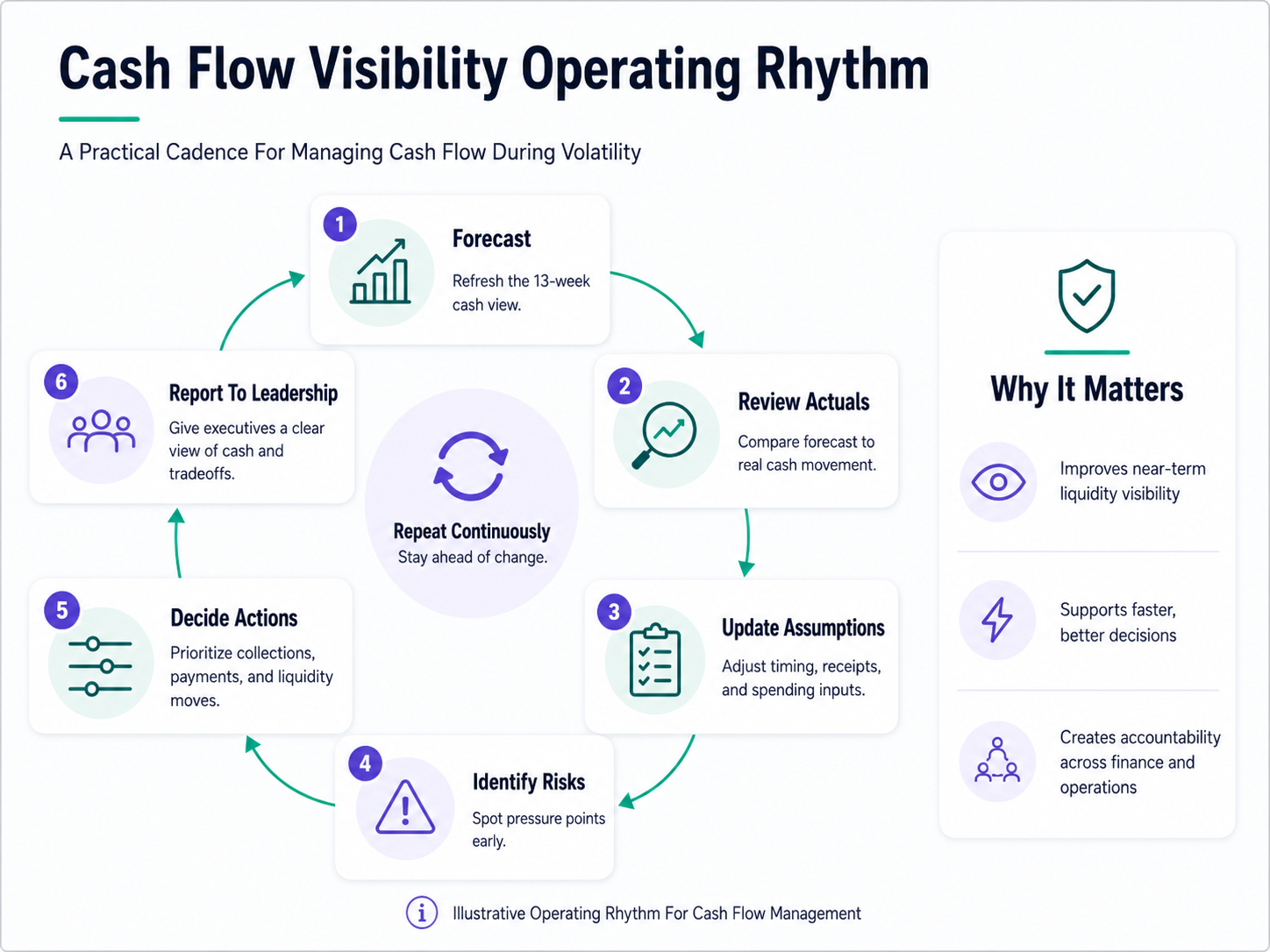
CFOs and finance leaders should prioritize these cash flow best practices:
These practices are most effective when they’re connected, when the 13-week forecast feeds directly into the scenario models, when working capital discipline drives the AR and AP inputs, and when the leadership cadence creates accountability for every assumption. The companies that build this system before they need it are the ones with the most options when pressure arrives.
These practices help leadership move from uncertainty to action. They also give the business more options when market conditions change.
Growth Operators helps CFOs, CEOs, private equity firms, and finance leaders bring more clarity, discipline, and execution capacity to cash flow management. Through Finance and Accounting Services, Growth Operators supports organizations with cash flow forecasting, liquidity enhancement, FP&A, budgeting, forecasting optimization, working capital management, financial reporting, close process improvement, and board-ready insights.
Growth Operators’ nextLEVEL® framework adds structure to that work by evaluating finance and accounting processes, identifying gaps, and creating a practical roadmap for improvement. For companies looking to strengthen cash flow visibility, improve liquidity management, and build a more resilient finance function, nextLEVEL helps turn assessment into execution.
Market volatility will continue to test leadership teams. The companies that navigate it best will not be the ones with perfect predictions. They will be the ones with better visibility, stronger financial discipline, and CFO leadership that can turn uncertainty into action.
Whether you’re navigating a volatile market today or building the financial infrastructure to handle the next one, Growth Operators’ fractional and interim CFO services are built for exactly this moment. Our team has helped PE-backed businesses, middle-market companies, and growth-stage organizations build forecasting discipline, working capital systems, and scenario-planning capabilities that turn uncertainty into action.
Let’s talk about where your finance function stands and where it needs to go.
No matter where you are in the process, we can help you develop an Exit Readiness plan to maximize the value of your company and bring you to closing.
"*" indicates required fields