Ready to Build Something That Lasts?
We meet companies where they are, whether they’re navigating rapid growth, a transaction, a leadership gap, or an operational rebuild. Let’s talk about what you are solving for.

For middle market companies, the future of work isn’t an abstract HR concept. It’s a balance sheet question, a retention risk, and a leadership decision happening inside every budget cycle, every workforce planning conversation, and every acquisition integration.
In 2026, the real issue isn’t whether your company uses AI. Most already do formally or informally. The issue is whether your organization can use AI, automation, and talent intelligence to improve business performance without eroding trust, culture, or the conditions that make your people effective.
That balance now sits squarely at the intersection of Finance and HR.
CHROs and CFOs in middle market companies are increasingly being asked to answer the same hard questions together:
They’ll be the ones who build smarter, more adaptive people strategies grounded in a clear operating model, better talent intelligence, and a leadership team willing to make decisions based on real data.
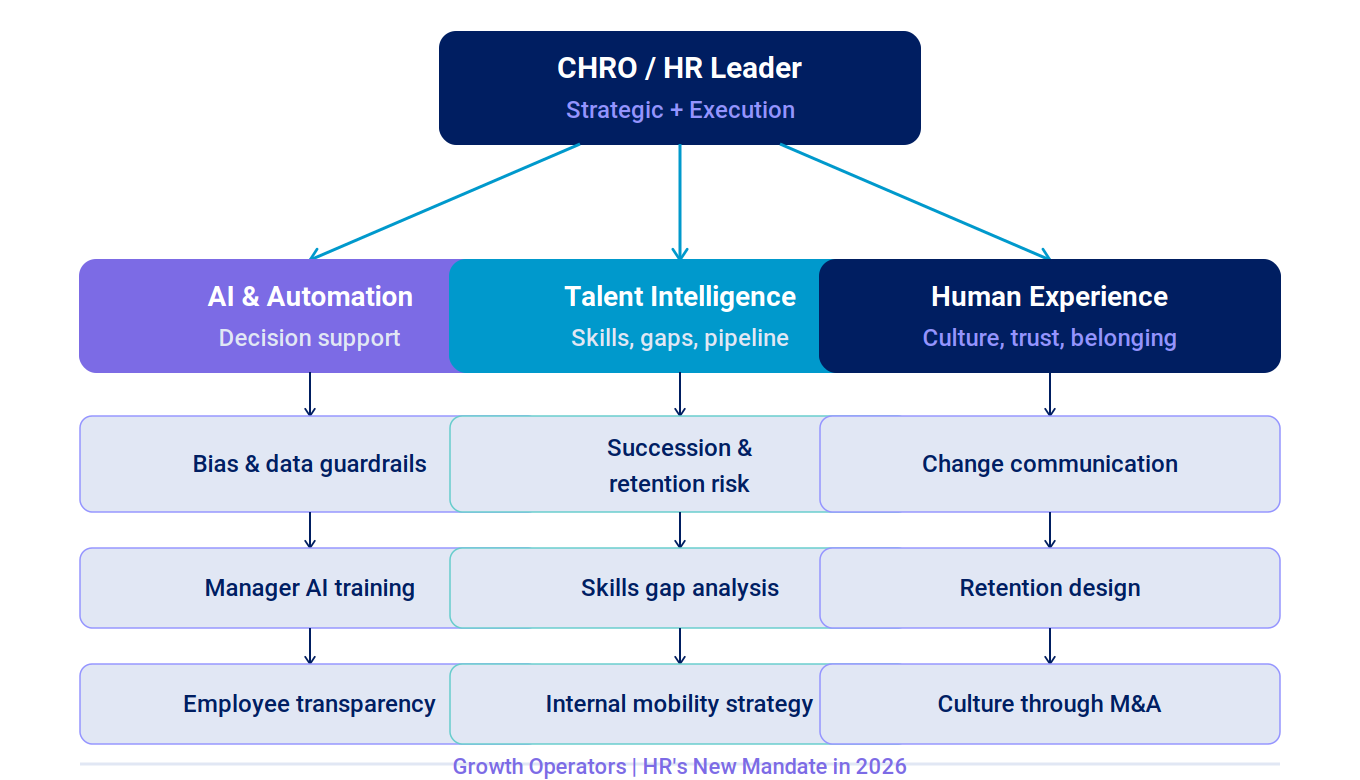
The CHRO now connects three interdependent pillars, each requiring both strategic vision and operational execution.
In 2026, HR is also responsible for helping the business understand how people, technology, data, and work design fit together and what it will cost when they don’t.
That’s a significantly broader mandate than traditional HR administration. For middle market companies, where HR teams are often lean and resources are limited, the modern HR function must help leadership:
This shift requires HR to operate as both a strategic advisor and a hands-on execution partner. CEOs and boards need HR leaders who can connect workforce decisions to business outcomes. CFOs need a counterpart who understands the cost of a leadership gap, the risk of unplanned attrition, and the ROI of an effective onboarding program.
“The cost of getting talent decisions wrong often shows up in the P&L before it shows up in an HR dashboard.”
AI can make HR faster. It can help screen data, summarize trends, support workforce analytics, automate repetitive tasks, and surface patterns that might otherwise take weeks to identify.
But speed alone doesn’t make HR better, and for CFOs evaluating AI investment, that distinction matters.
The real value of AI in HR comes from using it to improve decision quality, consistency, and the employee experience at scale. For example, AI can help HR teams identify turnover risk, analyze engagement data, model workforce scenarios, improve internal mobility, and reduce administrative burden on lean teams. That’s real capacity — and real cost savings
The governance imperative
Hiring, performance, compensation, development, succession planning, and workforce restructuring all carry human consequences. HR leaders need to ensure AI supports decisions, not quietly replace the accountability that comes with them. Establish clear guardrails around data quality, bias, privacy, manager training, and governance.
In 2026, the best HR leaders and the CFOs who partner with them won’t ask “How much can we automate?” They’ll ask: “Where does AI improve the work experience, sharpen business decisions, and give people more time for higher-value work?”
That’s the difference between technology adoption and workforce evolution.
Talent intelligence is the practice of using workforce data, labor market insight, skills data, performance trends, employee sentiment, and business priorities to make better people decisions.
For CFOs, this is not an abstract HR capability. It’s a risk management tool.
Talent intelligence can support:
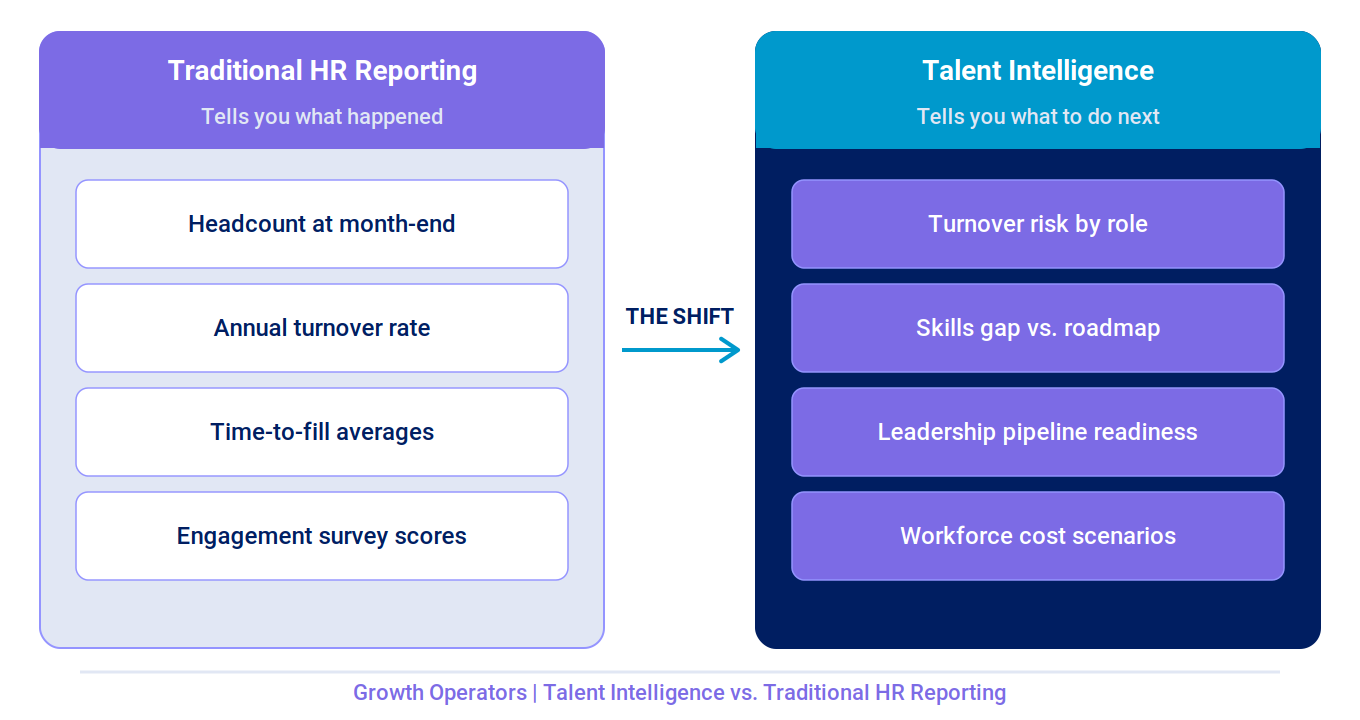
The shift from reactive reporting to predictive insight is the difference between managing the past and leading into the future.
The critical distinction: talent intelligence is not HR reporting. Reporting tells leaders what happened. Talent intelligence helps them understand what’s changing, what it means, and what to do before the problem is visible in the financials.
For growing middle-market companies, this matters because the cost of getting talent decisions wrong, a missed hire at a critical moment, unexpected attrition in a revenue-generating team, or a leadership gap during an integration often shows up on the P&L before it appears on an HR dashboard.
AI can improve processes. Talent intelligence can sharpen decision-making. But culture determines whether people actually adopt the change and whether your best performers stay through it.
Employees in 2026 are evaluating more than compensation and remote work policies. They’re evaluating whether leadership communicates clearly, whether managers are equipped to lead, whether career paths are visible, whether workloads are sustainable, and whether the organization uses technology in ways that feel helpful rather than intrusive.
For middle-market companies navigating growth, M&A, or transformation, this poses a critical risk: the efficiency gains from AI and improved workforce data can be completely offset by employee disengagement if the change isn’t well managed.
The best HR strategies pair operational discipline with human-centered execution. That means:
“A strong culture makes transformation easier. A weak culture turns even sound strategies into uphill battles, and that has a cost both the CHRO and CFO will eventually have to explain.”
As HR expectations expand, many middle-market companies need experienced leadership before they’re ready to hire or while they’re between leaders. That’s where fractional and interim HR services create real business value.
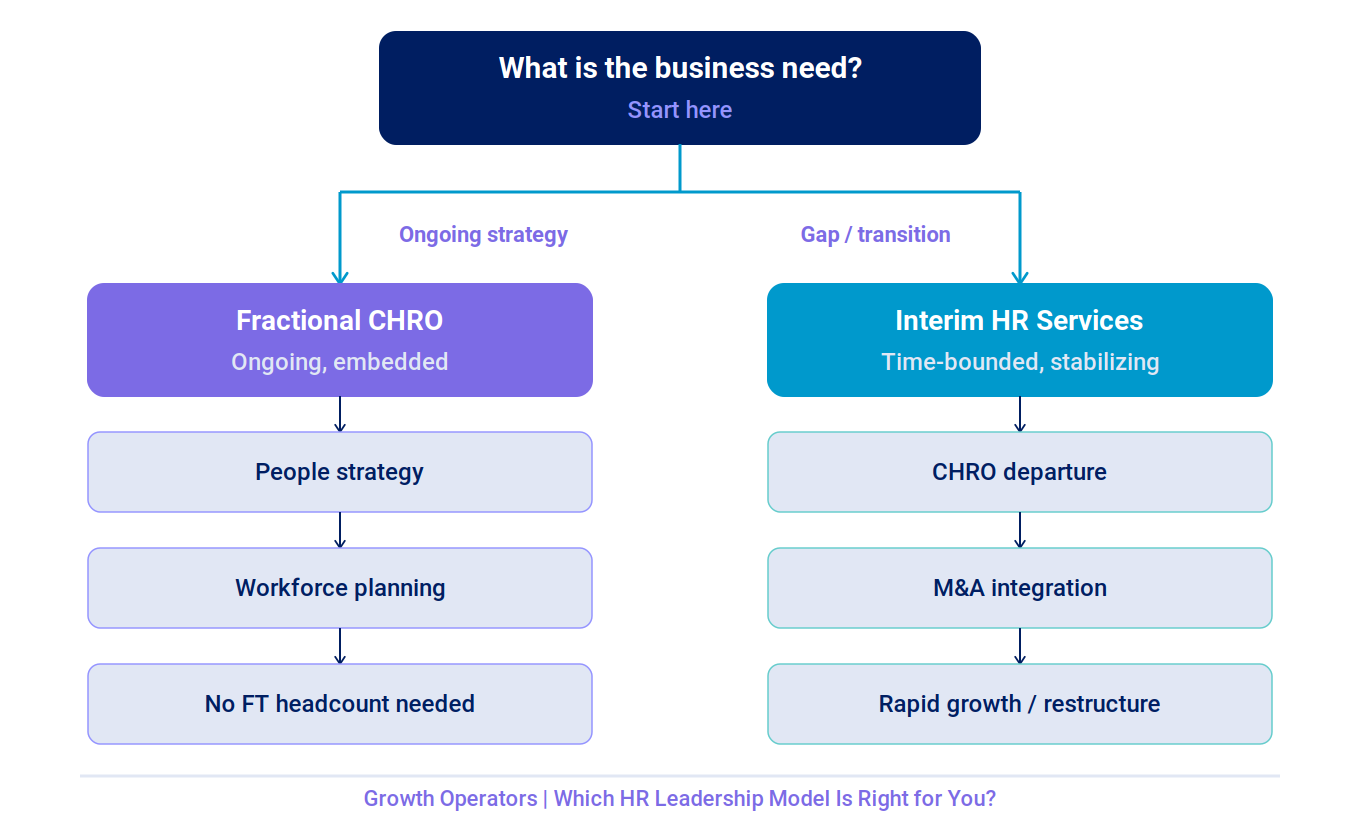
Use the decision framework above to match the model to the business need, not the other way around.
A fractional CHRO provides senior-level HR expertise on a part-time, ongoing basis, helping set people strategy, advise the executive team, lead workforce planning, strengthen HR operations, and support transformation without the cost and commitment of a full-time hire.
Interim HR services are different. Interim HR leaders step in during a temporary gap or period of disruption, such as a CHRO departure, acquisition, restructuring, HRIS implementation, or a period of rapid growth when the current team needs immediate leadership capacity.
The CFO’s case for fractional and interim HR
Both models offer access to seasoned HR leadership at the right level of engagement without the full-time compensation, benefits, and onboarding cost of a permanent hire. For PE-backed companies and middle market businesses managing growth or a transaction, this is a meaningful financial and operational advantage.
Companies should consider interim HR leadership when the function needs immediate support, and the cost of waiting is high. Common triggers include:
The mistake many organizations make is waiting until HR problems become visible across the business. By that point, managers are frustrated, employees are disengaged, compliance risk may be rising, and leadership is operating without the workforce intelligence it needs to make good decisions.
The best fractional CHROs and interim HR leaders share a few qualities that matter most in a middle-market context: they quickly understand the business, diagnose the people infrastructure honestly, build trust with leadership early, and translate strategy into execution — not just recommendations.
Growth Operators partners with CEOs, CHROs, and HR leaders to build the people infrastructure needed for growth, change, and transformation — including HR strategy, talent management, compliance, workforce planning, culture, systems, and scalable HR operations.
For companies that need senior HR leadership without adding permanent headcount, Growth Operators provides fractional and interim HR support, including fractional CHROs, interim HR leaders, and embedded HR expertise for critical initiatives.
Growth Operators’ nextLEVEL® framework helps organizations assess people, process, and technology; identify gaps; prioritize opportunities; and build a practical roadmap from assessment to action.
No matter where you are in the process, we can help you develop an Exit Readiness plan to maximize the value of your company and bring you to closing.
"*" indicates required fields