Ready to Build Something That Lasts?
We meet companies where they are, whether they’re navigating rapid growth, a transaction, a leadership gap, or an operational rebuild. Let’s talk about what you are solving for.


After 20 years helping companies adopt technology, I’ve learned that AI’s biggest problem isn’t the technology—it’s that we’re solving for the wrong problem.
Three weeks ago, a CEO interrupted my standard AI strategy pitch:
“Rob, my CFO is already using ChatGPT to analyze our financials. Sales is using Claude for proposals. Half my employees have Copilot. They didn’t ask permission. They just… started using it. So what exactly are we paying you to implement?”
He was right. And it crystallized something I’ve been seeing everywhere:
AI adoption isn’t the problem anymore. AI value is.
Here’s what I hear from CEOs and CFOs almost weekly:
“We bought Copilot. We ran a pilot with ChatGPT in customer service. Everyone’s excited about AI. But we can’t point to a single decision we’re making faster or better. In fact, we seem even busier. What are we doing wrong?”
They usually assume they picked the wrong tool, their team isn’t technical enough, or their data isn’t clean enough.
The real answer? None of those things.
This isn’t just anecdotal—you’ve probably seen some of these stats recently:
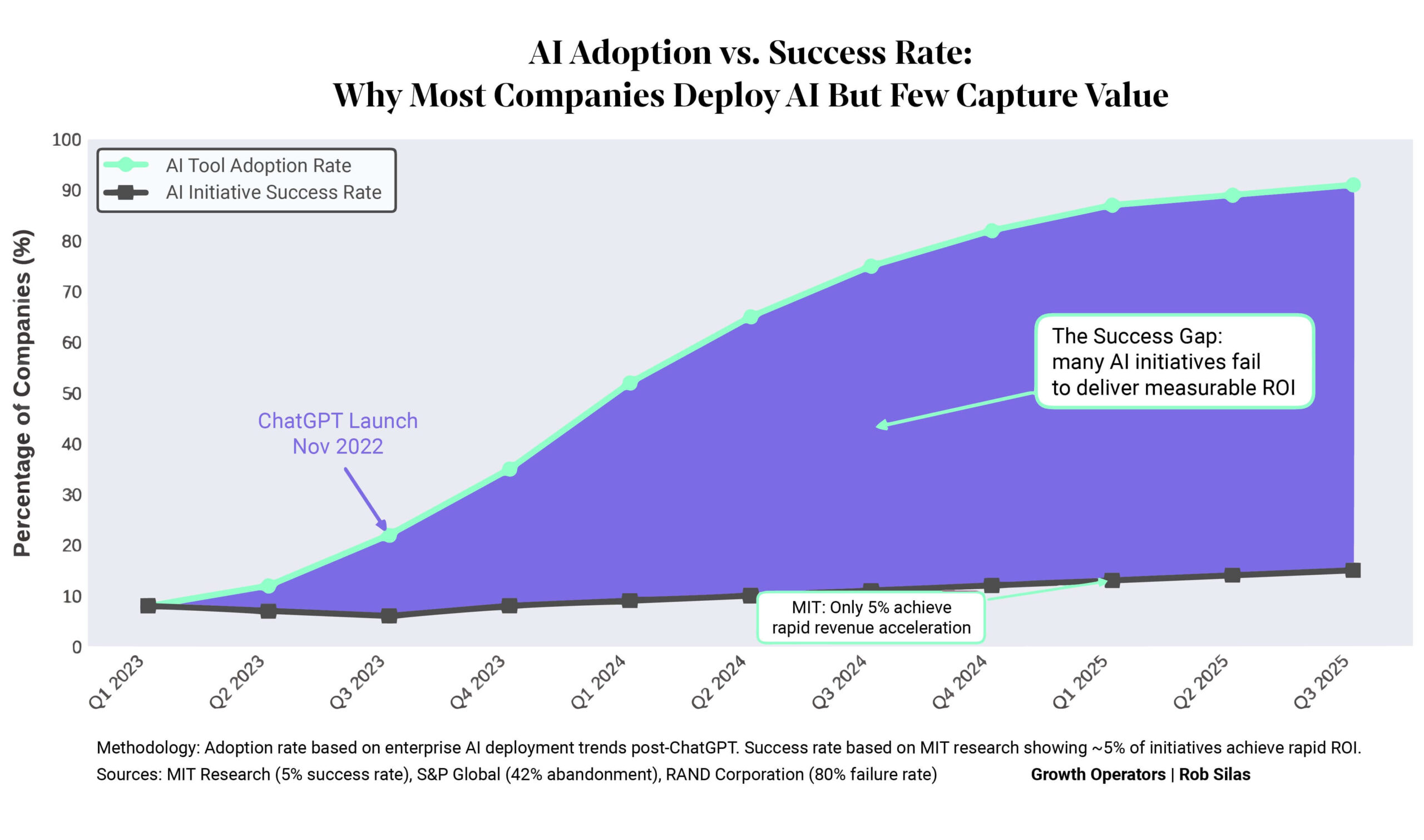
So, if you’re still waiting for AI to pay off, you’re in very good company. The question is: Why is this happening when the technology has never been more accessible?
For 20 years, the technology consulting playbook was consistent:
The total timeline was 2–3 years from awareness to value. And it made sense because technology required expert implementation, was expensive and complex, and could only be used by specialists.
But then AI changed everything:
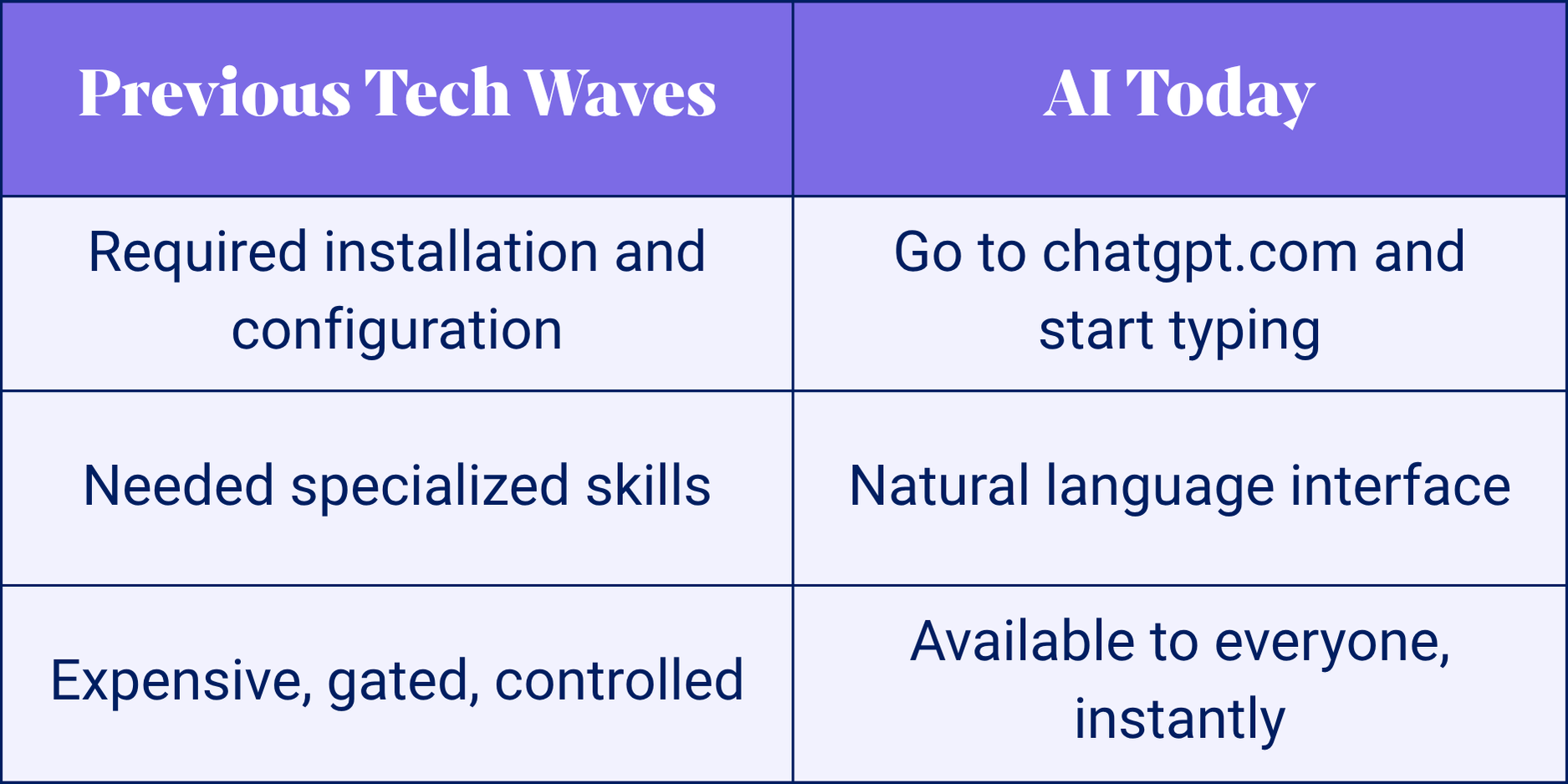
The barrier to entry changed. But the consulting model didn’t.
RAND Corporation research identified misunderstandings about project purpose and domain context as the most common reasons for AI project failure. A Gartner study found that 85% of AI projects fail due to unclear objectives and obscure project management.
As I’m talking to companies about their AI use, I’m typically seeing one or more of these business basics being skipped:
These aren’t technology problems. They’re business problems. The same questions that would make any initiative successful—AI-powered or not.
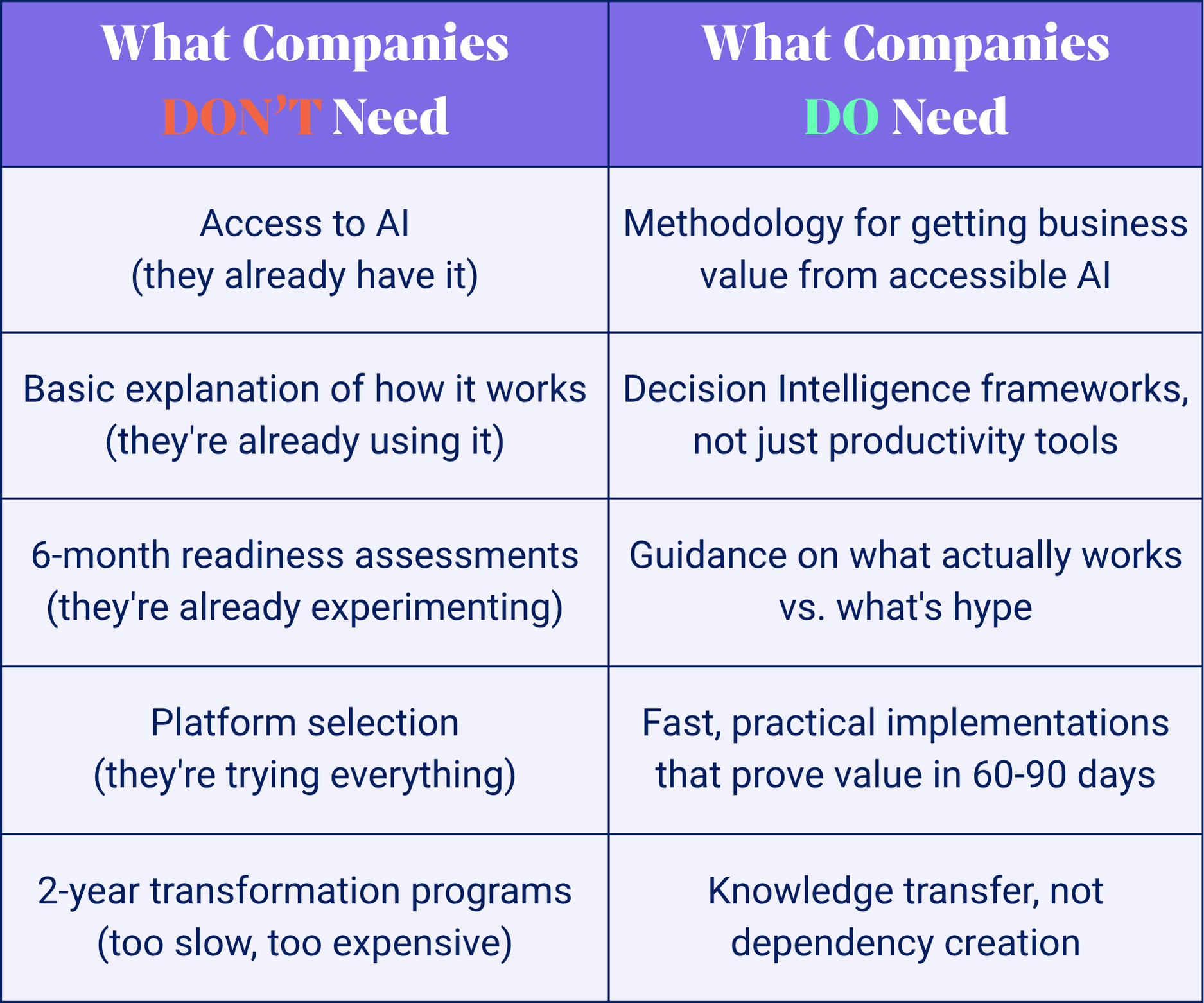
If you’re evaluating AI consultants and they’re selling:
Ask yourself: Is that because AI requires it, or because that’s what they’ve always sold?
The technology has changed. The consulting model needs to change, too.
The companies winning with AI don’t have better models, cleaner data, or smarter teams. They have better questions:
These aren’t sexy questions. They’re not revolutionary. But they’re the difference between the 5% who succeed and the 80% who fail.
This is an AI project planning grounded in business value—not hype.
After 20 years of helping companies turn analytics into decisions, here’s what I know: AI doesn’t fail because the technology is bad. AI fails because companies treat it as a software implementation rather than a business initiative.
Companies start with the tool instead of the decision. The winners treat AI as a business initiative, not a tech pilot.
It’s not flashy, but it works—especially for mid-market companies that need results in 60-90 days, not 18 months.
The real question isn’t: “How do we implement AI across our enterprise?”
It’s: “How do we extract business value from the AI our teams already use—quickly, practically, and economically?”
That’s the question that matters.
What’s been your experience? Are you seeing AI adoption outpace your ability to capture value from it? If your AI investments aren’t translating into outcomes, let’s talk about what’s getting in the way—and how to fix it.
Rob Silas
Managing Director, Decision Intelligence & AI
Growth Operators
Beyond the hype. Focus on what actually works for companies like yours.
No matter where you are in the process, we can help you develop an Exit Readiness plan to maximize the value of your company and bring you to closing.
"*" indicates required fields