Quality of Earnings Reports: What Buyers Test and How Sellers Protect Deal Value
|
Share:


Tiffany is a CPA and Managing Director with over 20 years of experience in accounting and finance, specializing in technical accounting and process improvement. At Growth Operators, she partners with clients to strengthen financial reporting, improve operational efficiency, and support transaction readiness. Tiffany brings a well-rounded background across technical accounting,...
A Quality of Earnings (QoE) report is an analysis of whether a company’s reported earnings are sustainable, recurring, and convertible to cash. It rebuilds EBITDA on a normalized basis, tests the durability of revenue and margin, and establishes a defensible net working capital target. A sell-side QoE is commissioned by the seller before going to market, so the seller controls the first credible version of the numbers rather than reacting to the buyer’s. That control is the point.
In a competitive process, the party that arrives with a tied-out, defensible earnings picture sets the anchor and the party that does not spend the period between LOI and close negotiating against someone else’s math.
For the bankers, sponsors, and search funds running these processes, a clean sell-side QoE is less about marketing the business than about protecting the deal that has already been agreed.
Key Takeaways
- A QoE report tests earnings quality, not GAAP compliance. It is not an audit and does not replace one.
- Sell-side QoE is a control mechanism: it lets the seller define adjusted EBITDA and the working capital peg before a buyer defines them.
- The most common value leakage in lower-middle-market deals is not the headline price. It is the post-LOI retrade and the working capital true-up.
- Add-backs are worth only what a buyer will accept. Documentation, not narrative, determines what survives diligence.
- Start six to twelve months before going to market. A QoE surfaces problems it cannot solve inside an exclusivity period.
What Is a Quality of Earnings Report?
A Quality of Earnings report analyzes whether a company’s reported profit reflects the cash the business generates on a repeatable basis. It typically covers a trailing twelve-month (TTM) period supported by three years of monthly detail, and it works from the general ledger up rather than the income statement down. The output is not an opinion on whether financial statements comply with GAAP. It is a schedule of adjustments with the evidence behind each one that a buyer’s diligence team can test line by line.
QoE Report vs. Audit vs. Financial Review
These three deliverables are routinely conflated, including by owners who assume an audit makes a QoE unnecessary. They answer different questions:
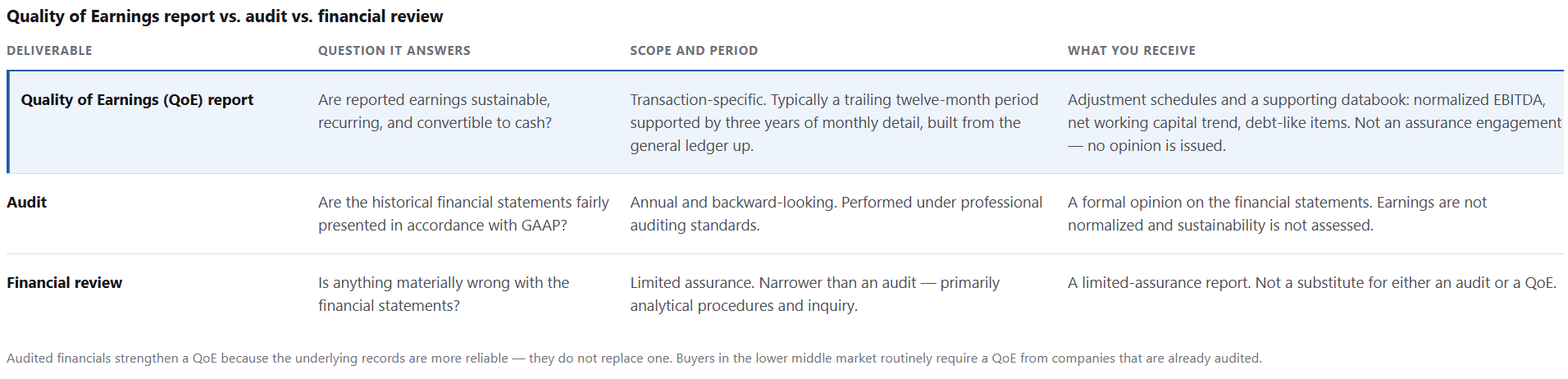
Audited financials strengthen the QoE because the underlying records are more reliable. They do not replace one. Buyers in the lower middle market routinely require a QoE on audited companies.
What a Sell-Side QoE Report Includes
Scope varies by deal size and industry, but a credible sell-side QoE addresses six areas:
Normalized (adjusted) EBITDA
Rebuilds earnings by removing one-time, non-recurring, owner-discretionary, and non-operating items — and by adding back costs a buyer will incur, such as a market-rate salary for an owner who has been underpaid. Every adjustment is documented to source so it can withstand challenges.
Revenue quality and concentration
Tests whether revenue is contracted, recurring, or transactional; measures customer and end-market concentration; and separates price from volume in reported growth. A buyer discounts growth it cannot attribute.
Cost structure and margin durability
Separates fixed from variable cost, isolates margin movement by driver, and flags costs that have been deferred rather than eliminated — underinvestment in maintenance, headcount, or systems that a buyer will have to fund post-close.
Net working capital
Builds a monthly NWC trend, normalizes seasonality and non-operating balances, and supports a target — the peg — that will govern the purchase price adjustment at close. This is frequently the largest dollar item in a QoE and the one sellers are least prepared to defend.
Debt and debt-like items
Identifies obligations that reduce equity value at close: deferred revenue, accrued PTO, unpaid taxes, earnouts, capital leases, deferred compensation, unfunded liabilities, and customer credits. Sellers are routinely surprised by what a buyer classifies as debt-like.
Proof of cash and record quality
Reconciles reported revenue and EBITDA to bank activity, and assesses whether the accounting function can produce timely, consistent, auditable data under diligence pressure. When this fails, everything above it gets discounted.
Why a Sell-Side QoE Changes the Negotiation
A sell-side Quality of Earnings report does not make a business more valuable. It prevents an already-agreed value from eroding, which is where most seller value is lost. Five mechanisms do the work.
1. It Shifts Who Carries the Burden of Proof
Without a sell-side QoE, the buyer’s diligence team produces the only normalized earnings model in the room, and every adjustment the seller wants becomes an exception the seller must argue for. With one, the seller’s schedule is the starting document, and the buyer is the party proposing changes to it.
Sellers should not oversell this. A sell-side QoE is commissioned and paid for by the seller, and no serious buyer treats it as independent verification; confirmatory diligence still happens. What changes is the sequence and the anchor — not the buyer’s obligation to test. That sequencing matters most in a competitive process, where diligence findings are less likely to become one bidder’s private leverage when every bidder works from the same documented package.
2. It Surfaces Retrade Triggers Before the Buyer Finds Them
A retrade — the buyer cutting price or reworking terms after the LOI is signed is almost always the result of a diligence finding the seller did not know about or could not explain. By that point, the seller has lost leverage: the process is exclusive, competing bidders have moved on, and the cost of walking away is real.
The findings that most often trigger a retrade or reworked terms:
- Concentration visible only at the contract level: of a top customer on an expiring agreement, or revenue routed through a single distributor
- Liabilities that were never accrued: sales and use tax exposure, unpaid PTO, deferred revenue, worker misclassification, or pending claims
- Cut-off and revenue recognition issues that shift earnings between periods
- Add-backs with no documentation or personal expenses that never ran through the books at all
- A working capital trend quietly funded by stretching vendors, which inflates cash and understates the peg
Each of these is manageable months before a process starts, and it is expensive to manage after an LOI. That timing asymmetry is the strongest argument for sell-side QoE, and it is the argument advisors make to reluctant owners.
3. It Makes Adjusted EBITDA Defensible — Which Defends the Multiple
Price in the lower middle market is usually a multiple of adjusted EBITDA, so every dollar of EBITDA disallowed in diligence is that dollar multiplied. On a 7x deal, a $400,000 add-back that cannot be supported is a $2.8 million swing. Sellers consistently underestimate this arithmetic.
Add-backs rarely fail because they are unreasonable. They fail because they cannot be evidenced.
Above-market owner compensation, a genuinely one-time legal settlement, a discontinued product line, a related-party lease above market rate are all legitimate, but only if each is traceable to source documents, quantified consistently across periods, and applied without cherry-picking favorable months. A QoE that documents fewer, well-supported add-backs typically survives diligence with more EBITDA intact than one that claims everything.
4. It Compresses the Time Between LOI and Close
Extended diligence itself is a risk. Momentum fades, key employees notice, trading results drift from the model, and buyer conviction decays. A prepared databook, reconciled schedules, monthly detail, and answers to the questions a buyer’s team will ask anyway removes weeks from the calendar.
Advisors see the second-order benefit most clearly: a seller who answers questions in days rather than weeks reads as a well-run business, and that perception affects how a buyer prices operational risk well beyond the numbers.
5. It Sets the Net Working Capital Peg on the Seller’s Evidence
The working capital peg is the target level of net working capital the seller must deliver at close. Miss it and the purchase price is adjusted down, dollar for dollar, at the true-up. Because the peg is typically set from a trailing average, the analysis behind it—which months are included, how seasonality is handled, whether non-operating balances are excluded —moves real money without ever touching the headline multiple.
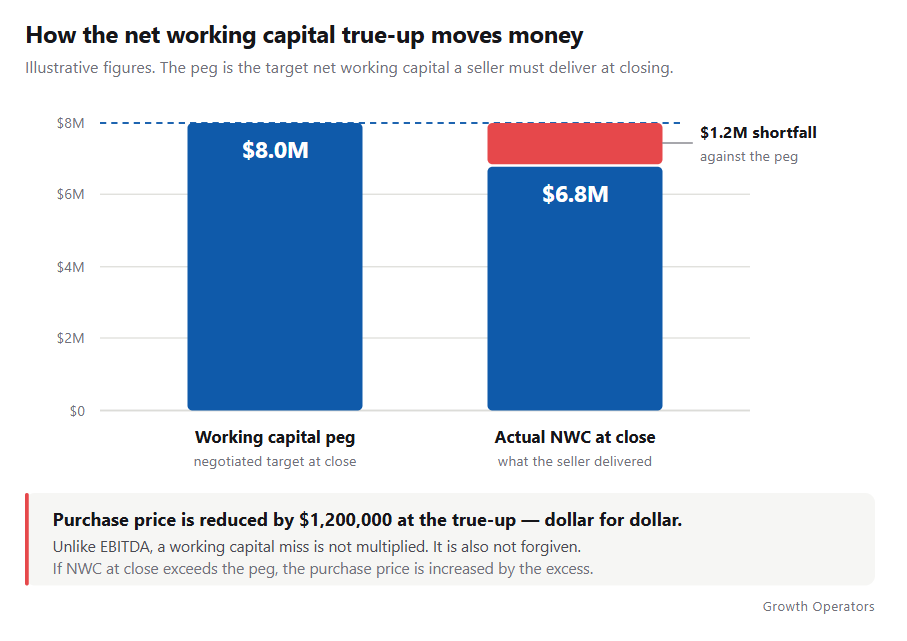
Sellers who arrive without their own NWC analysis accept the buyer’s construction by default. A sell-side QoE puts a documented, seasonally adjusted trend on the table first, and it gives the seller runway to manage receivables, payables, and inventory toward the target in the months before close rather than discovering the gap at the true-up.
When Should a Seller Commission a QoE Report?
Six to twelve months before going to market, for remediation time. A QoE frequently identifies problems it cannot fix on its own: revenue recognition that needs restating, tax exposure that needs quantifying and disclosing, an accounting function that cannot close the month reliably. Those are fixable with two or three quarters of runway. They are not fixable during an exclusivity period.
Practical timing considerations:
- Fieldwork typically runs for four to eight weeks for a lower-middle-market company with reasonably organized records, where the general ledger needs cleanup.
- A QoE is dated. If a process runs long, the report needs a roll-forward to keep the TTM period current. Plan and budget for it.
- If the company is also pursuing an audit or a systems conversion, sequence them. Running all three at once overwhelms a small finance team and degrades all three.
What Advisors and Sponsors Should Look for in a QoE Provider
For bankers, sponsors, and search funds, recommending a QoE provider is a reputational decision. A weak report does not merely fail to help; it invites the buyer’s team to rebuild the analysis from scratch and to treat everything else the seller produced with suspicion.
Five things separate a report that holds up from one that does not:
01
Deal experience at the relevant size and structure, not general accounting experience.
Diligence conventions in a $15 million transaction differ from those in a $500 million one.
02
A databook the buyer’s team can test.
Reconciled schedules, monthly detail, and source references, not a PDF of conclusions.
03
Willingness to disallow the seller’s weak add-backs.
A provider who defends everything the owner asks for produces a document no buyer will rely on.
04
Availability to defend the analysis directly to the buyer’s diligence team.
Not just to deliver a report and step away.
05
Capacity to remediate what the analysis uncovers.
A finding with no path to a fix is a problem transferred to the advisor.
Growth Operators: Operator-Led Transaction Advisory
Growth Operators approaches Quality of Earnings from the operating side of the business. Our team is built from finance and accounting operators — experienced CFOs and controllers who have closed books, rebuilt reporting, and run finance functions — rather than diligence specialists who only ever see a company through a data room. That distinction shows up both in what we find and in what we can do about it.
Our Sell-Side Readiness & Quality of Earnings engagements pair the analysis with the remediation: normalizing EBITDA and documenting every adjustment to source, building the working capital analysis that supports the peg, identifying debt-like items before a buyer classifies them, and, where the finance function itself is the constraint, strengthening close processes, reporting, and controls so the data holds up under diligence. We also stand behind the work in the room with the buyer’s team.
For sponsors and M&A advisors, that operating capability extends past the deliverable. Our nextLEVEL® Assessment evaluates the finance and accounting function against what the business will need after close, and our post-close support can stand up or stabilize that function during transition, so diligence findings become an integration plan rather than an open item at closing.
If you are preparing a client or a portfolio company for a sale process, a short conversation is usually enough for us to tell you whether the financials are ready for diligence and what it would take to get there. To get started, contact Growth Operators to discuss a sell-side Quality of Earnings engagement.
RELATED READING
An Operator’s Lens to Quality of Earnings — how operators evaluate earnings quality differently from traditional diligence teams.
Is a Quality of Earnings report the same as an audit?
No. An audit provides an opinion on whether historical financial statements comply with GAAP. A Quality of Earnings report analyzes whether earnings are sustainable and convertible to cash, and it produces adjustment schedules rather than an opinion. Audited companies are still routinely required to provide a QoE in a sale process.
How long does a Quality of Earnings report take?
Who pays for a sell-side QoE report?
What is an EBITDA add-back, and which ones do buyers accept?
What is a working capital peg?
Does a smaller company still need a QoE report?