5 Tips to Avoid Year-End Close Meltdown
|
Share:

As the year-end approaches, CEOs, CFOs, and business leaders face the daunting task of closing out their books, preparing for tax season, and ensuring their financial records are accurate and organized. Effective year-end closing procedures and annual accounts preparation are critical to getting that work done accurately and on time.
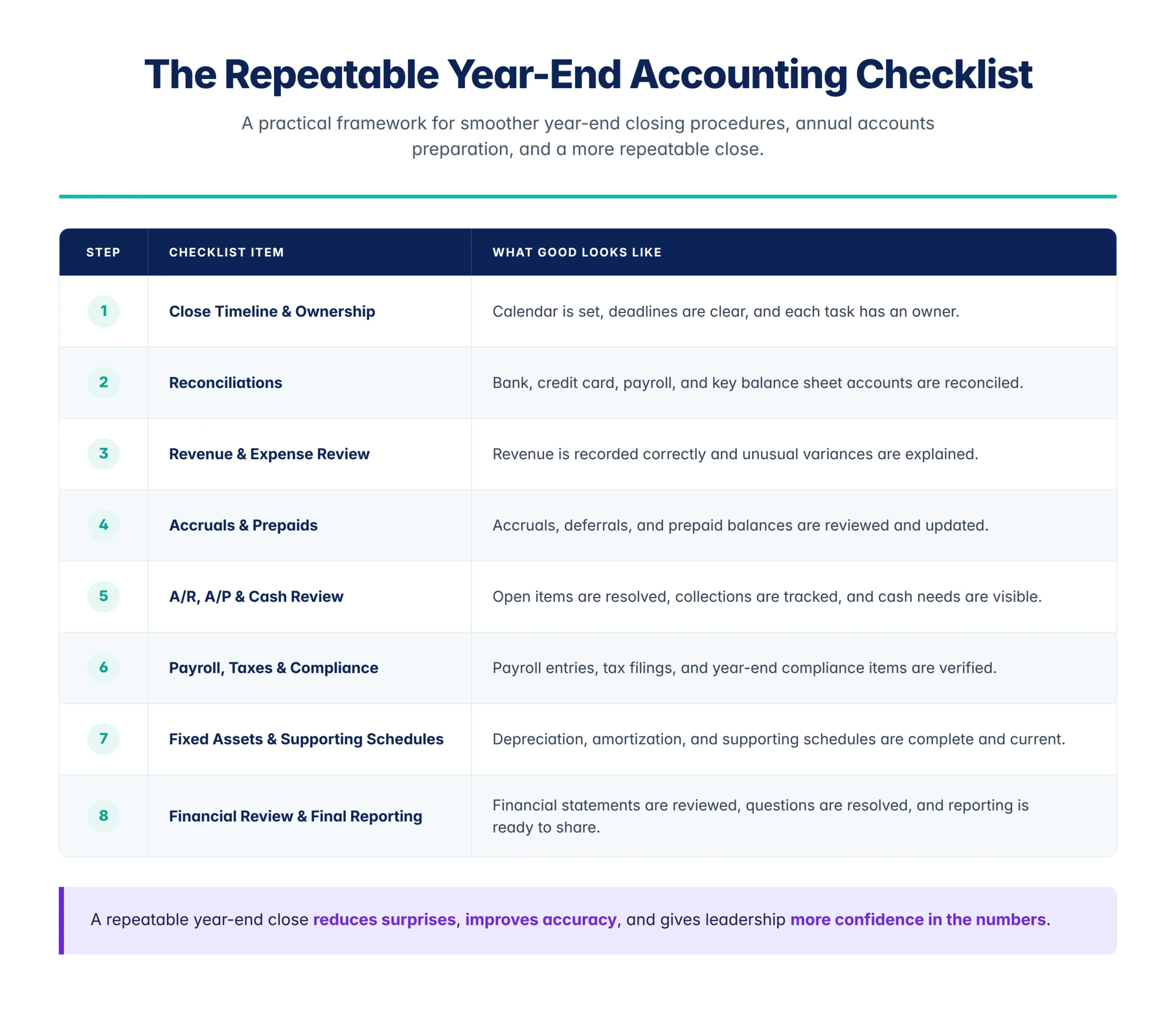
The pressures involved can lead to errors, missed opportunities, and inefficiencies that impact the profitability and health of the company. However, by planning early and following best practices, you can avoid the year-end meltdown and position your company for a successful launch into the new year. A repeatable year-end accounting checklist can also give your finance team clearer ownership, deadlines, and expectations throughout the close.
Below are five actionable tips to help you manage this critical period with ease. Using experienced and objective outside finance consultants like Growth Operators is a proven way to maximize your results when navigating each of the steps outlined below.
1. Get a Jump on Financial Reconciliations
Better monthly and quarterly processes can result in an improved year–end close. Consistent reconciliations are also one of the most important year-end closing procedures because they help finance identify errors before they compound. Waiting until the last quarter to begin reconciling your accounts is one of the most common mistakes companies make.
Here are steps to become more proactive and avoid the crunch:
- Conduct Monthly or Quarterly Reconciliations: This includes bank accounts, credit cards, accounts payable and receivable, and inventory accounts. By addressing discrepancies early, you reduce the likelihood of compounded errors and the scramble needed to fix them.
- Use Accounting Software: Modern accounting software can significantly reduce the manual effort involved in reconciliations and minimize mistakes from human error. Utilize tools that offer automated features and match transactions from your bank accounts to those recorded in your financial system.
- Assign Ownership and Accountability: Assign responsibility to specific team members to maintain consistency. Whether it’s your bookkeeper, accountant, or financial analyst, having clear ownership of each account by properly equipped employees ensures that reconciliations are completed on time and accurately.
- Document and Store Supporting Evidence: This includes bank statements, vendor invoices, receipts, and internal records that substantiate the transactions recorded in your financial system. Adopt cloud-based solutions that securely store your financial documents and make retrieval quick and efficient.
- Address Discrepancies Immediately: Common causes of discrepancies include data entry errors, duplicate entries, and unrecorded transactions such as bank fees, interest, or payments. By addressing these promptly, you avoid the headache of correcting significant errors during year-end close.
As part of your year-end accounting checklist, document which accounts must be reconciled, who owns each one, what supporting evidence is required, and when each reconciliation must be complete. Turning these activities into a repeatable process makes the next close easier to manage.
2. Evaluate Your Cash Flow Management
Proper cash flow management ensures there is enough liquidity to cover obligations such as year-end bonuses, taxes, and other outstanding liabilities. It also gives finance greater confidence that annual accounts preparation reflects the company’s true liquidity position.
Here are detailed steps to assess and improve your cash flow management in preparation for your end-of-year needs:
- Perform a Cash Flow Forecast: This forecast projects your company’s inflows and outflows over a specific period (e.g., the next 3–6 months) and helps you identify any potential liquidity gaps that may arise. If a cash shortfall is projected, you can take early action to correct it.
- Tighten Accounts Receivable Management: Outstanding customer payments can severely strain your cash position, especially when you need liquidity to meet end-of-year obligations. Implement cash flow strategies to stay on top of receivables, speed up cash inflows, and reduce the risk of liquidity shortages.
- Delay Non-Essential Expenditures: Review your capital expenditure (CapEx) and operating expense (OpEx) budgets to identify areas where you can delay or defer spending without negatively impacting business operations. By strategically controlling expenditures, you preserve more cash for higher-priority year-end obligations.
- Strengthen Cash Inflows: Bring in more cash before year-end by offering special promotions, adding incentives for up-front payments, and selling off excess inventory. These strategies can help improve the value of your cash flow statement.
- Monitor and Adjust Cash Flow Regularly: To stay on top of your liquidity needs, regularly monitor your cash flow metrics and adjust your strategies as needed. Use your findings to make data-driven decisions and maintain positive cash flow.
3. Streamline Your Payroll and HR Functions
Payroll and human resources (HR) management are often areas where inefficiencies and errors can bottleneck your year-end close. Ensuring these functions are optimized and compliant with regulations is essential to avoid penalties, payroll delays, or employee dissatisfaction. Finance and HR should establish clear ownership of shared year-end closing procedures, particularly for payroll, benefits, bonuses, and employee-related accruals.
Follow these steps:
- Conduct a Year-End Payroll Audit: An audit well in advance of year-end can help you catch and fix issues ahead of schedule. Items to review include employee classification, overtime calculations, benefits packages, and tax withholdings.
- Automated Payroll Processing: Manual payroll processes are not only time-consuming but also prone to errors. Automating payroll with the right accounting software can help you streamline processes, improve accuracy, and reduce administrative time.
- Centralize HR Data and Documentation: Centralizing HR data into a single platform can reduce manual processes, minimize errors, and provide clear visibility into all your HR functions. This system ensures compliance and that your team has easy access to the data they need for end-of-year reporting and reconciliation.
- Plan for Year-End Bonuses and Compensation Adjustments: Calculate bonus amounts, communicate with finance and HR departments, schedule bonus payouts strategically, and ensure tax compliance well before you need to write the checks.
- Review and Update Employee Benefits for the New Year: This includes health insurance, retirement plans, and other employee perks. To streamline this process, conduct an open enrollment period, verify employee contributions, reconcile benefits deductions, and communicate any benefit changes.
- Ensure Compliance with Year-End Tax Filings: Year-end comes with a series of payroll-related tax filings and compliance requirements that can become burdensome if you fail to plan properly. This may include reviewing W-2s and 1099s, payroll taxes, and ACA health insurance compliance.
4. Analyze Your Tax Position and Plan Ahead
Effective tax planning is crucial for a smooth year-end close and to minimize your company’s tax liability. It should also be coordinated with annual accounts preparation so tax assumptions, liabilities, and financial reporting are aligned before the books are finalized. By analyzing your tax position ahead of time, you can take advantage of deductions, avoid surprises, and ensure compliance with ever-evolving tax laws.
Consider these steps:
- Review Prior Year’s Tax Returns and Financial Statements: This serves as a baseline for understanding your current tax position and identifying areas where you can improve tax efficiency. Look closely at actual vs. projected tax liabilities, review your deductions and credits, and identify areas for improvement.
- Perform a Year-End Tax Projection: This projection estimates your total taxable income and calculates your estimated tax liability based on current figures. Do this by estimating your taxable income, reviewing your deductible expenses, and forecasting for any anticipated changes.
- Maximize Available Deductions and Tax Credits: Different industries and business models offer a range of opportunities to lower your tax bill. Take advantage of them by accelerating deductible expenses, reviewing your Section 179 deductions for equipment and software, analyzing research and development credits, compiling depreciation deductions, and revisiting carryover losses.
- Plan for Capital Gains and Losses: If your company has investments in stocks, real estate, or other assets, managing capital gains and losses can significantly impact your tax position. To minimize your tax burden, harvest tax losses, defer gains to next year, and review long-term vs. short-term capital gains.
- Assess State and Local Tax Obligations: State and local tax obligations can vary significantly depending on your business’s location and activities. Stay on top of state and local tax planning by reviewing nexus requirements, allotting for sales tax liabilities, and researching local tax incentives that you can adopt into your strategy.
- Collaborate with Tax Advisors or Consultants: Working with a tax advisor or external consultant is invaluable when dealing with multiple jurisdictions, evolving tax laws, and specific industry regulations. Tax professionals can help you stay compliant, optimize your tax-saving opportunities, and provide insight into tax structuring for long-term savings.
5. Conduct a Year-End Financial Health Check
Companies that consistently evaluate their financial health are more likely to respond swiftly to market changes and capitalize on new opportunities. Consider conducting a nextLEVEL® assessment from Growth Operators to gain an unbiased view of your company’s financial position. This will help you start the new year with a strong, data-driven strategy. Here are the key steps companies should take to gauge their financial health:
- Review Key Financial Statements: Review your income statement, balance sheet, and cash flow statement. Together, these documents provide a comprehensive picture of your business’s profitability, liquidity, and operational efficiency.
- Analyze Profitability Ratios: Profitability ratios help you measure how effectively your company generates profit relative to revenue, assets, and equity. These ratios provide insight into operational efficiency and overall financial health. Look at gross profit margin, operating profit margin, net profit, return on assets (ROA), and return on equity (ROE).
- Assess Liquidity and Solvency: A financially healthy company can pay off its debts while maintaining sufficient cash reserves to operate smoothly. Key metrics to monitor include the current ratio, quick ratio, debt-to-equity ratio, and interest coverage ratio.
- Evaluate Cost Efficiency and Operational Performance: Identifying areas for improvement in cost management can lead to substantial gains in profitability. Assess your company’s cost structure by reviewing the cost of goods sold (COGS) and operating expenses, and perform a break-even analysis to determine the sales volume required to cover all fixed and variable costs.
- Benchmark Against Industry Standards: Comparing your company’s financial performance to industry benchmarks will help you understand how your business is performing relative to competitors. Areas to benchmark include profitability margins, cost structure, and growth rate.
For companies that need to turn those findings into specific priorities, owners, and execution plans, Growth Operators’ Strategy & Execution Advisory can help bridge the gap between financial insight and action.
Can a Fast Financial Close Be Done Without Automation?
While new technologies can help streamline your financial close, good technology layered over a poor process will hamper the results. If your organization does not have a good set of rules or a well-thought-out financial close process, then those same problems will appear in the automated processes.
To best leverage automations, eliminate manual steps that are not essential. Look for opportunities to simplify and streamline the process, while ensuring integrity of the data. This includes looking at industry benchmarks and implementing best practices. Technology should enable an improved process, not be the final answer.
Adapting to New Regulatory Requirements and Standards
An efficient financial close and reporting process may depend on your organization’s ability to accommodate and adapt quickly to new regulatory requirements and reporting guidelines. Some of the recent changes that should be considered are:
- Tightened SEC filing deadlines
- Upcoming revenue recognition and lease accounting guidelines
- New disclosure requirements
- Increased SOX controls
Maintaining flexibility in processes and technology is key to adapting quickly to new requirements.
The Value of External Support and Business Benefits of a Fast Close Process
As outlined above, there are a number of steps available to mitigate end-of-financial-year meltdown. However, many companies face resource constraints or lack the internal expertise to manage the complexities of these processes effectively.
Organizations demonstrating a world-class year-end close process realize numerous benefits over the bottom performers. One of the biggest benefits of a fast close is that the finance team spends less time on data gathering and more time focused on data analysis and future FP&A.
This is where outside consultants like Growth Operators can play a pivotal role in helping your company reach the end-of-year finishing line without the stress.
Crafting a repeatable year-end accounting checklist that entire teams can follow creates a faster, more accurate end result. It also makes year-end closing procedures easier to improve over time because bottlenecks, ownership gaps, and recurring errors become more visible from one close to the next.
Whether you need assistance with HR assessment, financial planning, or interim management, our experts can provide you with the guidance, tools, and personnel needed to ensure a successful year-end close. We specialize in supporting private equity and venture capital-backed companies through complex transitions and foundational processes alike.
Contact Growth Operators today and get a jump on your year-end preparations with a free 30-minute call.
What are year-end closing procedures?
Year-end closing procedures are the steps a finance team follows to finalize accounting records for the fiscal year. They typically include reconciling accounts, reviewing transactions and balances, recording adjusting entries, resolving discrepancies, completing annual accounts preparation, reviewing financial statements, and documenting approvals before the period is formally closed.
Why is the closing process necessary in accounting?
What should be included in a year-end accounting checklist?
How can you improve the year-end closing process?