Ready to Build Something That Lasts?
We meet companies where they are, whether they’re navigating rapid growth, a transaction, a leadership gap, or an operational rebuild. Let’s talk about what you are solving for.

Employee well-being has often been treated as an HR program. A benefit. A culture initiative. A “nice-to-have” that becomes easier to discuss when business conditions are strong.
That view is very much outdated.
For today’s leadership teams, employee well-being is a business strategy. It directly affects retention, productivity, engagement, manager effectiveness, hiring competitiveness, and the organization’s ability to execute. When employees are burned out, disconnected, or unsupported, the business feels it. Turnover rises. Productivity slips. Managers spend more time reacting. Institutional knowledge walks out the door. Recruiting becomes harder. Culture weakens.
The numbers bear this out. Gallup’s 2026 State of the Global Workplace report found that global employee engagement fell to just 20% in 2025, its lowest level since 2020, costing the world economy an estimated $10 trillion in lost productivity. Employee well-being is not a soft concern; it’s a measurable driver of retention, productivity, and business performance.
For CHROs, CFOs, CEOs, and boards, the conversation should no longer be whether employee well-being matters. The better question is how to manage it with the same rigor applied to other performance drivers.
That doesn’t mean reducing people to metrics. It means recognizing that mental health, employee engagement, and employee retention are connected to measurable business outcomes. The companies that understand this will be better positioned to compete for talent, navigate change, and sustain performance in a demanding market.
Employee well-being isn’t just about offering wellness benefits or encouraging people to take time off. Those efforts matter, but they’re only part of the picture.
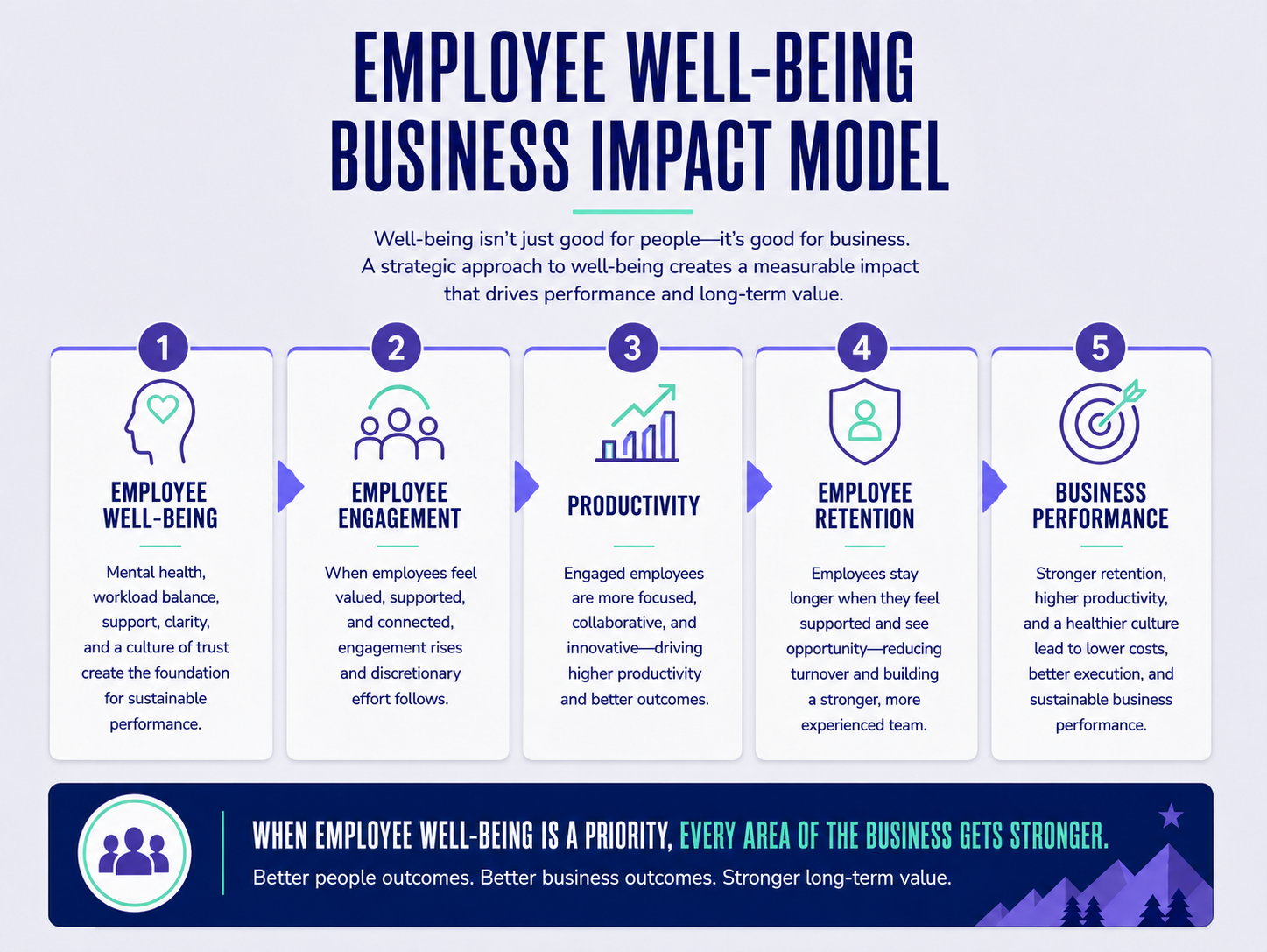
A strategic approach to employee well-being looks at the full employee experience: workload, manager quality, clarity of expectations, flexibility, psychological safety, recognition, growth opportunities, communication, and access to support. It asks whether the work environment helps people perform well over time or slowly drains the organization’s capacity.
That distinction is important.
Many companies are asking teams to do more with less. They’re managing cost pressure, technology change, hybrid work, M&A integration, leadership transitions, and shifting employee expectations. In that environment, well-being is not separate from performance. It’s part of the operating model.
When employee well-being is ignored, the cost shows up in ways leadership can measure:
When well-being is managed strategically, it supports resilience, retention, and execution.
CFOs don’t need well-being initiatives to sound soft. They need them to connect to business impact.
Employee turnover is expensive. Disengagement is expensive. Burnout is expensive. Poor manager capability is expensive. When employees leave, companies lose productivity, customer knowledge, team continuity, and recruiting investment. When employees stay but disengage, the business may avoid immediate turnover costs but still lose performance.
And these costs are quantifiable. Replacing an employee typically runs 50% to 200% of their annual salary, depending on role and seniority. Engagement carries comparable weight, as Gallup attributes roughly 70% of the variance in team engagement to the manager and estimates that closing the global engagement gap could add $9.6 trillion in productivity to the economy. For a CFO, that reframes employee well-being and engagement as levers on productivity, retention, and avoidable replacement cost, not as discretionary overhead.
That’s why the ROI of well-being should be evaluated through practical business indicators, such as:
The goal is not to turn well-being into a spreadsheet-only exercise. The goal is to help leaders identify where people-related issues affect business performance and where targeted action could reduce risk.
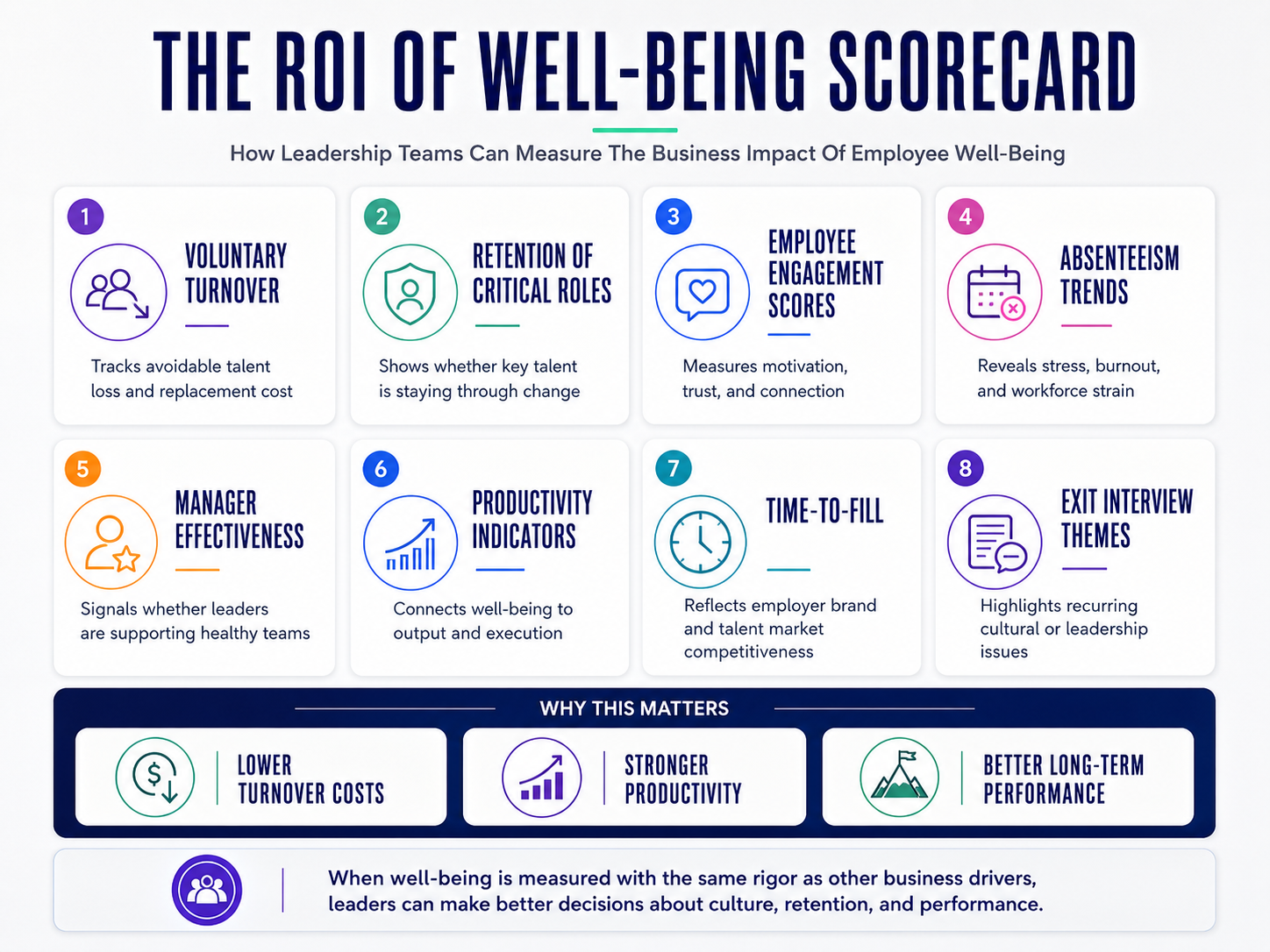
For example, if turnover is concentrated under certain managers, the issue may not be compensation alone. It may be workload, communication issues, unclear priorities, or a lack of development. If engagement is low among high performers, the organization may be creating retention risk in the very population it most needs to keep. If burnout is rising during a transformation effort, execution may be at risk before the financial metrics show it.
Good HR strategies help leadership connect those dots early.
Mental health has become a central part of the workplace conversation, but many organizations still treat it mainly as a benefit design issue. Benefits are important, but they’re not enough.
A company can offer strong mental health resources and still create an environment where employees feel overwhelmed, unsupported, or afraid to speak up. CHROs and HR leaders need to look beyond program availability and assess whether the culture, workload, manager behaviors, and communication norms actually support sustainable performance.
Mental health affects the business because it affects how people work, decide, collaborate, and lead. Employees under sustained stress may struggle to focus. Managers under pressure may communicate poorly. Teams operating in ambiguity may become reactive instead of strategic. Over time, these issues slow execution.
A healthier approach starts with leadership alignment. Executives need to define what sustainable performance looks like inside the business. That includes clarifying priorities, reducing unnecessary friction, equipping managers, and creating a culture where employees can raise concerns before they become crises.
This isn’t about removing pressure from the business. Some pressure is unavoidable. The point is to make sure pressure is managed with clarity, support, and discipline.
Wellness and employee engagement should not be managed as disconnected initiatives. Employees experience them together.
A wellness program may provide resources, but engagement is shaped by daily work: the manager relationship, team dynamics, role clarity, career path, workload, communication, and trust.
To prioritize wellness and employee engagement for current employees, HR leaders should focus on five practical steps that improve the lived experience of work.
Employee surveys, pulse checks, stay interviews, manager feedback, and exit interview themes can help identify what employees are experiencing. The key is to listen with the intent to act. Asking for feedback and doing nothing with it can damage trust.
Not every well-being issue has the same root cause. Some teams may be struggling with workload. Others may need manager training, role clarity, technology support, communication, or career development. HR should help leaders diagnose the issue before prescribing the solution.
Managers are the front line of employee engagement. They influence workload, recognition, communication, flexibility, development, and trust. CHRO employee engagement strategies should include manager enablement, not just employee-facing programs.
Employees disengage when everything is urgent, priorities keep shifting, or success is unclear. Leadership teams should regularly communicate what matters most, what can wait, and how work connects to business goals.
Engagement and well-being efforts should be evaluated over time. HR can track indicators of retention, engagement, participation, sentiment, manager effectiveness, and productivity to understand what is improving, where risk remains, and what needs adjustment.
Future employees are evaluating more than compensation. They’re looking for signals that a company understands the modern employee experience.
That scrutiny carries real retention stakes. In Bank of America’s 2024 Workplace Benefits Report, 39% of employees said strong benefits, especially those tied to wellness and flexibility, are a primary reason they stay. The signals that tell a candidate you care about well-being are often the same ones that keep a current employee from leaving, which is why employer brand and employee retention rise and fall together.
Companies show future employees they care about well-being by aligning what they say with how they operate. Career pages, recruiting conversations, benefits summaries, and employer branding all matter, but candidates are also paying attention to tone, transparency, manager behavior, and how clearly the company communicates expectations.
Practical ways to show commitment include:
The strongest employer brands are built from the inside out. If current employees are burned out or disengaged, candidates will eventually feel that. If current employees feel supported, trusted, and clear on how they contribute, that becomes a competitive advantage in hiring.
This connects directly to employee retention. The same factors that attract talent often determine whether people stay.
The CHRO role is evolving. HR leaders are no longer expected to simply administer programs. They’re expected to help the business build workforce strategies that improve performance.
Strong CHRO employee engagement strategies should connect employee experience to business priorities. That means focusing on the places where engagement affects execution, retention, and growth.
Key strategies include:
For HR leaders building a more structured workforce strategy, our article on workforce planning best practices offers additional guidance on aligning people planning with business needs. Our article on improving employee onboarding programs with retention in mind also connects directly to the retention side of the well-being conversation.
One of the risks in bringing well-being into the business strategy is overcorrecting into measurement without meaning. Employees don’t want to feel like their mental health is being reduced to dashboard metrics.
The right approach is balanced.
Leaders should measure what helps them make better decisions, but they should also maintain a human understanding of what those numbers represent. A drop in engagement isn’t just a data point. It may reflect unclear priorities, poor manager communication, change fatigue, or a loss of trust. Rising turnover isn’t just a retention metric. It may reveal cultural issues that are already affecting productivity and customer experience.
HR can help the business use data responsibly by pairing metrics with qualitative insight. Surveys, focus groups, manager conversations, and employee feedback can help explain the “why” behind the numbers.
By connecting leadership readiness, team dynamics, employee engagement, and talent strategy, organizations can make better decisions about the people side of performance.
Growth Operators helps CEOs, CHROs, HR leaders, and executive teams treat employee well-being, engagement, and retention as business priorities. Through Human Resources Services, Growth Operators supports organizations with HR strategy, workforce planning, talent management, culture, compliance, employee experience, and organizational change.
For companies that need senior HR leadership without adding permanent headcount, Growth Operators provides Fractional and Interim Human Resources support. That may include a fractional CHRO, an interim HR leader, or an embedded HR expert who can help leadership teams assess engagement risk, improve manager effectiveness, strengthen retention, and build a practical well-being strategy tied to business outcomes.
Growth Operators’ nextLEVEL® framework adds structure to that work by helping organizations assess people, processes, and technology, identify gaps, and prioritize action. For companies working to connect employee well-being to measurable performance, nextLEVEL helps turn insight into execution.
Employee well-being is not separate from business performance. It’s one of the conditions that allows performance to last. The organizations that understand this will be better equipped to retain talent, sustain productivity, and build cultures that can handle whatever comes next.
No matter where you are in the process, we can help you develop an Exit Readiness plan to maximize the value of your company and bring you to closing.
"*" indicates required fields