Frequently Asked Questions About Middle Manager Burnout
Not finding the answer you’re looking for? Contact our team today to speak to a dedicated HR expert.

In the drive to maximize returns, private equity (PE) and venture capital (VC) firms often overlook the well-being of their middle managers as they quickly integrate an acquisition. Despite being the linchpin of their portfolio companies, executives leave middle managers to toil with expanding workloads and diminishing resources. Under these circumstances, it’s only a matter of time until enough is enough.
Middle manager burnout is more than an employee well-being issue. It’s an operational risk that can weaken execution, slow transformation, and create unnecessary leadership strain. For private equity and venture capital sponsors, middle manager burnout is a direct threat to the value creation plan: it slows integration, stalls transformation initiatives, and drives out the people who hold institutional knowledge.
Cultivating a thriving portfolio company requires a sincere and dedicated investment in the talent that drives it forward. To keep your companies moving forward, our Growth Pros have identified six strategies to help you recognize signs of burnout and prioritize the well-being of your middle managers. We also discuss how professional HR advisory services and fractional HR services can play a pivotal role in preventing burnout.
Middle managers are the backbone of any company. They are the bridge between your executive vision and the daily operations that make it a reality. More than just task managers, they are the custodians of your company’s culture and the carriers of its operational knowledge. They translate high-level strategies into actionable plans and motivate teams into action while always looking for ways to improve.
Mergers, acquisitions, and the corporate ethos of “doing more with less” often lead to increased workloads for all employees, particularly middle managers. It’s no surprise that this continuous juggling act leads to burnout, chronic workplace stress, and exhaustion.
Burnout happens when job demands consistently exceed the resources, control, recognition, and support managers need to do their jobs well. For middle managers, that often means absorbing pressure from executives above them while protecting and guiding the teams below them. Burnout is a process, not an event. It typically builds in a predictable sequence: workload expands after a merger, acquisition, or restructuring; decision-making authority stays with executives; recognition, staffing, and clarity fail to keep pace; and the middle manager quietly absorbs the gap. Sustained long enough, that gap hardens into exhaustion, cynicism, and reduced effectiveness — the three markers the World Health Organization uses to define burnout as an occupational phenomenon.
Most large-scale research puts middle manager burnout between roughly half and three-quarters of the population. Capterra’s global Middle Manager Survey found that 71% of middle managers report feeling overwhelmed, stressed, or burned out at work — a figure that rises to 76% among managers under 35. In the same survey, 53% said they were swamped with tasks and 51% said they could not give their direct reports the time they needed.
The risk is measurable. Harvard Business Impact reported that 85% of midlevel leaders experience burnout on a weekly basis, while Microsoft’s Work Trend Index data shows that 53% of managers report feeling burned out at work.
If you lack the HR resources to address this issue head-on, it may be time to call in outside help.
Frazzled, disengaged middle managers can have a ripple effect throughout an entire organization.
So, what does middle manager burnout look like? It often shows up as decision fatigue, irritability, slower follow-through, reduced creativity, disengagement, and managers who are too overwhelmed to coach, communicate, or lead with consistency. At the organizational level, it looks like slipping deadlines, teams that stop escalating problems early, meetings that generate no decisions, and quiet attrition among your strongest performers.
These are some of the signs to watch for:
To better understand what burnout feels like, the Harvard Business Review compiled a list of the symptoms managers describe during burnout and placed them into six categories. These can be summarized as:
These symptoms result in an inability to manage teams or complete goals, ultimately setting employees and companies back.
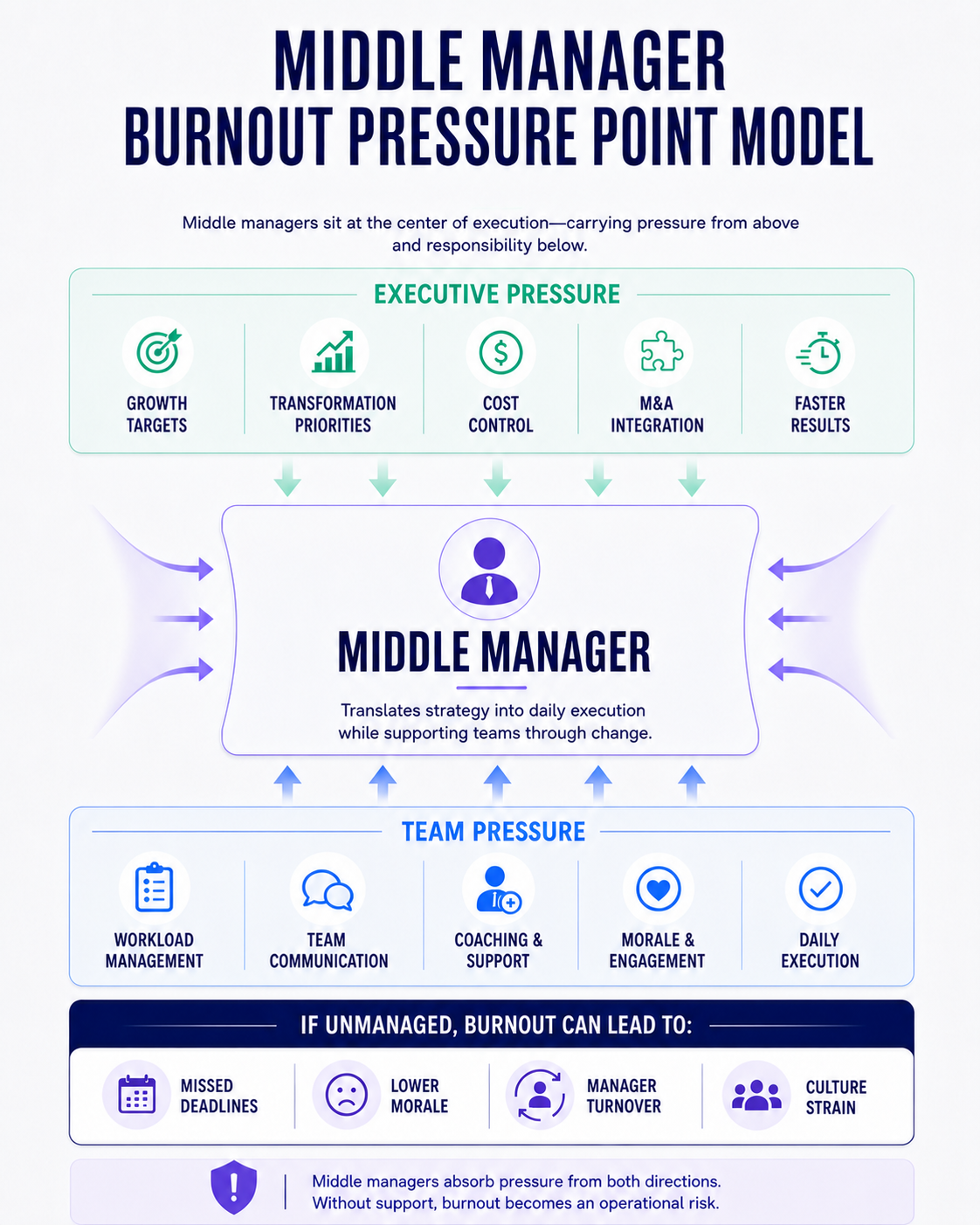
Business transformation services can also help with HR by connecting people, processes, systems, and leadership expectations. Instead of treating burnout as an isolated morale issue, transformation-minded HR support looks at workload design, role clarity, communication, manager capability, and the operating model behind the stress.
In practice, that means auditing spans of control and decision rights, redesigning roles so accountability matches authority, rebuilding the communication cadence between executives and middle managers, and sequencing change so managers are not absorbing three initiatives at once. Pairing business transformation services with HR advisory services or fractional HR services treats the cause rather than the symptom.
To prevent burnout in your company, you need to identify its sources and implement changes that will foster greater job satisfaction. The clearest and quickest means of achieving this is through professional HR advisory services or fractional HR services that bring experienced HR leadership, structure, and an outside perspective. Third-party HR consultants can work alongside your upper management team to identify potential burnout hotspots and implement proactive strategies to mitigate these risks.
Here are six strategies to combat burnout in your company:
Our HR experts work with your executive team to trace problems back to their source and pinpoint specific areas within the organization that cause stress to middle managers. Then, we work with you to remove triggers and create a path to better productivity. See how we did it for our non-profit client.
We can facilitate open communication and difficult conversations between executives and middle managers so that everyone is working towards the same goals and objectives.
An outside perspective is valuable for discovering inefficiencies in job responsibilities. By closely examining manager roles and responsibilities, our HR consultants can recommend the necessary adjustments to make workloads manageable. This might involve redistributing tasks, introducing new efficiencies, or suggesting additional support.
Streamlining workloads might involve redistributing tasks, introducing new efficiencies, or suggesting additional support. This is where HR advisory services and broader business transformation support can work together to reduce friction, clarify ownership, and make change more sustainable.
Investing in the development of your middle managers not only helps with talent retention but also enhances their capabilities. Our HR consultants can identify the key areas for development and recommend tailored training programs to better equip your managers for their job.
New research from Gallup finds that recognition and wellbeing, together, can pave the way for improved business outcomes and positive culture.
But there’s a catch: The research finds the business benefits of high wellbeing are greatly enhanced by optimum recognition and greatly damaged by poor recognition–making it even more important to prioritize both.
If the company culture inadvertently promotes unsustainable work practices, especially after a merger or acquisition, Growth Pro HR consultants can highlight these issues to the executive team and partner within the organization to recommend strategies for creating a more supportive environment. This could include initiatives to promote work-life balance, recognize and reward contributions, and encourage regular feedback.
Perhaps most importantly, the right HR consultant serves as a neutral, objective peacemaker who can bridge gaps between different levels of management. They can facilitate communication, explain new initiatives, and oversee a smooth and effective implementation of changes.
Not finding the answer you’re looking for? Contact our team today to speak to a dedicated HR expert.
Roughly 71% of middle managers report feeling overwhelmed, stressed, or burned out at work, according to Capterra’s global Middle Manager Survey — rising to 76% for managers under 35. Harvard Business Impact reports that 85% of midlevel leaders experience burnout on a weekly basis, and Microsoft’s Work Trend Index finds 53% of managers burned out. Middle managers consistently report higher burnout than both the executives above them and the individual contributors they lead.
PE and VC firms need to prioritize the well-being of middle managers to retain top talent in a competitive labor market. Don’t let middle manager burnout become a silent threat to your portfolio companies’ success.
Contact Growth Operators today to discuss how Growth Operators’ HR advisory services, fractional HR services, nextLEVEL® assessment, and Talent Intelligence® Advisory can help identify gaps, then provide detailed recommendations on where to implement sustainable practices to create a thriving environment for all your talent.
No matter where you are in the process, we can help you develop an Exit Readiness plan to maximize the value of your company and bring you to closing.
"*" indicates required fields