Ready to Build Something That Lasts?
We meet companies where they are, whether they’re navigating rapid growth, a transaction, a leadership gap, or an operational rebuild. Let’s talk about what you are solving for.

The best consulting engagements do more than solve the problem in front of the client. They leave the business stronger, more capable, and better prepared for the next challenge. Yet most engagements end with a deliverable and a goodbye, leaving teams to figure out the rest on their own.
At Growth Operators, we believe that’s not good enough.
This article explores how Growth Operators makes structured knowledge transfer a core part of every engagement and why continuous learning consultants who prioritize capability-building deliver fundamentally better outcomes than those who simply deliver work and walk away.
Many companies bring in outside support during moments of pressure: a leadership gap, a transaction, a finance transformation, an HR challenge, a systems implementation, or a period of rapid growth. The immediate need may be execution capacity, technical expertise, or interim leadership–but the long-term value comes from what remains after the engagement ends.
Were processes improved? Did the internal team gain confidence? Are managers better equipped to make decisions? Does leadership have clearer reporting, stronger operating rhythms, and a better understanding of what good looks like?
That is where knowledge transfer becomes a core part of client value.
At Growth Operators, we believe the best operators are always learning and always teaching. We don’t enter client relationships to create dependency. We embed experienced finance, accounting, HR, and transformation leaders who help solve problems while strengthening the teams and systems around them. The goal is not just to get through the work. The goal is to build capability that lasts.
Consulting can fail when expertise stays trapped with the consultant. Without a deliberate knowledge-transfer strategy, even technically excellent work can leave an organization no more capable than it was when the engagement began.
A project may look successful while the outside team is involved, but if the client organization cannot sustain the process, interpret the reports, run the cadence, or make decisions without external support, the improvement is fragile. It may work for a moment, but it does not become part of the operating model.
Strong engagements work differently. They are designed with knowledge transfer from the beginning.
That means documenting what matters, training the right people, clarifying ownership, building repeatable tools, and helping managers understand not just what changed, but why it changed. It also means making space for questions, feedback, and iteration while the consultant is still embedded in the work.
For C-suite executives and finance leaders, this is especially important. Finance and accounting improvements often involve new reporting structures, forecasting methods, controls, close processes, KPIs, or board materials. If those improvements are not transferred clearly to internal leaders and teams, the organization can slide back into old habits once the engagement ends.
Knowledge transfer turns execution into capability.
Knowledge transfer is not a final meeting or a shared folder created at the end of a project. It’s an ongoing discipline throughout the engagement.
In practice, effective knowledge transfer may include:
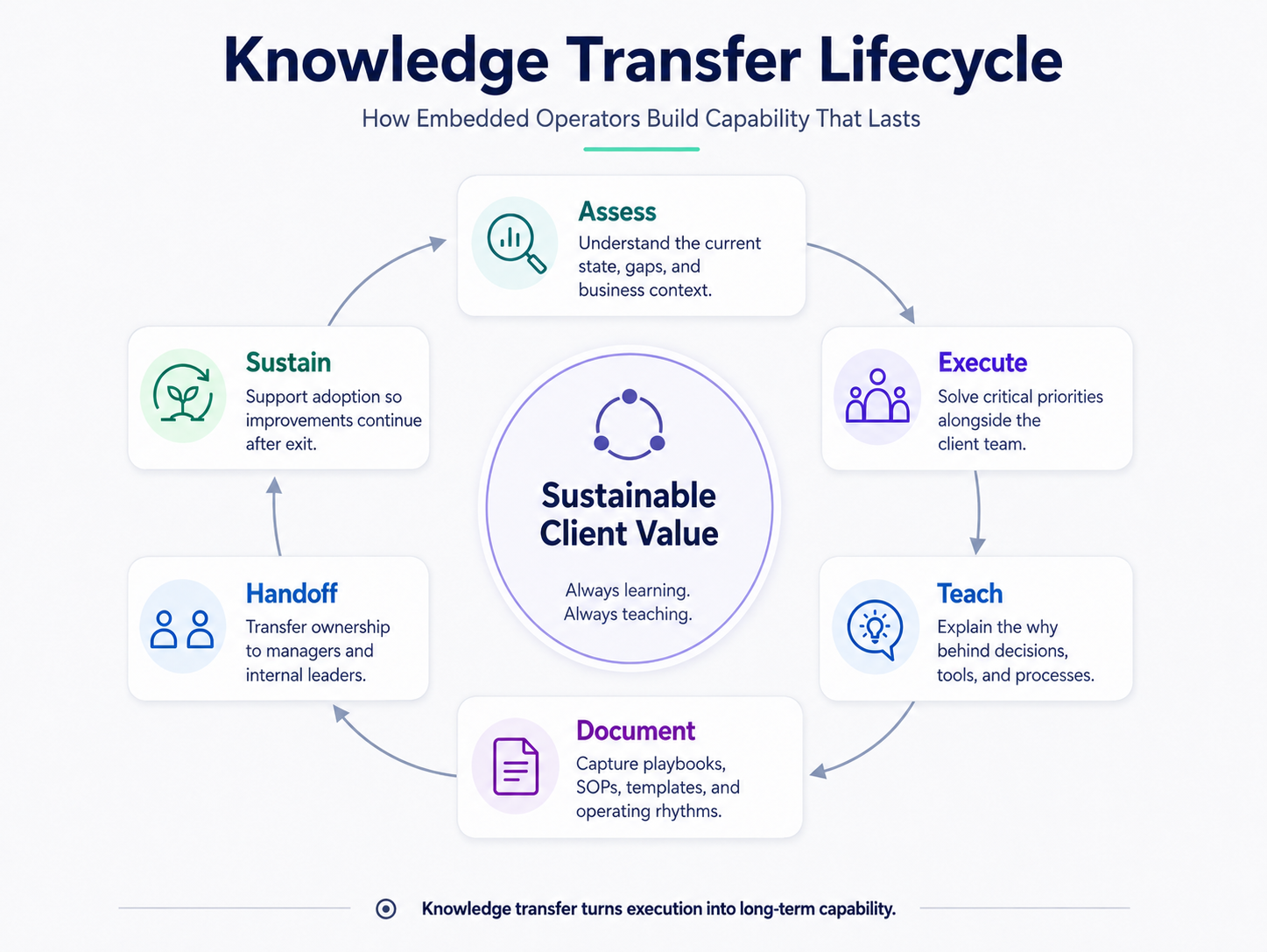
This workflow explains the elements of the knowledge transfer lifecycle and its impact on long term capacity.
For example, a finance transformation effort may include building a better forecasting model. The deliverable matters, but the handoff matters just as much. Internal leaders need to understand the model’s assumptions, update cadence, data inputs, decision points, and limitations. They need to know how to use it, explain it, and adapt it as the business changes.
That’s the difference between delivering a spreadsheet and improving financial leadership.
The most effective way to transfer knowledge when leaving a consulting engagement is to plan the exit before the exit arrives. Knowledge handoff should be built into the engagement from day one, not rushed during the final week.
A practical handoff should answer four questions:
This is where a structured closeout process creates real value. It gives the client team clarity, confidence, and continuity. It also ensures that the engagement ends with momentum rather than uncertainty.
Managers are often the most important link in an effective knowledge transfer. They’re close enough to the work to sustain day-to-day execution, but senior enough to influence adoption across the team.
If managers don’t understand the new process, the team will struggle. If they understand the process but not the business reason behind it, they may follow the steps without improving decision-making. If they aren’t given ownership, the work can become dependent on one or two people instead of becoming part of the organization’s operating rhythm.
A strong knowledge handoff from consultants to managers should include:
This is especially relevant during finance, accounting, HR, and transformation engagements. Managers may need to own a new close process, maintain a dashboard, support a workforce planning cadence, lead a team through change, or explain performance trends to executives.
The handoff should make that easier, not harder.
Information sharing for consultants works best when it’s structured, intentional, and aligned to business priorities. Too little information slows progress. Too much unfiltered information creates confusion. The goal is to give consultants the context they need to act quickly while protecting focus and accountability.
Intentional consultant communication strategies also accelerate knowledge transfer because when information flows clearly, internal teams build understanding alongside the consultant, not after the consultant’s gone.
Good consultant communications strategies include:
These consultant communications strategies are not just project management habits. They’re part of how knowledge transfer happens. When communication is clear, the client team sees how decisions are made, how tradeoffs are evaluated, and how progress is measured. That visibility helps internal leaders build their own capability.
The best communication cadence also protects the client’s time. Executives need clarity, not noise. Managers need direction, not ambiguity. Teams need enough context to execute without being overwhelmed.
Continuous learning is not only something consultants bring to clients. It’s something strong consultants practice themselves.
Every client environment is different. Every company has its own systems, culture, constraints, ownership structure, leadership dynamics, and operating history. The best consultants don’t assume that yesterday’s answer automatically fits today’s business. They listen first, learn the environment, and adapt their expertise to the client’s reality.
That’s why continuous learning consultants are more valuable than playbook-only advisors. They bring experience, but they don’t rely on canned recommendations. They know when to teach, when to listen, when to challenge, and when to adjust.
That combination is what creates lasting client value.
Executives don’t hire outside support just to produce activity. They hire support to improve performance, reduce risk, increase capacity, and create better outcomes.
Knowledge transfer supports all of those goals.
In finance and accounting, it may help teams close faster, forecast better, improve working capital visibility, or produce more useful board reporting. In HR, it may help leaders strengthen workforce planning, improve manager capability, or support organizational change. In transaction or transformation work, it may help management teams sustain improvements after the initial push.
Growth Operators’ nextLEVEL® framework reinforces this kind of structured improvement by helping organizations assess people, processes, and technology, identify gaps, and build a practical roadmap for execution. That roadmap becomes more powerful when the client team understands it, owns it, and can continue advancing it after the engagement.
Growth Operators is built around experienced operators who know how to step into complex environments and get meaningful work done. But execution is only part of the value.
The deeper value comes from how the work is done.
We embed with client teams. We communicate clearly. We build practical tools. We share knowledge as the engagement progresses. We help managers understand the operating rhythm. We document what matters. We leave behind stronger processes, clearer ownership, and more confident teams.
That’s why knowledge transfer isn’t just a side benefit of our work—it’s an integral part of the work.
Whether a client needs fractional or interim finance and accounting support, broader finance and accounting services, HR leadership, transaction advisory, or transformation support, the goal is the same: solve the immediate challenge while making the organization more capable for what comes next.
The best consulting engagements don’t end with a deliverable. They end with a stronger client. That’s the standard Growth Operators works toward every day.
If you’re evaluating outside support and want a partner who builds your team up rather than creates reliance, we’d welcome the conversation. Connect with Growth Operators today to learn how our embedded operators approach knowledge transfer from day one.
No matter where you are in the process, we can help you develop an Exit Readiness plan to maximize the value of your company and bring you to closing.
"*" indicates required fields