Ready to Build Something That Lasts?
We meet companies where they are, whether they’re navigating rapid growth, a transaction, a leadership gap, or an operational rebuild. Let’s talk about what you are solving for.

Private equity firms are under more pressure than ever to create value quickly, show measurable progress, and deliver a stronger story at exit. In a market where growth is harder to buy, margins are under pressure, and buyers are asking tougher questions, value creation can no longer depend on financial engineering alone. It requires operational engineering: the practical, day-to-day work of improving how a business runs so it can scale, perform, and deliver against the investment thesis.
That shift has changed the role of the operating partner.
Today’s operating partners are expected to do far more than advise from the sidelines. They are increasingly responsible for helping private equity firms translate deal logic into execution, align leadership teams, prioritize initiatives, and drive real performance in portfolio companies. They sit at the point where investment strategy meets operational reality.
But even the strongest operating partner model has limits if the right support is not in place behind it. In many portfolio companies, the biggest constraints to growth and performance are not found in strategy decks. They are found in the back office: Finance, Accounting, HR, reporting, controls, workforce planning, and leadership capacity. When those functions are weak, value creation slows. When they are strengthened early, deal outcomes improve.
That is why evaluating the impact of operating partners in private equity firms requires a broader lens.
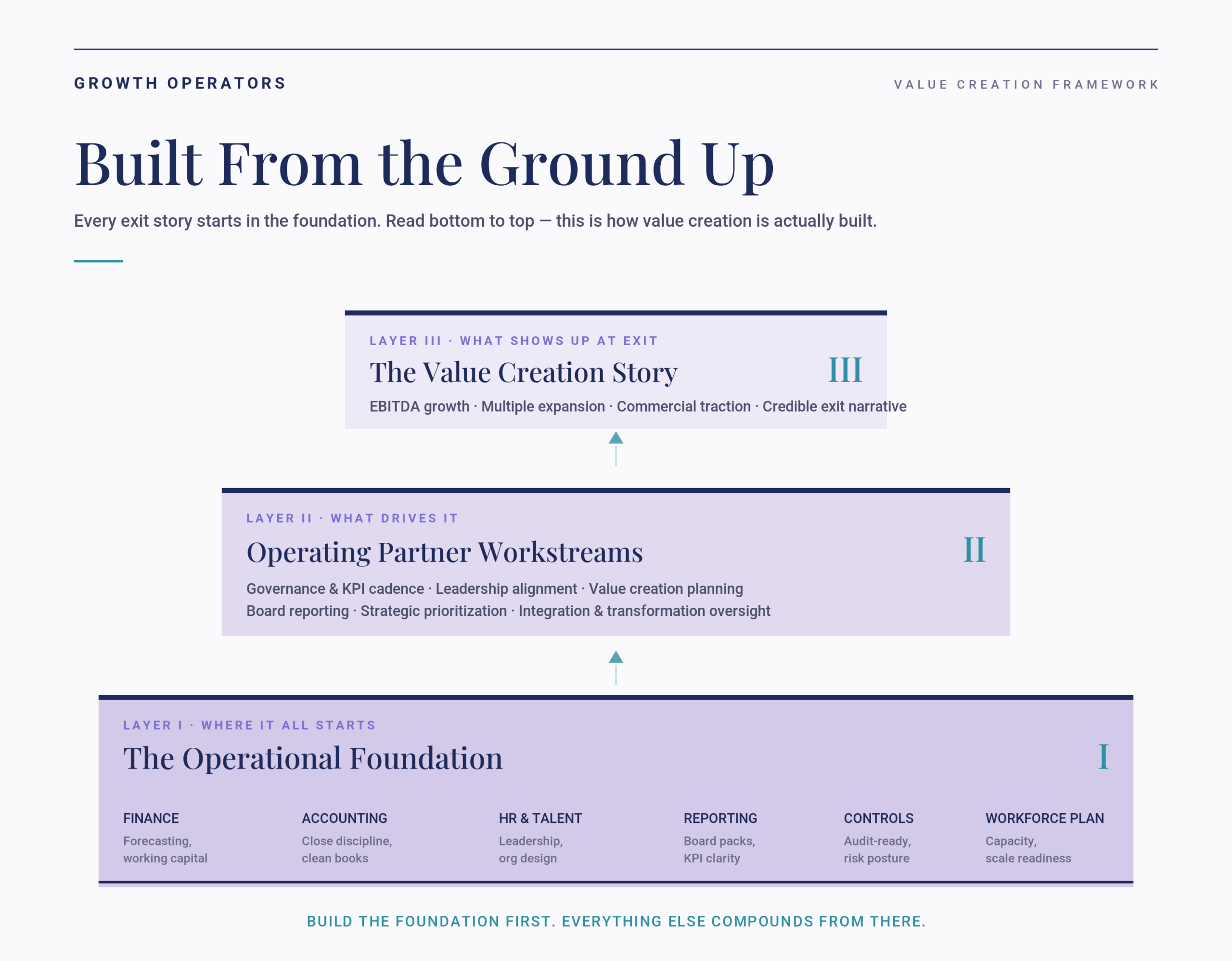
The question is not just what operating partners do. The question is how effectively they are supported by embedded functional expertise that helps accelerate value creation without adding unnecessary headcount.
Operating partners help private equity firms move from investment thesis to execution. Their role is to identify where value can be created, determine what needs to happen first, support management teams through change, and help sponsors build a more repeatable path to portfolio performance.
In practice, that work often spans the full investment lifecycle.
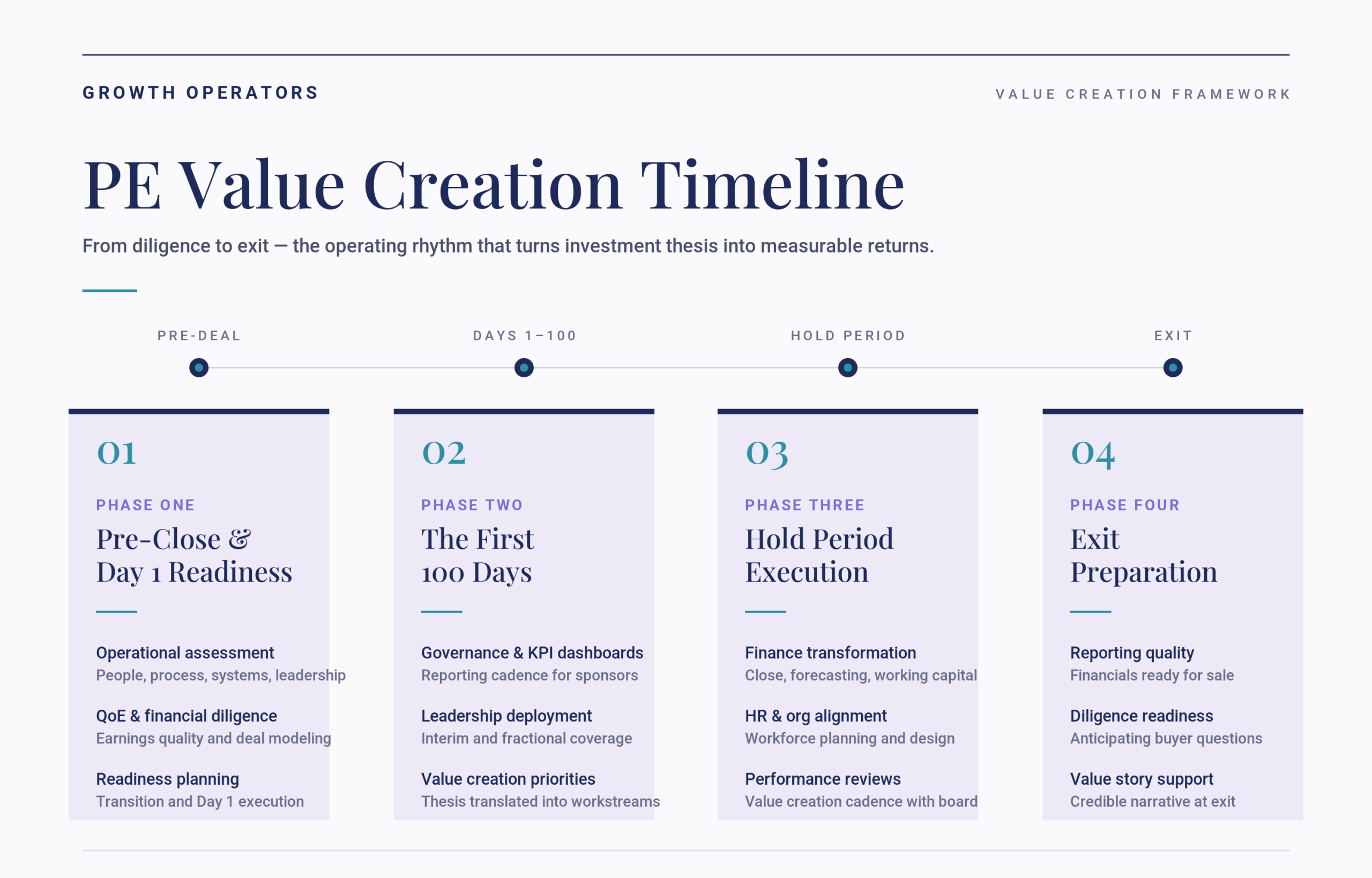
The best operating partner involvement begins before close. This is when firms have the opportunity to identify hidden risks, evaluate readiness, and define what the business will need on day one. That work often includes operational and financial due diligence, Quality of Earnings support, financial modeling, strategy assessment, preliminary value-creation planning, transition planning, and day-one readiness.
This is also where a meaningful operational assessment should begin. A strong assessment looks beyond surface-level financial performance to examine people, processes, technology, reporting, leadership structure, and cross-functional readiness. It helps sponsors understand not just where the company stands today, but what will be required to improve performance under new ownership.
The first 100 days are often when value creation either gains momentum or stalls. For operating partners, this period is less about broad ambition and more about disciplined execution. Priorities need to be narrowed. Governance must be established. Management teams need clarity. Reporting must improve fast enough to support decision-making.
A strong first-100-days plan often includes standing up a governance structure for integration and value creation, completing an operational assessment, finalizing priorities, deploying leadership support where needed, and establishing KPI monitoring and sponsor reporting. These are not secondary tasks. They are the foundation for everything that follows during the hold period.
Once the initial plan is in motion, operating partners help drive sustained execution. This is the phase where short-term stabilization gives way to deeper transformation. It includes leadership assimilation, operating model improvement, Finance and HR transformation, value creation reviews, and ongoing board-level visibility into progress.
This is also where operating partners need the right level of horsepower around them. It is difficult to improve performance consistently across a portfolio if every initiative depends on already-stretched internal teams or management leaders who are still trying to stabilize the basics.
Strong exits are built well before the sale process even begins. Operating partners help ensure the company can substantiate its performance claims, respond effectively to due diligence, and present a credible value-creation story to buyers. That often means preparing financials for sale, strengthening the diligence narrative, supporting leadership teams, and coordinating exit readiness across key functions.
Operating partners in private equity firms help connect the investment thesis to measurable business performance. But to do that well, they need strong operational support in the functions that most directly affect execution.
Operating partners may help shape the roadmap, but Finance, Accounting, and HR often determine whether it is realistic, measurable, and executable.
That is why back-office expertise has become such an important part of private equity value creation.
In finance and accounting, weak infrastructure can slow everything down. If the business lacks timely reporting, reliable forecasts, visibility into working capital, strong close processes, clean board materials, or credible KPI tracking, sponsors are forced to make decisions without sufficient clarity. That creates drag not just in finance, but across the full portfolio performance agenda.
Human resources has a similar impact. Leadership integration, workforce planning, organizational design, onboarding, role clarity, and change management all influence how quickly a portfolio company can absorb change and execute against priorities. If leadership capacity is thin or the organization is not aligned to the strategy, even well-designed plans can stall.
Private equity firms often talk about value creation as if it starts with commercial growth or margin improvement. In reality, those outcomes are often made possible by better infrastructure behind the scenes. Stronger reporting. Better forecasting. Tighter controls. Smarter workforce planning. Cleaner decision-making. More accountability. These are all back-office capabilities that directly influence how well the portfolio performs.
For private equity firms, that is a critical insight. Portfolio company performance is driven not only by market opportunity or commercial strategy. It is also driven by whether the back office is capable of supporting speed, accountability, and smarter decision-making.
When private equity leaders ask, “How can operating partners accelerate value creation for private equity firms?”, the answer usually starts with the first 100 days.
This window matters because it establishes the operating rhythm for the rest of the hold period. It is the moment when sponsors and management teams need to align on what matters most, where the risks are, who owns what, and how progress will be measured. If those fundamentals are weak, the business can lose months before the real issues are fully visible.
The first 100 days should not be treated like a generic integration checklist. They should be treated like a focused operating plan tied directly to the investment thesis.
That means:
This is where operational engineering becomes especially important. In the private equity context, operational engineering is the work of improving how the business actually functions day-to-day, so the investment thesis can translate into measurable results. It is not a theory. It is execution discipline across people, process, technology, and leadership.
In other words, the first 100 days are not just about moving quickly. They are about moving correctly, with the right operating support in the right places.
There is no shortage of conversation in private equity around value creation. The harder question is which strategies actually work in practice.
The most effective private equity operating partners’ value creation strategies tend to share five core characteristics.
A strong operational assessment helps sponsors see where value is actually getting blocked. That may be in finance leadership, reporting discipline, systems, controls, HR infrastructure, or integration readiness. Without that clarity, firms risk chasing too many initiatives at once or focusing on the wrong ones.
One of the most common breakdowns in private equity happens between the deal team and the operators responsible for execution. Good diligence findings do not create value on their own. They need to be translated into a practical plan, with owners, timelines, and measurable outcomes.
Sponsors often focus first on revenue, go-to-market execution, or high-level transformation initiatives. But many portfolio company issues stem from the back office. Forecasting may be weak. Reporting may be late. Working capital may be unmanaged. Leadership may be stretched too thin. HR processes may not support scaling. Addressing those issues early creates the conditions for stronger results later.
Execution usually improves when expertise is embedded inside the portfolio company rather than delivered only through periodic review meetings. Value creation happens faster when experienced leaders work shoulder to shoulder with management teams rather than remaining at a distance.
Operating partners are most effective when they help create a repeatable management cadence around performance. That includes value creation reviews, KPI dashboards, sponsor reporting, board participation, and clearly owned workstreams. This operating cadence helps private equity firms accelerate value creation not just once but across multiple investments.
Private equity firms often need deeper operational support than their internal operating teams alone can provide. But that does not always mean adding permanent headcount. In many cases, the smarter move is to deploy targeted, on-demand expertise where and when it is needed most.
A portfolio company may need:
Another may need a more structured operating model during integration or sell-side prep. These needs are real, but they may not justify a full-time hire at the sponsor level or an immediate permanent addition inside the portfolio.
That is where an embedded, on-demand model becomes powerful. It allows private equity firms to bring in seasoned operators with the right functional expertise at the exact point of need. It gives operating partners more execution capacity without overbuilding the organization. It also gives portfolio company leadership teams practical support from people who understand both the urgency of sponsor-backed performance and the realities of operating inside a business.
For PE firms, that creates flexibility. It allows sponsors to bring in the right level of support without creating unnecessary organizational complexity. It also gives operating partners access to the Finance, Accounting, and HR expertise needed to execute faster and with more discipline.
Operating partners help private equity firms translate their investment thesis into execution by supporting due diligence, guiding the first 100 days, improving operations, and helping portfolio companies deliver stronger performance over the hold period.
Operating partners accelerate value creation by identifying performance gaps early, prioritizing the right initiatives, improving governance, and embedding the Finance, Accounting, and HR expertise needed to execute quickly.
Operational assessment helps firms identify risks, capability gaps, and performance barriers early, enabling them to prioritize the right value-creation initiatives and build a more effective execution plan.
The most effective operating partner models are not built around observation. They are built around execution.
Growth Operators supports private equity firms with embedded expertise in the functions most likely to affect deal outcomes: Finance, accounting, HR, transaction support, and operational transformation. Our approach is designed to help operating partners and portfolio leadership teams close the gap between strategy and execution, especially in the first 100 days and throughout the hold period.
A key part of that approach is nextLEVEL®, Growth Operators’ proprietary framework for evaluating people, process, and technology, identifying operational opportunities, and building a practical roadmap for execution. It helps create structure around the operational assessment process and supports a clearer path from insight to implementation.
If your firm is looking to accelerate value creation across the portfolio, Growth Operators can help. From reporting and forecasting to working capital optimization, transaction readiness, and interim leadership, our Finance and Accounting team brings the embedded expertise PE firms need to move faster and execute with confidence.
Contact us today to get started.
No matter where you are in the process, we can help you develop an Exit Readiness plan to maximize the value of your company and bring you to closing.
"*" indicates required fields