A strategic guide for CHROs, HR leaders, and executive teams navigating workforce optimization while protecting the corporate culture that drives long-term performance.

67%

Of employees who survived layoffs report reduced engagement within 90 days

2.3×

Higher voluntary attrition in companies with poor layoff communication

$4.1M

The average employer brand damage cost from a poorly managed reduction event

THE STRATEGIC CONTEXT

Right-Sizing is Not Just a Headcount Exercise – It’s a Culture Moment

Financial pressure forces hard decisions. When revenue slows, margins tighten, capital becomes more expensive, or investor expectations shift, leadership teams often have to look closely at workforce size, structure, and productivity. For many organizations, that means right-sizing.

Handled poorly, workforce reduction can damage trust, create fear, weaken engagement, and drive the very employees the business needs most to look elsewhere. Handled well, it can help an organization reset priorities, protect financial health, clarify how work gets done, and preserve the corporate culture that supports long-term performance.

That is where HR leadership matters.

The CHRO’s role in workforce reduction is not limited to process management or compliance. HR leaders must help the business make clear, fair, data-informed decisions while protecting employee dignity, manager confidence, and organizational trust. The strongest HR strategies balance financial discipline with human judgment.

CMO LENS

Your Glassdoor score, LinkedIn employer brand, and talent pipeline are all downstream of how this moment is handled. The workforce reduction event is a brand event. Treat it as such.

DEFINITION

Right-Sizing Is Not The Same As Cutting Headcount

The term right-sizing is often used as a softer word for layoffs. That is not how leadership teams should think about it.

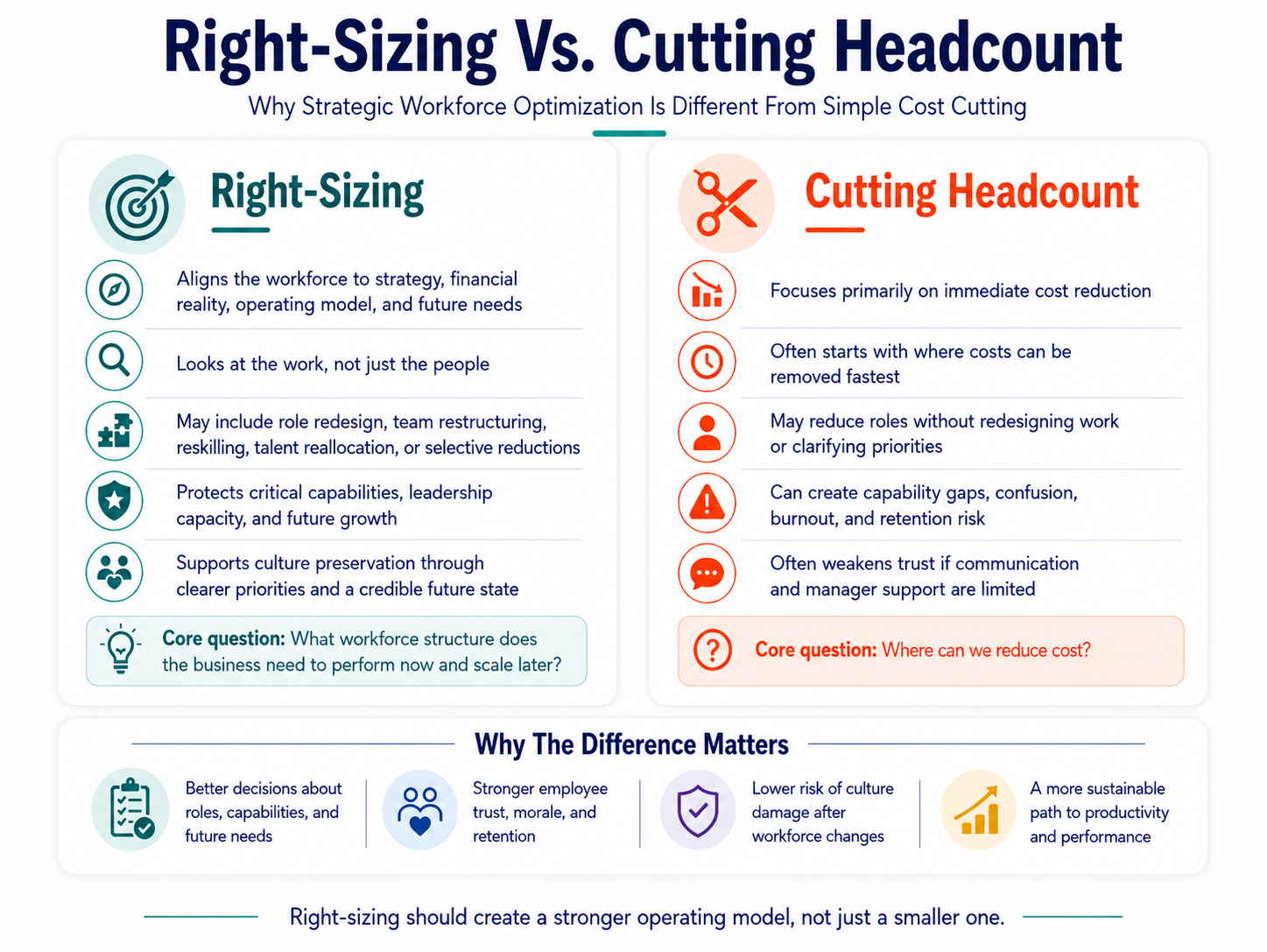
Right-sizing means aligning the workforce to the company’s current strategy, financial reality, operating model, and future needs. In some cases, that may involve workforce reduction. In others, it may involve restructuring roles, redesigning teams, eliminating duplicated work, or reallocating talent to higher-growth functions.

Layoff Mindset

“Where can we reduce costs?”

Right-sizing Mindset

“What workforce structure does the business need to perform now and scale later?”

That question leads to better decisions. It forces leadership to evaluate work, not just people. Effective workforce reduction HR strategies should consider:

  • Which roles are essential to current performance
  • Which capabilities will be needed over the next 12 to 24 months
  • Where work is duplicated, misaligned, or no longer strategic
  • Whether productivity issues are caused by headcount, process, systems, or leadership gaps
  • Which employees are critical to customer relationships or institutional knowledge
  • How changes will affect managers, remaining teams, and corporate culture

Right-Sizing vs Cutting Headcount Infographic - Why strategic workforce optimization is different from simple cost cutting

CULTURE RISK

How Does Right-Sizing Affect Corporate Culture?

Right-sizing affects corporate culture by changing how employees experience trust, security, leadership, communication, and fairness. Even employees who are not directly impacted will pay close attention to how decisions are made and how people are treated.

If the process feels rushed, unclear, or impersonal, employees may assume leadership does not value transparency or loyalty. If managers are unprepared, employees will receive inconsistent messages. If the remaining teams are left with more work and no operating changes, burnout increases. If high performers do not see a clear path forward, retention risk rises.

Psychological safety collapse

Survivors withdraw, stop speaking up, and default to self-protective behavior, halting innovation.

Informal network loss

The connective tissue that makes organizations function lives in people, not org charts.

Trust erosion velocity

Trust built over years degrades in weeks. Rebuilding it requires consistent, visible action, not messaging.

Tribal knowledge drain

Institutional memory walks out the door with every departure, especially in poorly targeted cuts.

“Culture is not what leaders say during a town hall. It’s what employees believe after watching leadership make difficult decisions.”

Right-sizing can weaken corporate culture when decisions appear arbitrary, employees hear rumors before leadership speaks, or remaining employees absorb more work without support. But right-sizing can also strengthen culture when leaders are honest, consistent, and disciplined. Employees may not like every decision, but they are more likely to trust the organization when the rationale is clear, the process is respectful, and the path forward is credible.

CULTURE PRESERVATION

How Do I Protect Our Company Culture During Layoffs?

Protecting company culture during layoffs starts before the announcement. The most important work happens in the planning process, where leadership defines the business case, decision criteria, communication strategy, manager support, and post-reduction operating plan.

HR leaders should guide executives through five core questions:

01
Why is this change necessary?
Employees need a clear explanation that connects the decision to business realities. Vague language creates anxiety. Honest, direct communication builds credibility.
02
How were decisions made?
Leadership should explain the criteria used to evaluate roles, functions, and business needs. Employees don't need every detail, but they do need to believe the process was thoughtful and fair.
03
How will impacted employees be treated?
Severance, benefits, transition support, references, timing, and respectful communication all matter. How a company treats departing employees sends a message to everyone who remains.
04
What happens to the work?
If roles are eliminated but work remains unchanged, employees will quickly lose trust. Right-sizing must include operating model adjustments, role clarity, and priority setting.
05
What is the future state?
Remaining employees need to understand where the company is going, what priorities matter most, and how their work contributes to the next chapter.
CORE PRINCIPLE

Culture preservation is not about making a difficult moment feel easy. It’s about making sure the organization acts with clarity, consistency, and respect.

COMMUNICATION STRATEGY

What is the Best Way to Communicate Layoffs Internally?

The best way to communicate layoffs internally is to be direct, timely, coordinated, and human. Employees should hear the message from leadership before rumors fill the gap. Managers should be prepared before they are asked to answer questions. Impacted employees should receive individual communication before broad announcements are made.

01
Cascade before you broadcast
Every affected manager must be briefed before any employee notification. Leaders who learn via Slack at the same moment as their teams never recover credibility.
02
Name the "why" with specificity
Vague strategy language reads as evasion. Name the specific business reality driving the decision. Executive alignment on the core message must happen first.
03
Separate affected from unaffected — fast
Ambiguity is psychological torture. Anyone who isn't directly impacted should know that within hours, not days.
04
Give departing employees a platform
Offer LinkedIn recommendations, alumni networks, and warm introductions. How you treat people on the way out defines you to everyone watching.
05
Commit to a 'no more surprises' moment
Leaders must make a credible commitment about what comes next. Overcommunicate the forward operating plan. Follow-up communication after the initial announcement is not optional.
DO NOT DO THIS

Do not announce reductions via email-only without a synchronous town hall within 24 hours. Do not use passive language (“positions were eliminated”). Do not let middle managers improvise; they need scripts, talking points, and real-time HR support.

CHRO LEADERSHIP

What CHROs Can Do During Layoffs To Help Employee Retention

Employee retention after layoffs depends on what the remaining employees experience next. The organization may have reduced costs, but now it must protect focus, morale, and performance. The CHRO’s role in workforce reduction includes helping the business stabilize after the decision and shifting quickly from notification to rebuilding.

Rebuild trust through transparency

Be honest about what is known, what is not, and when updates will be shared. Silence reads as bad news.

Reset priorities visibly

Clarify what work stops, what continues, and what becomes more important. Don’t operate as if nothing changed.

Enable managers at scale

Managers carry the culture after a reduction. Give them coaching, talking points, escalation paths, and space for team conversations.

Monitor engagement in real time

Pulse surveys, exit interview themes, and manager feedback reveal where morale is deteriorating before attrition spikes.

Identify flight-risk talent early

High performers become more open to outside opportunities after layoffs. Initiate retention conversations before they update their LinkedIn profiles.

Reconnect people to the future

Visible strategy, development opportunities, role clarity, and renewed investment in culture give people a reason to stay.

Rewrite career paths immediately

If roles changed, the development conversation must happen now — not at the next annual review cycle.

Recognize critical talent publicly

High performers need to feel seen in the new structure. Accelerate recognition cadence in the 90 days post-reduction.

THE RETENTION MATH

Losing one top-quartile performer post-reduction costs 1.5–2× their annual salary in replacement costs — and disrupts the very velocity you were trying to protect by right-sizing. Retention is not a soft KPI.

IMPLEMENTATION FRAMEWORK

A Strategic HR Playbook For Right-Sizing

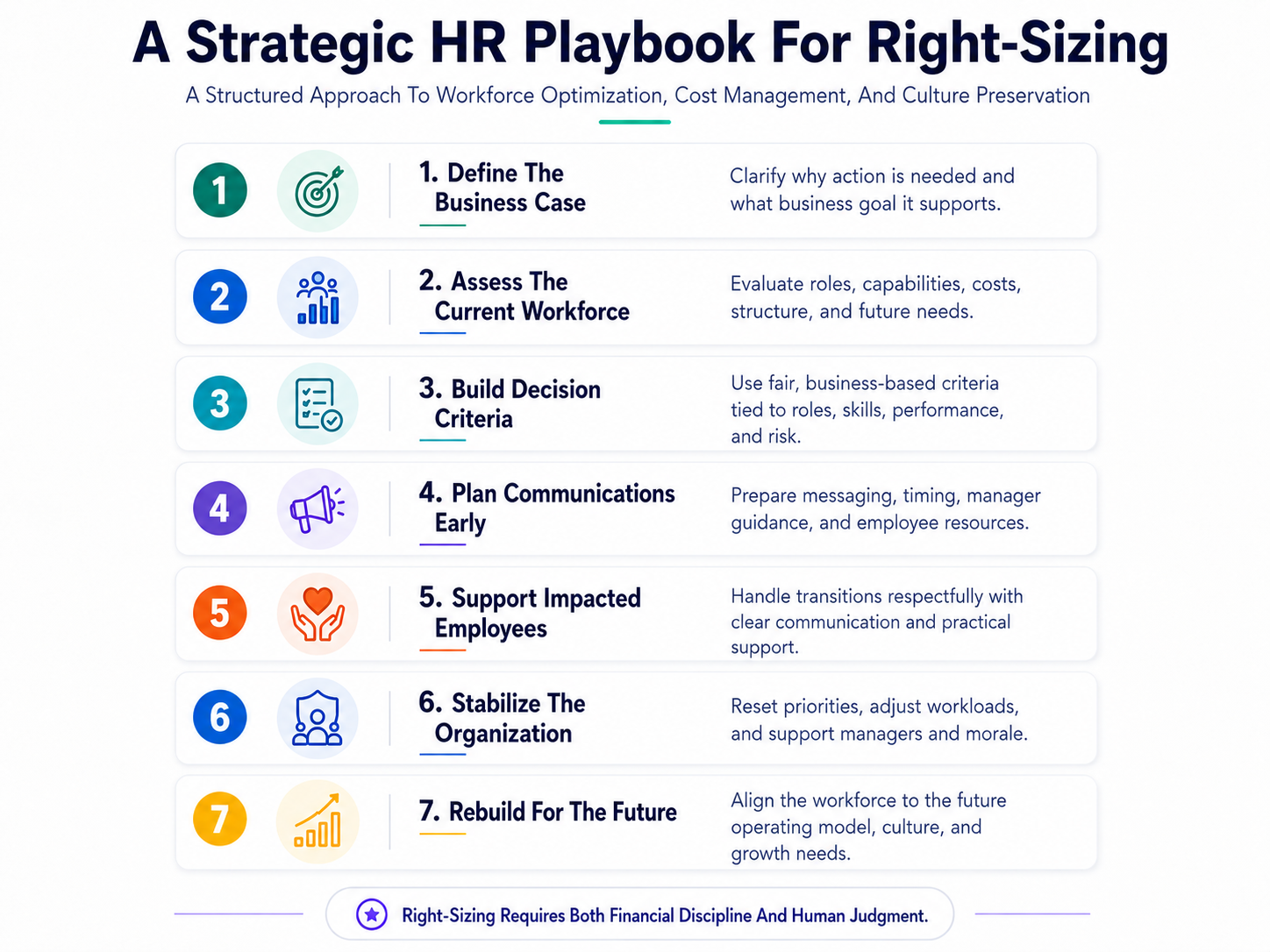
Right-sizing should be managed as a structured business process, not a reactive cost exercise. HR leaders can guide the organization through this practical seven-step playbook.

A Strategic HR Playbook for Right-Sizing Infographic

Define the Business Case
Be clear on why action is needed. Is the goal to reduce costs, improve productivity, prepare for a transaction, respond to demand changes, or redesign the operating model? The answer shapes the entire process.
Assess the Current Workforce
Evaluate roles, functions, spans of control, productivity, skills, costs, and future capability needs. Look for structural issues before jumping to reductions.
Build Decision Criteria
Criteria should be tied to business need, role requirements, skills, performance, and future priorities. HR must ensure the process is reviewed for fairness, consistency, and legal compliance.
Plan Communications Early
Don’t wait until decisions are final to build the communication plan. The message, timing, audiences, manager support, and employee resources should be developed in parallel.
Support Impacted Employees
How people exit matters. Severance, transition support, benefits guidance, and respectful communication all influence the broader employee experience and your employer brand.
Stabilize the Organization
After the reduction, leaders must clarify priorities, adjust workloads, monitor morale, and support managers. This is where most companies underinvest, and where culture damage typically grows.
Rebuilding For the Future
Right-sizing should create a stronger operating model, not just a smaller one. Define what capabilities, systems, roles, and leadership behaviors are needed in the next chapter.

01
Define the business case
Be clear on why action is needed. Is the goal to reduce costs, improve productivity, prepare for a transaction, respond to demand changes, or redesign the operating model? The answer shapes the entire process.
02
Assess the current workforce
Evaluate roles, functions, spans of control, productivity, skills, costs, and future capability needs. Look for structural issues before jumping to reductions.
03
Build decision criteria
Criteria should be tied to business need, role requirements, skills, performance, and future priorities. HR must ensure the process is reviewed for fairness, consistency, and legal compliance.
04
Plan communications early
Don't wait until decisions are final to build the communication plan. The message, timing, audiences, manager support, and employee resources should be developed in parallel.
05
Support impacted employees
How people exit matters. Severance, transition support, benefits guidance, and respectful communication all influence the broader employee experience and your employer brand.
06
Stabilize the organization
After the reduction, leaders must clarify priorities, adjust workloads, monitor morale, and support managers. This is where most companies underinvest, and where culture damage typically grows.
07
Rebuilding for the future
Right-sizing should create a stronger operating model, not just a smaller one. Define what capabilities, systems, roles, and leadership behaviors are needed in the next chapter.

The Questions HR and Executive Leaders Are Actually Asking

These are the four highest-volume search queries from HR and executive leadership teams navigating workforce reductions, each answered directly for fast reference.

How Do I Protect Our Company Culture During Layoffs?

Start before the announcement. Culture protection is not crisis communication; it’s pre-event design. Map your culture’s critical carriers (informal leaders, cross-functional connectors, values champions), protect them from indiscriminate cuts, and deploy them as anchors in the weeks that follow. Culture is behavioral, so prioritize preserving the rituals, feedback systems, and decision-making norms that make yours unique even as headcount contracts.

ABOUT GROWTH OPERATORS

How Growth Operators Helps Companies Right-Size With Discipline And Humanity

Growth Operators helps CEOs, CHROs, HR leaders, and executive teams make workforce decisions with the structure, experience, and execution support required in high-stakes moments. Through our Human Resources services, our experts support workforce planning, HR strategy, talent management, culture, compliance, change management, and scalable HR operations.

For organizations that need senior HR leadership during a transition, Growth Operators also provides Fractional and Interim Human Resources, including interim HR leadership during restructuring, a fractional CHRO to guide workforce strategy, or embedded HR expertise to stabilize the organization before, during, and after right-sizing.

Growth Operators’ nextLEVEL® framework adds structure to this work by evaluating people, process, and technology, identifying operational gaps, and building a practical roadmap for execution.

RIGHT-SIZING IS NEVER EASY.

But with the right HR strategies, it can be done in a way that protects the business without losing the trust, engagement, and corporate culture required to move forward. Contact Growth Operators to learn how our Human Resources services can support your next transition.


Exit Readiness Whitepaper

"*" indicates required fields

Full Name*