Ready to Build Something That Lasts?
We meet companies where they are, whether they’re navigating rapid growth, a transaction, a leadership gap, or an operational rebuild. Let’s talk about what you are solving for.

Succession planning is often treated like an HR exercise. A chart. A conversation about who might be ready someday. A plan that’s updated once a year and then filed away until a leader leaves.
That approach misses the point.
Succession planning is risk management. When critical roles aren’t covered, leadership transitions create operational drag, financial uncertainty, employee anxiety, and value leakage. The risk is not only that someone leaves. The risk is that too much knowledge, decision-making authority, customer context, financial discipline, and organizational trust are concentrated in too few people.
For CHROs, CFOs, CEOs, boards, and investors, leadership continuity should be managed with the same rigor as liquidity, compliance, cyber risk, and customer concentration. Because when the wrong leader leaves without a plan, the business can feel it quickly.
Revenue momentum slows. Forecasts become less reliable. Managers lose direction. Employees start asking questions. Buyers, lenders, and investors see instability. The cost is not always visible immediately, but it shows up in execution, confidence, and enterprise value.
That’s why HR and Finance need to jointly own succession planning.
Strong succession planning isn’t limited to naming replacements for senior executives. It’s the process of understanding which roles are critical to the business, where leadership risk exists, how ready the next layer of talent is, and what the organization needs to do before a transition creates disruption.
For middle-market companies, this work is especially important. Many organizations have grown around a small group of high-impact leaders who know the history, own key relationships, and make the business work day to day. That can be a strength, but it can also create risk.
You may be at risk if:
This kind of concentration is widespread. In SHRM research, 72% of organizations said they have at least one employee whose sudden departure would significantly disrupt operations.
Succession planning helps leadership teams identify those exposures before they become emergencies. It also helps create a stronger, more scalable business, whether the company is preparing for growth, a transaction, private equity investment, or the next generation of leadership.
Risk management protects enterprise value by reducing uncertainty around the company’s ability to perform. Buyers, investors, lenders, boards, and leadership teams all want confidence that the business can continue to operate, grow, and execute through change.
Leadership risk affects that confidence.
When succession planning is weak, the business may be overly dependent on a few individuals. That creates questions about continuity, scalability, and resilience. Can the company still hit the forecast if a key leader exits? Can the team execute the growth plan without the founder in every decision? Can Finance maintain reporting quality through a leadership transition? Can HR retain critical employees during a period of uncertainty?
Those questions matter because enterprise value depends on more than current performance. It also depends on the quality, durability, and transferability of that performance.
Risk management protects value by making the business less fragile. In the context of succession planning, that means:
When HR and Finance collaborate on this work, succession planning becomes more than a people initiative. It becomes a practical way to protect earnings quality, operating continuity, and buyer confidence.
HR sees the people risk. Finance sees the business impact. Succession planning gets stronger when both views are connected.
HR can identify leadership readiness, talent gaps, engagement risk, turnover trends, compensation issues, development needs, and organizational health. Finance can quantify the business impact of leadership instability, including the cost of turnover, productivity loss, missed growth targets, delayed initiatives, and increased transaction risk.
Together, HR and Finance can answer the questions that matter most:
This is where succession planning becomes cross-functional alignment. HR owns the talent strategy, but Finance helps make the case for investment, sequencing, and prioritization. The CFO can help quantify the impact of leadership development, retention planning, compensation alignment, or interim support. The CHRO can help ensure that financial decisions don’t create unintended talent risk.
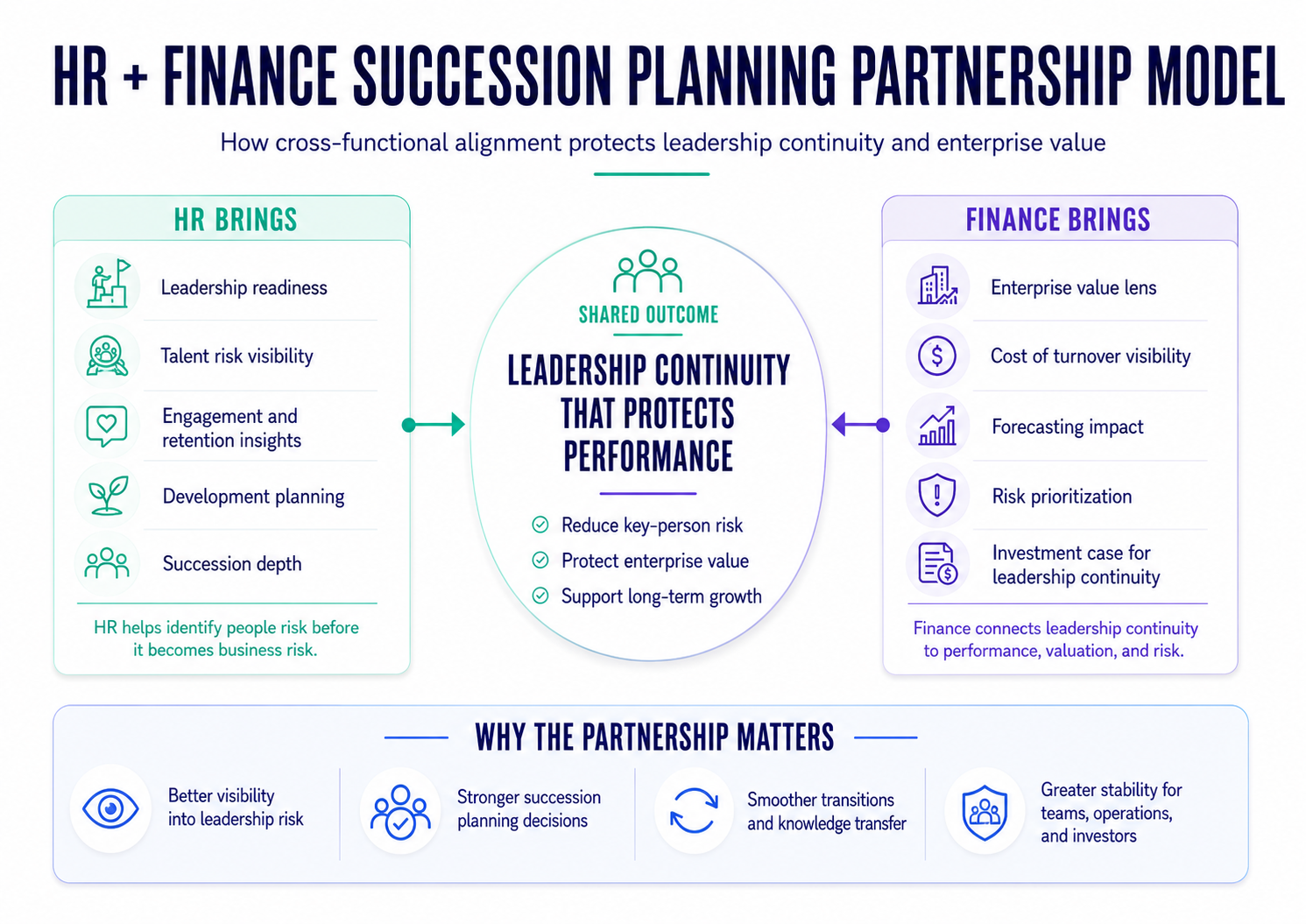
When the partnership works, the company gets a clearer view of both leadership readiness and business exposure.
HR advisory services can help with succession planning by bringing structure, objectivity, and execution support to an area that is often informal or underdeveloped. For many companies, the challenge is not that leaders don’t care about succession. It’s that no one has built a repeatable process for assessing readiness, developing talent, and managing leadership risk over time.
That gap is the norm, not the exception. SHRM’s 2024 data shows that only 21% of organizations have a formal succession plan in place, while 56% have none at all.
Growth Operators helps companies move succession planning from concept to operating discipline. That may include identifying critical roles, assessing leadership depth, building career paths, strengthening manager capability, improving retention strategies, and aligning talent decisions with business priorities.
Effective HR advisory services can support succession planning in several ways:
This is also where Talent Intelligence® can create value. Talent Intelligence® gives leadership teams a more objective view of leader readiness, team dynamics, succession risk, and whether the people in critical roles are prepared for the next stage of the business. For companies preparing for a sale, acquisition, or leadership transition, that visibility can be critical.
The concern is real: In Spencer Stuart’s 2024 director survey, 45% of directors said they worry they don’t have even one internal successor ready for a critical leadership role.
A strong team supports confidence. An unclear bench creates questions.
Fractional CFO services can protect enterprise value by providing companies with experienced financial leadership when they need greater visibility, better forecasting, and clearer insight into business risk. Succession planning is not only about who fills the role. It’s also about whether the business has the financial infrastructure to withstand leadership change.
A fractional CFO can help quantify the financial impact of succession risk and connect leadership continuity to performance. For example, they may evaluate how a key departure could affect forecasting, customer retention, cash flow, reporting quality, or transaction readiness. They can also help leadership teams understand where financial processes are overly dependent on a single person and where controls, reporting, or operating cadence need strengthening.
The numbers make the case. SHRM estimates that replacing a senior executive can cost three to four times the role’s annual salary once recruiting, lost productivity, and ramp-up time are counted.
Growth Operators’ Fractional and Interim Finance & Accounting services help companies stabilize finance leadership, improve visibility, and build stronger financial infrastructure without waiting for a permanent hire.
Fractional CFO services can support succession planning by helping companies:
The point isn’t to make Finance responsible for HR. The point is to make sure leadership risk is understood in financial terms. When the CFO and CHRO speak the same language, succession planning becomes much easier to prioritize.
A succession plan is only as strong as the knowledge transfer behind it.
If critical information remains trapped with a single leader, the company remains exposed even if a successor has been named. Middle-market companies often underestimate how much business knowledge is informal: customer history, pricing logic, employee context, vendor relationships, operational workarounds, reporting assumptions, and the reasons behind key decisions.
Knowledge transfer helps turn individual expertise into organizational capability.
That work should start before a leadership change is imminent. HR can help identify key roles and development needs. Finance can help prioritize roles tied most closely to enterprise value. Functional leaders can document processes, train successors, and clarify decision rights. Together, the company can reduce disruption before it happens.
The best transition plans are built while the business is still stable. Waiting until someone announces a departure compresses the timeline and increases risk.
Succession planning doesn’t need to start with a massive enterprise-wide initiative. It should start with the roles, risks, and business priorities that matter most.
CHROs and CFOs can begin by aligning on a few practical questions:
From there, the organization can create a focused roadmap. Some companies may need leadership development and retention planning. Others may need interim leadership, fractional CFO services, HR advisory services, or deeper assessment through a structured framework like nextLEVEL®.
The best plans are practical. They define ownership, timelines, communication, metrics, and follow-through. They also recognize that succession planning is not a one-time event. It’s an ongoing discipline that should evolve with the business.
Succession planning protects enterprise value by reducing the risk that leadership change becomes a business disruption. It gives companies more confidence, more options, and more control over the future.
For CHROs, it’s a way to connect talent strategy to business continuity. For CFOs, it’s a way to protect performance, visibility, and value. For CEOs, boards, investors, and advisors, it’s a signal that the business is built to last beyond any one leader.
Growth Operators helps companies build that kind of readiness. Through HR advisory services, fractional CFO support, and Talent Intelligence®, we help leadership teams identify risk, build capability, and protect the enterprise value they have worked hard to create.
If your company is growing, preparing for a transaction, navigating a leadership change, or simply trying to reduce risk before it becomes urgent, now is the time to view succession planning through a business lens.
Because leadership transitions will happen. The question is whether they will disrupt the business or prove how strong the business has become.
No matter where you are in the process, we can help you develop an Exit Readiness plan to maximize the value of your company and bring you to closing.
"*" indicates required fields