What Open Enrollment Reveals About Your HR Function That Nothing Else Will
|
Share:

Open enrollment tells the truth.
Not the version of the HR function that appears in leadership updates. Not the version documented in process maps. The real version. The one employees experience when they need clear answers, accurate data, working systems, responsive vendors, and confident HR support at the same time.
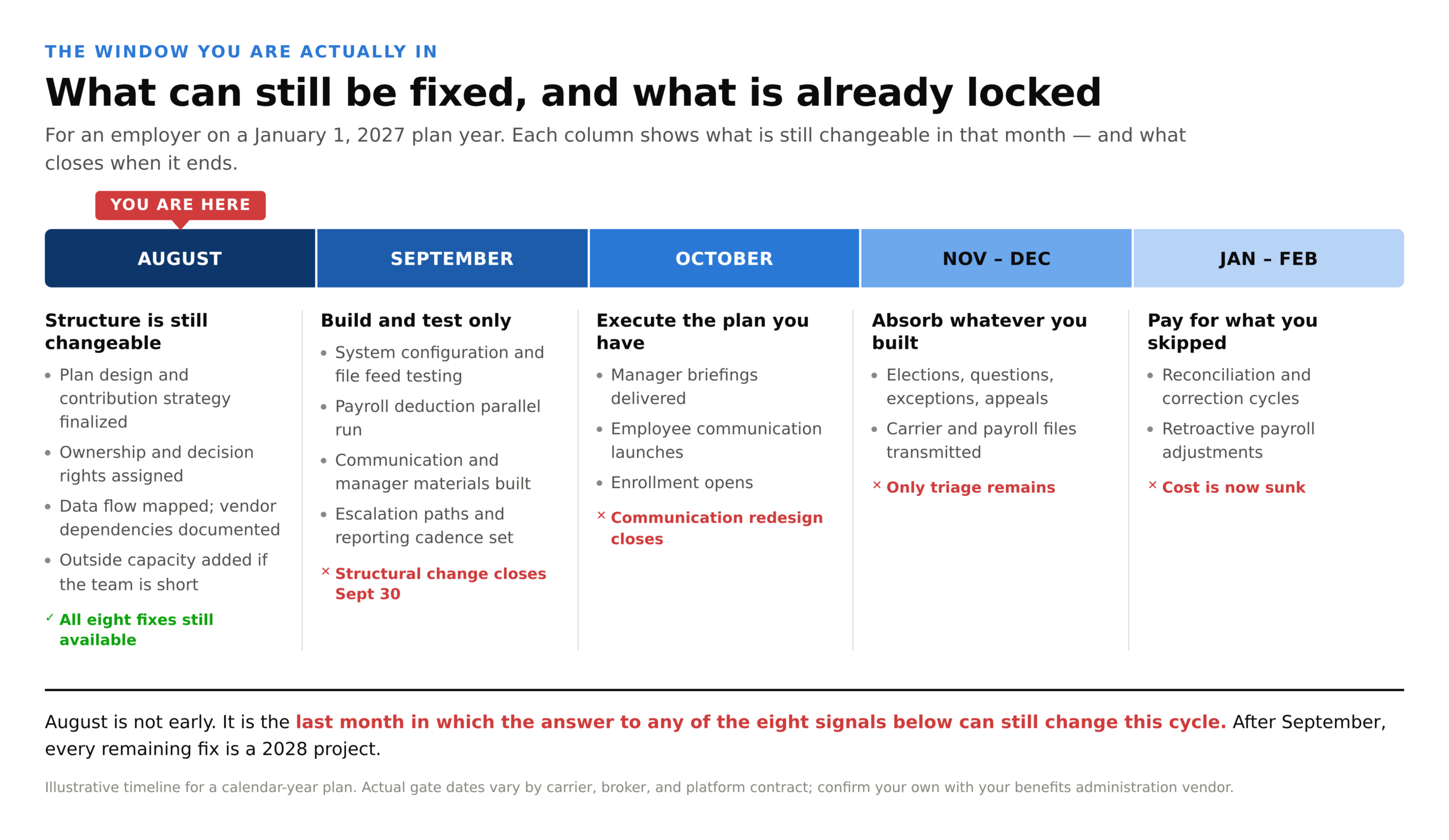
For many employers on a January 1 plan year, they finalize plan design in August and September. That means August is not early. It’s the last practical point when HR leaders can still fix the communication gaps, workflow issues, data problems, and ownership questions that will show up during open enrollment.
If your plan year begins January 1, 2027, the practical gate is September 30. Before that date, you can still change the structure of your HR open enrollment process. After that, you can only send messages and triage.
The stakes are also higher this year.
PwC projects the group medical cost trend to reach 9% in 2027, the highest in nearly two decades17 years, and that is the plan year your employees are about to enroll in, while SHRM, citing Mercer, reported that 66% of employers with more than 500 employees are likely or very likely to raise premiums next year.
Mercer’s own survey found that 48% of large employers also expect to change medical plan design, raising deductibles or copays. Most employees will therefore see two changes at once: what they pay, and what they get.
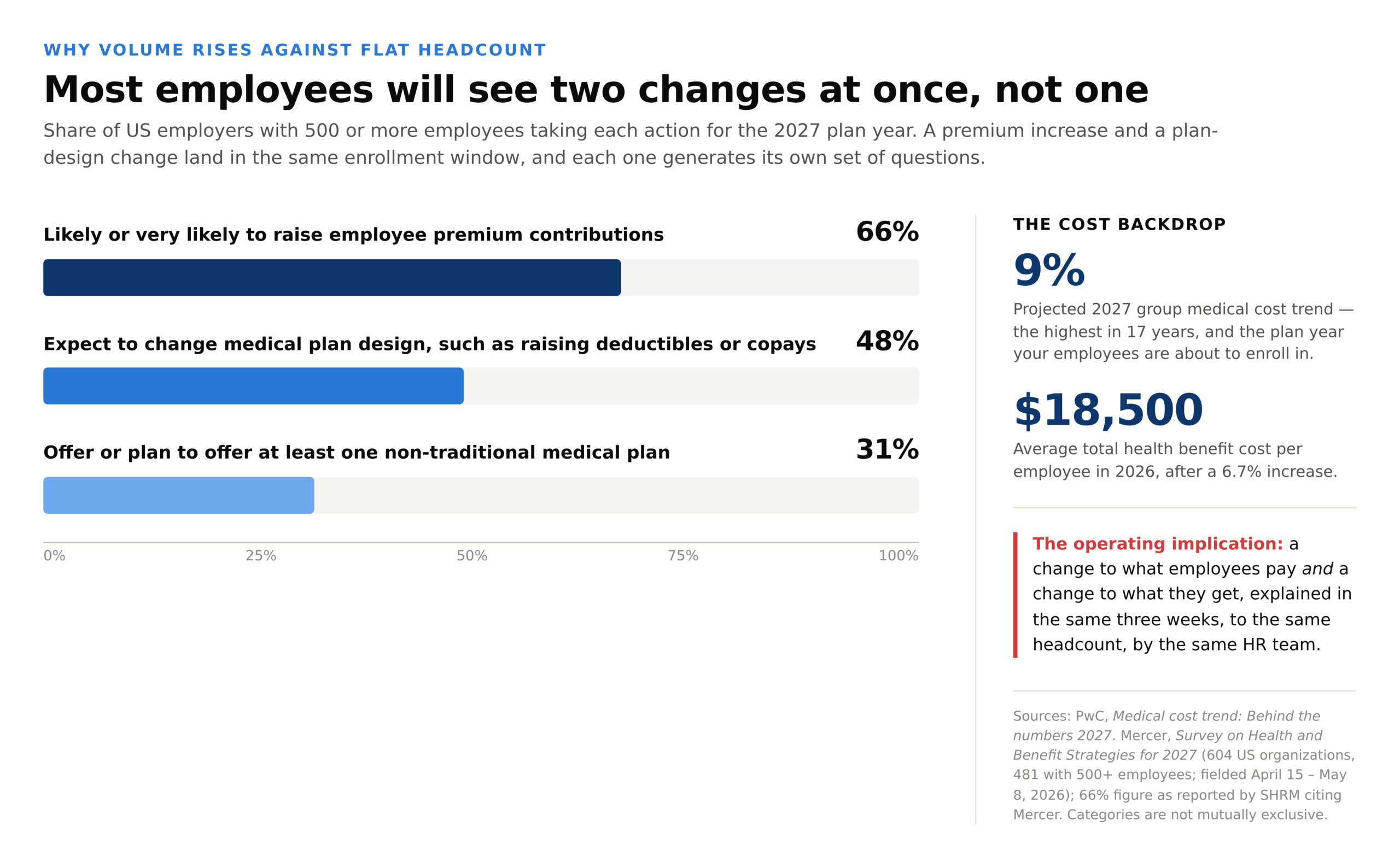
That combination matters. Higher costs, more plan changes, and more employee cost sharing will drive more questions, escalations, exceptions, and appeals. Against the same headcount, in the same three-week window, handled by the same team. That is the capacity math, and it does not improve with effort. If your HR open enrollment process already depends on heroic effort, this is the year that cracks get louder.
Open enrollment doesn’t create HR dysfunction. It exposes the dysfunction that’s already there, on a schedule you don’t control.
Open Enrollment is an HR Operating Model Test
Most open enrollment content reads like an HR open enrollment checklist: confirm plan design, update employee materials, schedule meetings, test the enrollment platform, send reminders, and reconcile elections.
That work matters. But the checklist isn’t the real diagnostic. The real diagnostic is what happens when the checklist meets the business.
- Do employees understand what changed?
- Does payroll trust the deduction file?
- Does the benefits vendor respond quickly?
- Can managers answer basic questions without creating confusion?
- Does HR know where the process stands at any moment, or is the team managing open enrollment from email threads and memory?
When open enrollment goes poorly, it’s rarely because HR didn’t work hard enough. It’s usually because the HR function carries structural issues that are manageable during normal weeks but become unavoidable under pressure.
That’s why CHROs, CEOs, and CFOs should pay attention. Open enrollment reveals whether the HR function has the structure, systems, capacity, and communication discipline required to support a growing business. The distinction between effort and capacity is not semantic, because the two have different fixes and different owners. More effort is free, and you’ve already spent it. More capacity headcount, structure, or systems costs money and requires a decision from someone above HR. Open enrollment is the one annual event that makes which of the two you are short of impossible to hide.
What Open Enrollment Can Reveal
|
If you’re seeing this |
What it indicates structurally |
What you can still do before September 30 |
|
Only the vendor knows how the file feed works |
Single point of failure in a critical process |
Require a written field map, feed schedule, and error-handling protocol — then have a named employee walk it back to you without the vendor on the call |
|
Employees ask the same questions every year |
Communication designed for compliance, not comprehension |
Rewrite the top five questions in plain language, leading with what changed and what it costs |
|
Reconciliation was still running in February |
Data governance between HRIS, payroll, and carriers is unowned |
Assign a named data owner per system and move the payroll parallel run to before enrollment closes |
|
Managers don’t know what to say |
The business has not been equipped with context |
One page of talking points and one escalation address, delivered before October |
|
Every exception becomes a fire drill |
Decision rights and escalation paths are undefined |
Write the rule for your five most common exceptions and name the decision-maker for each |
|
The platform works, but the workflow doesn’t |
No single owner across HR, payroll, IT, and vendors |
Name one accountable owner for the end-to-end timeline this week |
|
Leadership can’t see status in real time |
No operating cadence; reporting happens after the fact |
Stand up a one-page weekly status: completion, aged issues, payroll readiness |
|
Employees read benefits as a cost increase |
Only the price change is communicated, never the total value |
Pair every cost change with what the company still absorbs, in the same message |
|
No one has confirmed the 2027 affordability test |
Compliance exposure is being carried rather than managed |
Run the test against your lowest-cost plan and lowest-paid population before contribution strategy is locked |
|
There is a plan for the work but not for the surge |
Capacity is the constraint, and it has not been budgeted |
Decide now whether to add temporary capacity — after September, the decision is moot |
10 Failure Signals to Watch
A strong HR open enrollment process is observable. So is a weak one. Here are ten signals that tell you something deeper is happening inside the HR function.
1. Your Benefits Vendor is the Only One Who Knows How the File Feed Works
This isn’t just a vendor management issue. It’s a single-point-of-failure risk.
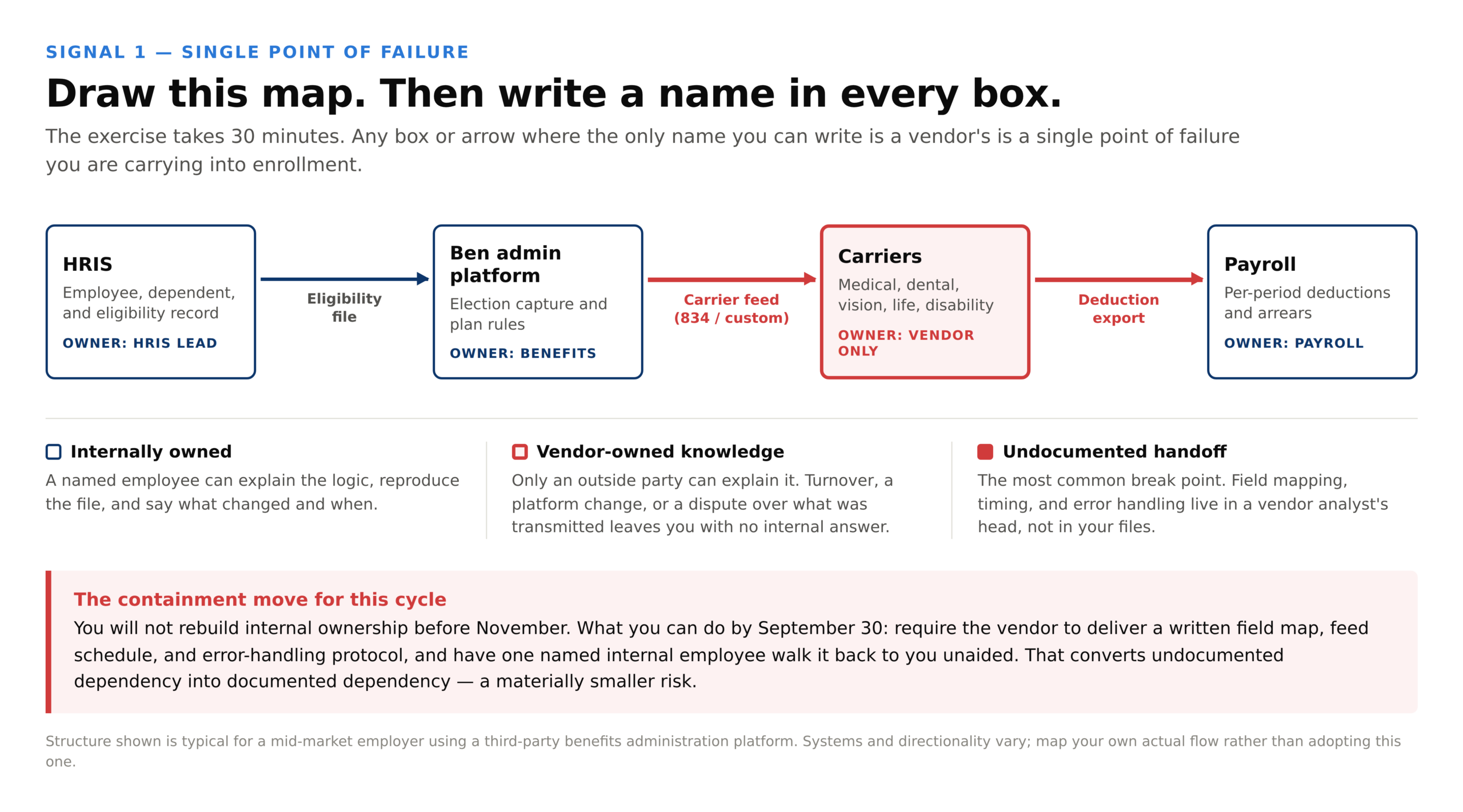
If no one inside the organization understands how data moves between the HRIS, payroll, benefits administration platform, carriers, and vendors, HR is depending on outside memory instead of internal processes. That creates risk during turnover, vendor changes, system issues, or disputes over what was sent and when.
You will not rebuild internal ownership of that file feed before November. What you can do before September 30 is convert an undocumented dependency into a documented one: require the vendor to deliver a written field map, a feed schedule, and an error-handling protocol, then have one named internal employee walk it back to you without the vendor on the call. If they can’t, you’ve found your risk — and you’ve found it while there is still time to put a second name on it.
2. Employees Ask the Same Questions Every Year
You may not realize it, but repeated questions are feedback.
If employees consistently ask what changed, what their options mean, how deductibles work, or why costs increased, the issue may be communication design, not employee attention. Data shows the size of that gap. In a 2026 survey of 622 US employees, 46% said they felt confident managing their benefits independently — but only 23% said they genuinely understood them.
Effective open enrollment communication strategies for HR managers start with one sentence per change: what changed, what it costs you, and what you need to do. Everything else supports that sentence.
A complete plan includes:
- Plain-language explanations of what changed and why
- Role-specific reminders for employees, managers, and executives
- Decision support that helps employees compare options
- Manager talking points for common questions
- Multiple communication formats, including email, meetings, FAQs, and self-service resources
3. HR Is Still Reconciling Enrollment Discrepancies in February
That points to broken data governance.
When deductions, carrier elections, dependent information, and payroll data don’t reconcile quickly, the problem is usually upstream. Data ownership is unclear. Systems aren’t integrated cleanly. File feed testing was incomplete. Manual corrections weren’t tracked.
The result is a painful cleanup period that distracts HR and frustrates employees.
The longer reconciliation drags on, the more open enrollment becomes a finance, payroll, employee experience, and compliance issue, not just an HR issue. A usable hard test: if last cycle’s reconciliation was still open after January 31, treat that as a structural finding rather than a busy season.
4. Managers Don’t Know What to Say
Open enrollment isn’t only an HR communication event. It’s a leadership communication event.
Managers don’t need to become benefits experts, but they do need to know what’s changing, where to send employees, and how to avoid giving inaccurate advice. If managers are surprised by employee questions, HR may not be equipping the business with enough context.
This matters most when plan costs rise. Employees will bring questions to the leaders they trust first, not always to HR.
5. Every Exception Becomes a One-Off Fire Drill
Some exceptions are unavoidable. Too many exceptions point to process design issues.
If HR is constantly handling late enrollments, missed communications, incorrect dependent information, special payroll cases, or eligibility confusion, the team may lack clear rules, decision rights, escalation paths, and documentation. That creates inconsistency and drains capacity.
6. The Enrollment Platform Works, But the Workflow Doesn’t
Technology can process elections without solving the whole problem.
How does HR manage open enrollment well? By putting one accountable owner in charge of connecting plan design, vendor readiness, employee communication, system configuration, payroll deduction testing, manager enablement, compliance, and post-enrollment reconciliation into one coordinated workflow.
If different people own those pieces without a shared timeline, open enrollment will feel harder than it should.
For a deeper look at HR systems and workflow readiness, our article, How to Leverage HR Technology in 2026, offers helpful context.
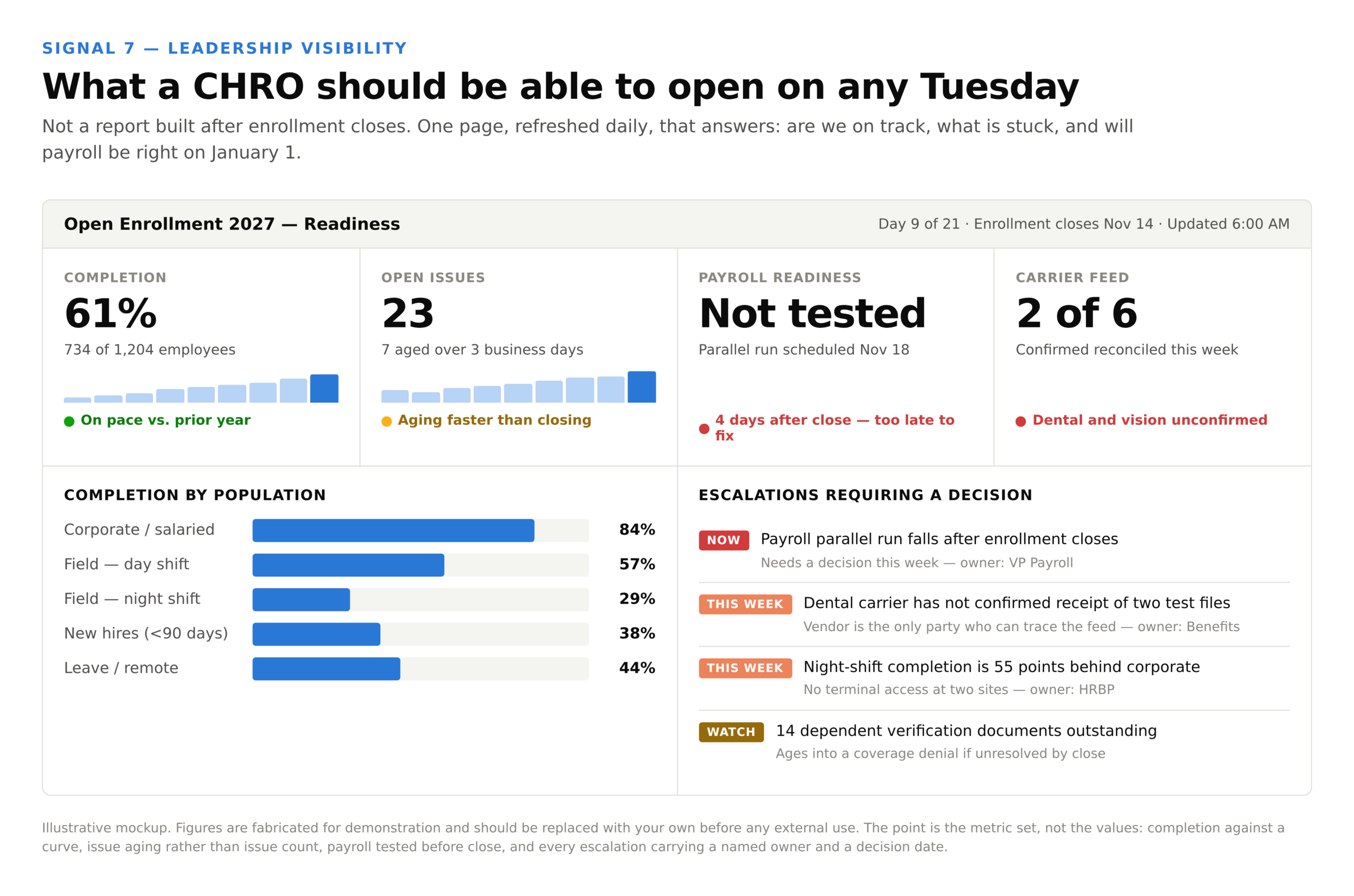
7. The Team Can’t Tell Leadership What’s Happening in Real Time
CHROs and CFOs need visibility during open enrollment. Not after it ends.
If HR can’t quickly report participation status, completion rates, unresolved issues, high-volume questions, vendor performance, and payroll readiness, the function may be missing basic operating cadence. Leadership doesn’t need noise. It needs visibility into risk.
A clean dashboard, a weekly status rhythm, and a defined escalation process can turn open enrollment from a scramble into a managed operating cycle. The metric set matters more than the tool: completion measured against a curve rather than a number, issue aging rather than issue count, payroll tested before enrollment closes rather than after, and every open escalation carrying a named owner and a decision date.
8. Employees Experience Benefits as a Cost Increase, Not a Company Investment
When costs rise, this becomes a major risk.
If employees only see higher premiums, higher deductibles, or new plan limitations, they may miss the broader investment the company is making in their well-being, financial security, and family needs. That can weaken trust and engagement, even as the company still absorbs high costs.
This is where benefits communication, total rewards, employee well-being, and retention strategy come together. Our article, Employee Well-Being as a Business Strategy, explores why support systems matter to performance and long-term value.
9. No One Has Confirmed the 2027 Affordability Test
This one has a deadline and a dollar figure attached.
For plan years beginning on or after January 1, 2027, the ACA affordability threshold rises to 10.22% of household income, up from 9.96% in 2026. That is the first time it has exceeded 10% since the law took effect. If your lowest-cost, self-only plan cleared affordability at 9.96% by a narrow margin, it may still clear at 10.22%, but you have to run the calculation against your lowest-paid population before locking in the contribution strategy.
If no one can tell you who ran that test and when, this is not a benefits detail that lives with the broker. It is an unowned compliance exposure heading into a plan year, and of everything on this list, it is the signal most likely to produce a number the CFO has to explain.
10. There Is a Plan for the Work, But No Plan for the Surge
Ask what happens if inquiry volume doubles in week two. If the answer is a name, the function is designed. If the answer is “we’ll get through it,” the function is staffed for a normal week and hoping.
This is the signal underneath the other nine. Every item on this list is survivable with enough individual effort, which is precisely why each one persists: the team absorbs the cost personally, leadership never sees a number, and the same conversation happens again next August. The constraint is not commitment. It is capacity and structure, and neither can be added in October.
The decisions that are still available in August are real ones: bring in temporary capacity, redistribute ownership across the function, or reduce the scope of what changes this year. By the time enrollment opens, none of them are.
How to Automate Benefits Enrollment and Open Enrollment Workflows
To automate benefits enrollment and open enrollment workflows, map the full process first- from plan design through post-enrollment reconciliation then automate only the steps that already have a defined owner, a defined rule, and a defined output. Automation shouldn’t start with the software. It should start with the workflow.
Before automating benefits enrollment and open enrollment workflows, HR leaders should map the full process from plan design through post-enrollment reconciliation. That includes employee eligibility, dependent verification, carrier connections, HRIS configuration, payroll deduction testing, communication triggers, reminder schedules, escalation paths, reporting, and audit documentation.
Once the workflow is clear, automation can reduce manual effort where structure already exists.
|
Workflow Area |
Automation Opportunity |
What Has to Be True First |
|
Employee reminders |
Triggered emails based on completion status |
A completion-status field that is actually accurate |
|
Eligibility rules |
Automated logic for employee groups and dependent coverage |
Written eligibility logic that HR and payroll both agree on |
|
File feeds |
Scheduled carrier and payroll file transfers with validation steps |
A validated field map with a named internal owner |
|
Reporting |
Real-time enrollment dashboards and issue tracking |
Agreement on what counts as an “issue” |
|
Reconciliation |
Exception reports that flag mismatches before payroll runs |
A defined tolerance for what counts as a mismatch |
The goal isn’t to remove HR from the process. The goal is to remove avoidable manual work so HR can focus on the decisions, communication, exceptions, and employee support that require judgment.
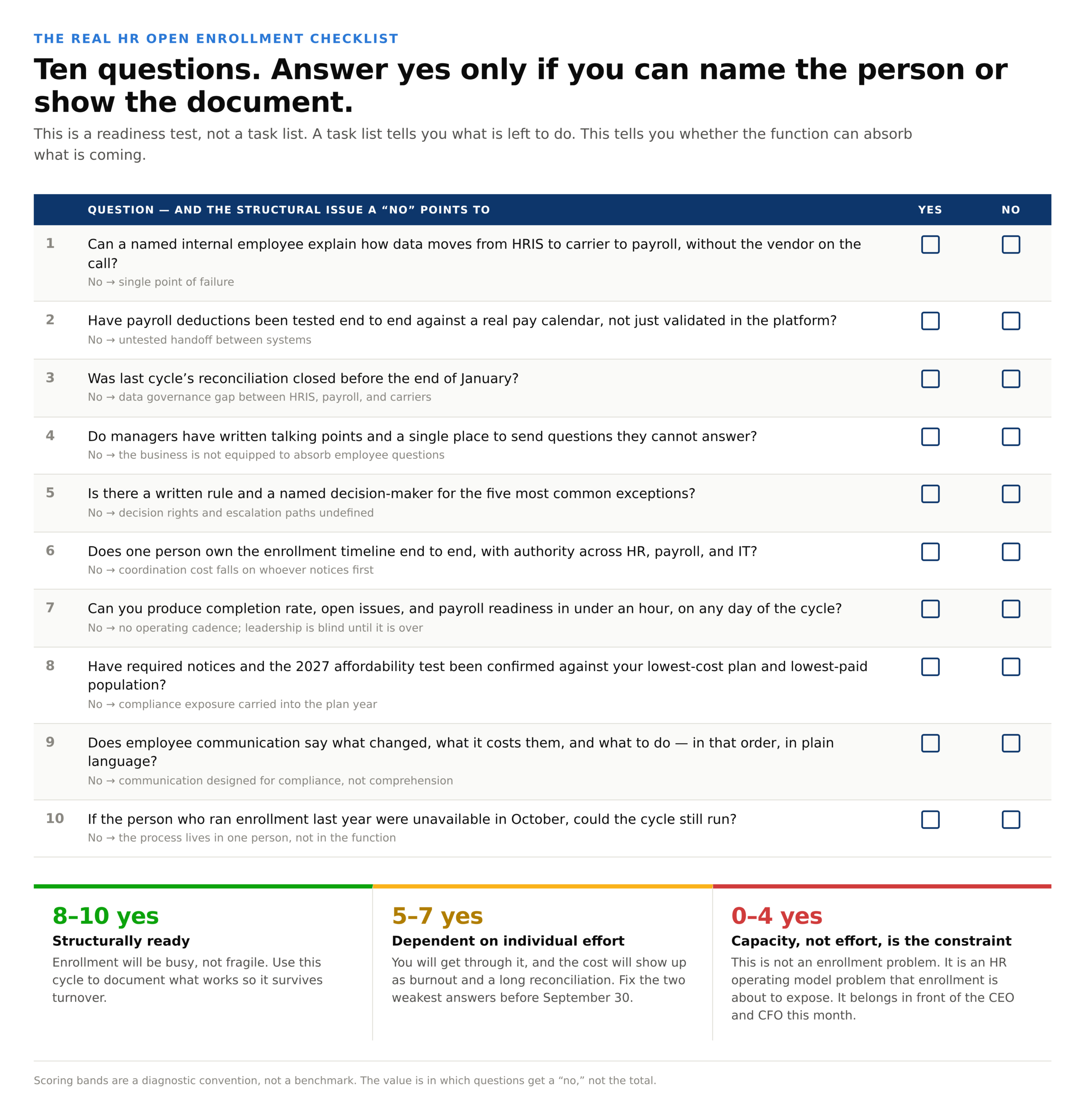
If the answers are unclear, the issue isn’t simply open enrollment. The issue is HR capacity, structure, and operating discipline.
That’s the conversation CHROs should bring to the C-suite. Open enrollment isn’t just an annual benefits event. It’s a diagnostic for whether HR has the infrastructure to support the business through cost pressure, workforce change, employee expectations, and growth.
Turn Open Enrollment Into a Stronger HR Function
Open enrollment will always be busy, but it shouldn’t always be chaotic.
With the right structure, systems, communication plan, vendor accountability, and leadership visibility, open enrollment becomes more than an administrative cycle. It becomes a chance to build trust, clarify value, improve employee experience, and strengthen the HR operating model.
Growth Operators helps companies get there. Our HR Growth Pros embed themselves in your organization to identify what’s not working and build the structure needed to move forward with confidence.
If your answers to those ten questions were mostly clear, you’re in reasonable shape. Use this cycle to document what works, so it survives the next turnover. If they weren’t, the constraint is structural, and the window to act for the 2027 plan year closes at the end of September.
Explore our HR Advisory Services, or ask us for an open enrollment readiness review. We’ll run these ten questions with your team, tell you which gaps are fixable before enrollment opens and which are honestly 2028 projects, and put it in writing.
How does HR manage open enrollment?
HR manages open enrollment by coordinating plan design, vendor readiness, HRIS configuration, employee communication, manager support, payroll testing, carrier data, and post-enrollment reconciliation. The strongest HR open enrollment process has clear owners, a defined timeline, tested systems, plain-language communication, and real-time visibility into completion rates, questions, exceptions, and data issues.
What should be included in an HR open enrollment checklist?
What are effective open enrollment communication strategies for HR managers?
How can HR automate benefits enrollment and open enrollment workflows?
When should a company consider HR advisory services for open enrollment?
When is it too late to fix open enrollment problems for a January 1 plan year?