Investing in Employee Development: A Financial Perspective
|
Share:

Employee development is often treated as an HR priority. It shows up in conversations about engagement, retention, manager capability, and culture.
All of that matters. But for financial leaders, employee development should also be understood as a capital allocation decision.
For HR leaders, that translation is the assignment. Development budgets rarely get cut because the idea is wrong. They get cut because the case arrives in HR language instead of financial language.
The question isn’t whether training sounds good. The question is whether the company can build the skills, leadership depth, and operating capability needed to hit the plan without over-relying on outside hires, overloading managers, or letting knowledge walk out the door.
That’s why a strong employee development plan belongs in the same conversation as productivity, margin protection, turnover costs, succession risk, and growth capacity. When it’s built well, employee development isn’t a soft investment. It’s an operating lever.
The CFO-level case for employee development is simple: Build the capability you need before the business pays more to replace it, rent it, or recover from not having it.
Why is Employee Development Important to Finance Leaders?
Employee development is important because skills have a shelf life, and that shelf life is getting shorter.
The World Economic Forum’s Future of Jobs Report 2025 found that employers expect 39% of workers’ core skills to change by 2030. The same report noted that, if the global workforce were 100 people, 59 would need training by 2030.
That’s not an HR trend. That’s a workforce capacity issue that affects forecasting, productivity, operating risk, and transformation readiness.
For finance leaders, the implication is direct. If the skills required to run the business are changing, then the cost of not developing employees will show up somewhere. It may show up as:
- Slower execution
- Higher contractor spend
- Weaker manager capability
- More turnover
- Missed automation opportunities
- Difficulty scaling without adding disproportionate headcount
That’s why employee development strategies should be evaluated like any other investment: by the business risk they reduce and the future capability they create.
The Financial Case: Make Money, Save Money, or Reduce Risk
Finance leaders don’t need HR to prove that employee learning is good. They need HR to show what the investment changes. A practical CFO filter is whether the initiative helps the company.
|
CFO Lens |
What Employee Development Can Improve |
|---|---|
|
Make money |
Sales capability, customer retention, leadership effectiveness, productivity |
|
Save money |
Turnover reduction, faster onboarding, less rework, fewer outside hires |
|
Reduce risk |
Succession readiness, compliance, knowledge transfer, manager capability |
LinkedIn’s 2025 Workplace Learning Report makes a similar point: learning and talent development leaders need to connect initiatives to whether they help the company make money, save money, or mitigate risk. The report also notes that engagement and retention are common ways organizations measure the business impact of career development.
That framing matters. An employee development plan that says “we want to provide more training” is easy to cut. One that says “we need to reduce first-year manager turnover, improve time-to-productivity for new hires, and build successors for three critical finance and operations roles” is much harder to dismiss.
The Productivity Argument: Learning Has to Change the Work
Employee learning and productivity connect only when training ties directly to the work employees actually do.
That’s where many development programs lose finance leaders. They’re too broad, too disconnected from operating priorities, or too difficult to measure. A better approach starts with the work that needs to improve.
For example:
- If close cycles are slow: develop process discipline, systems fluency, and controller bench strength.
- If managers are overwhelmed: invest in delegation, coaching, prioritization, and communication.
- If automation tools are underused: train employees on the workflows, not just the software.
- If succession risk is high: build role-specific development paths tied to critical positions.
- If customer experience is inconsistent: develop frontline decision-making and manager accountability.
Gallup has found that organizations could realize an estimated 18% increase in profit and a 14% increase in productivity by doubling the proportion of employees who feel they have opportunities at work to learn and grow. Gallup also reported that, in 2024, less than half of U.S. employees participated in education or training for their current job.
That gap is the opportunity.
The finance takeaway: Learning only compounds when it’s connected to execution. Training hours alone don’t create value. Better capability applied to business-critical work does.
The Retention Argument: Development Can Be Cheaper Than Replacement
When employees can’t see a future inside the company, they’re more likely to look outside it. That creates a direct financial issue.
Gallup estimates that:
- Replacing leaders and managers costs around 200% of salary
- Replacing technical professionals costs about 80% of salary
- Replacing frontline employees costs about 40% of salary
And that doesn’t include unmeasured losses in morale and institutional knowledge. That’s why development opportunities for employees should be part of the turnover conversation.
Compensation matters, but employees also want a path. SHRM notes that nearly a quarter of employed adults in highly rated workplace cultures cited a lack of career opportunities as the top reason they were seeking to leave, and 65% of employers rated professional and career development benefits as very or extremely important in SHRM’s 2025 Employee Benefits Survey.
The benefits of training to employees are clear: more confidence, more mobility, clearer career paths, and stronger readiness for the next role. The benefits to the business are just as important: stronger retention, less disruption, deeper leadership, and less pressure to buy every capability externally.
How to Support Employee Career Development Without Overbuilding It
A development program doesn’t need to be complicated to work. In fact, the best employee development strategies are usually practical, role-specific, and tied to the business plan.
For finance leaders reviewing the investment, ask: What capability are we trying to build, and where will it show up in the business?
A strong employee development plan should include:
- Critical roles: Which positions create the most operational or financial risk if they’re vacant or weak?
- Current capability: What skills do employees have today?
- Future capability: What skills will the business need in the next 12 to 36 months?
- Development opportunities: What experiences, training, mentoring, or stretch assignments will build those skills?
- Metrics: How will we know whether the investment worked?
What Are Development Opportunities for Employees?
Development opportunities for employees can include formal training, manager coaching, mentorship, cross-functional projects, internal mobility, certifications, job shadowing, leadership programs, succession planning, and on-the-job stretch assignments.
LinkedIn’s 2025 report found that career development champions are more likely than non-champions to offer career-enhancing gig opportunities or project-based learning, and it connects mature career development practices with stronger indicators of business success.
For CFOs, that matters because project-based learning is often easier to tie to ROI than standalone training. Employees learn while improving a real process, solving a real problem, or preparing for a role the company already needs filled.
How to Invest in Employee Development Like a Finance Leader
Don’t fund employee development on instinct alone. It should be sequenced.
The Association for Talent Development reported that organizations spent an average of $1,283 per employee on workplace learning in 2023. ATD’s 2025 State of the Industry findings reported 13.7 formal learning hours used per employee and $1,254 in average direct expenditure per employee in 2024.
Those benchmarks are helpful, but they shouldn’t become the goal. Spending more doesn’t automatically mean developing better capability.
A finance-minded investment approach should look more like this:
|
Investment Question |
CFO-Level Translation |
|---|---|
|
Who needs development? |
Which roles carry the highest value or risk? |
|
What skills matter most? |
Which capabilities affect execution, productivity, or growth? |
|
What will it cost? |
What’s the full cost of training, time, tools, and support? |
|
What will it prevent? |
What turnover, rework, delay, or outside hiring could we avoid? |
|
How will we measure it? |
What business metric should move? |
HR and Finance should work together here. HR can define the capability gaps. Finance can help quantify the cost of those gaps and prioritize investment. When HR brings the capability gap, and Finance brings the cost of that gap, the ask stops being a budget line and starts being a business case.
Where Development Investments Go Wrong
Employee development often underperforms for predictable reasons.
The most common failure is treating development as an activity instead of a business outcome. A training calendar is not a strategy. A learning platform is not a workforce plan. A leadership program is not automatically succession planning.
Development investments also fail when:
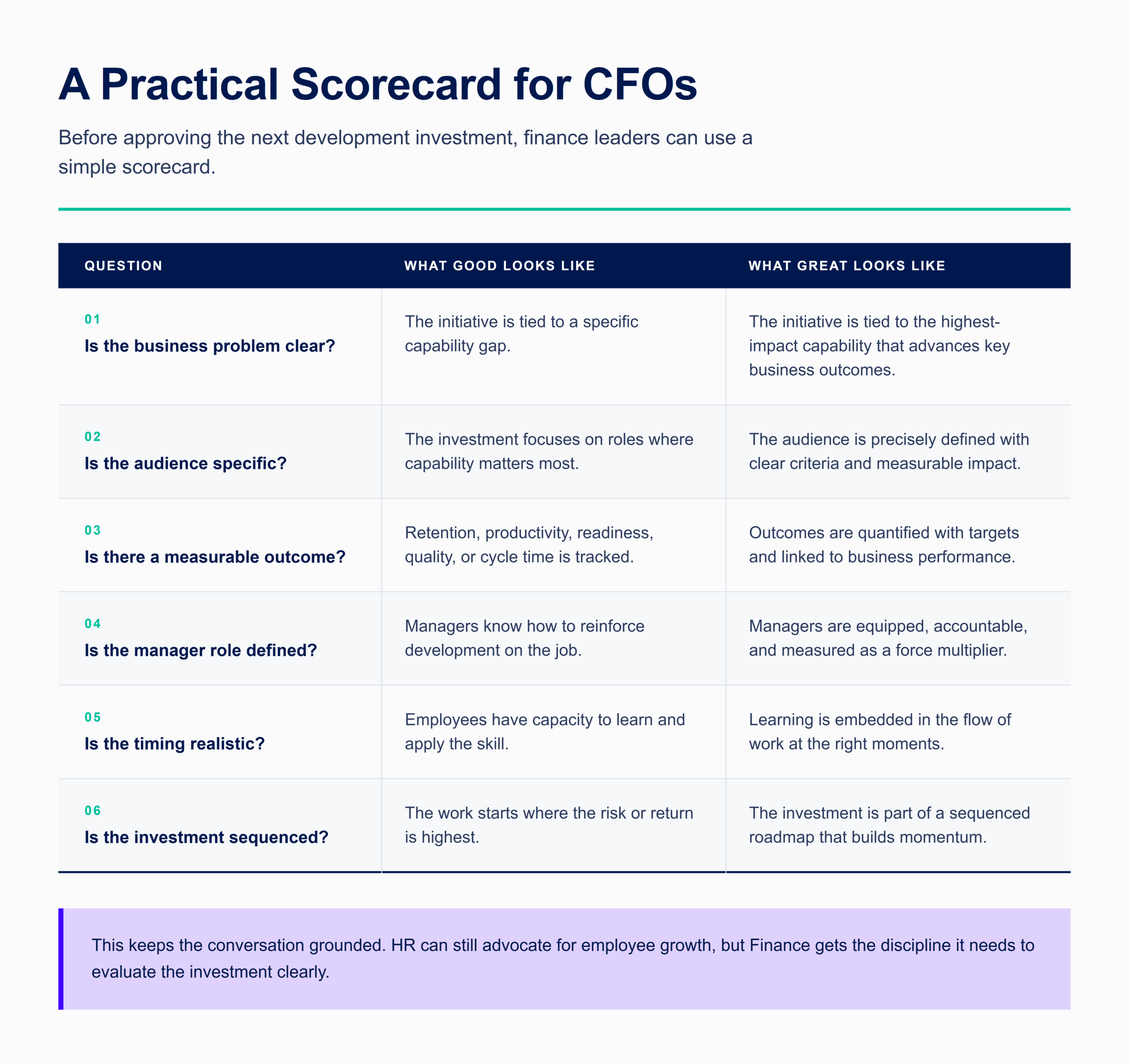
- The business problem is unclear.
- The target audience is too broad.
- Managers aren’t equipped to reinforce the learning.
- Employees don’t have time to apply new skills.
- Success is measured by attendance, not performance.
- Finance only sees the cost, not the avoided risk.
That’s why we often encourage leadership teams to start with the operating plan. If your company is preparing for growth, transaction readiness, system implementation, AI adoption, or leadership transition, your employee development plan should support those priorities directly.
For related thinking on tying people strategy to performance, our article on Employee Well-Being as a Business Strategy offers helpful examples of how people investments can support stronger business outcomes.
Build Capability Before You Have to Buy It
Employee development is important because companies can’t scale on today’s skills forever. They need people who can learn, lead, adapt, and take on the next version of the business.
Why invest in employee development? Because capability is almost always cheaper to build early than to buy under pressure.
For CFOs, the financial perspective is straightforward. Investing in employee development can reduce turnover risk, improve productivity, strengthen succession planning, support transformation, and protect institutional knowledge. It can also help avoid the more expensive path: waiting until a capability gap becomes urgent, then trying to hire or outsource your way out.
Growth Operators helps companies make those decisions with clarity. Through Human Resources Advisory and Finance & Accounting Consulting, we help leadership teams connect people investments to business priorities, financial performance, and long-term value creation.
Talent Intelligence® gives leadership teams a clearer view of leadership readiness, bench strength, and people-related risk. Pairing that insight with finance discipline helps companies decide where development dollars should go first.
If your organization is ready to build stronger capability, reduce talent risk, and make employee development a more disciplined business investment, Growth Operators can help you turn the plan into measurable progress. Contact us today to get started.
Why is employee development important?
Employee development is important because the skills a business runs on change faster than its headcount plan. The World Economic Forum expects 39% of workers’ core skills to shift by 2030. Left unaddressed, that gap resurfaces as slower execution, higher contractor spend, turnover, and reduced ability to buy capabilities at market rates.
How do you invest in employee development?
How do you support employee career development?
What are development opportunities for employees?