Building a Culture of Continuous Learning: How to Future-Proof Your Workforce for Growth
|
Share:

For many organizations, learning still happens in bursts. A new manager training here. A compliance module there. A leadership workshop when turnover starts making everyone nervous.
But that’s not a learning culture. That’s a reaction.
Creating a learning culture in the workplace means building an organization where employees, managers, and leaders are expected to grow with the business. Skills are developed before they become constraints. Talent development is tied to strategy. And learning isn’t treated as an annual program, but as part of how work gets done. A future-ready workforce is the result: one whose skills, leadership bench, and structure match where the business is heading, not only where it is today.
PwC’s 2025 Global Workforce Hopes and Fears Survey reinforces the connection between learning and employee motivation. Workers who feel supported to upskill are 73% more motivated than those who receive the least support. Yet only 56% of workers surveyed said they learned new skills at work in the past year that are helping their careers, and just 51% of non-managers said they have the resources they need for learning and development.
For HR leaders, that gap underscores the importance of continuous learning in the workplace: employees need visible pathways to build skills, apply them on the job, and understand how their development connects to where the business is going.
Doing that consistently takes more than good intent. It takes visibility into which skills the business already has, where readiness is thin, and which gaps will be most expensive to leave open — which is where assessments and talent data come in.
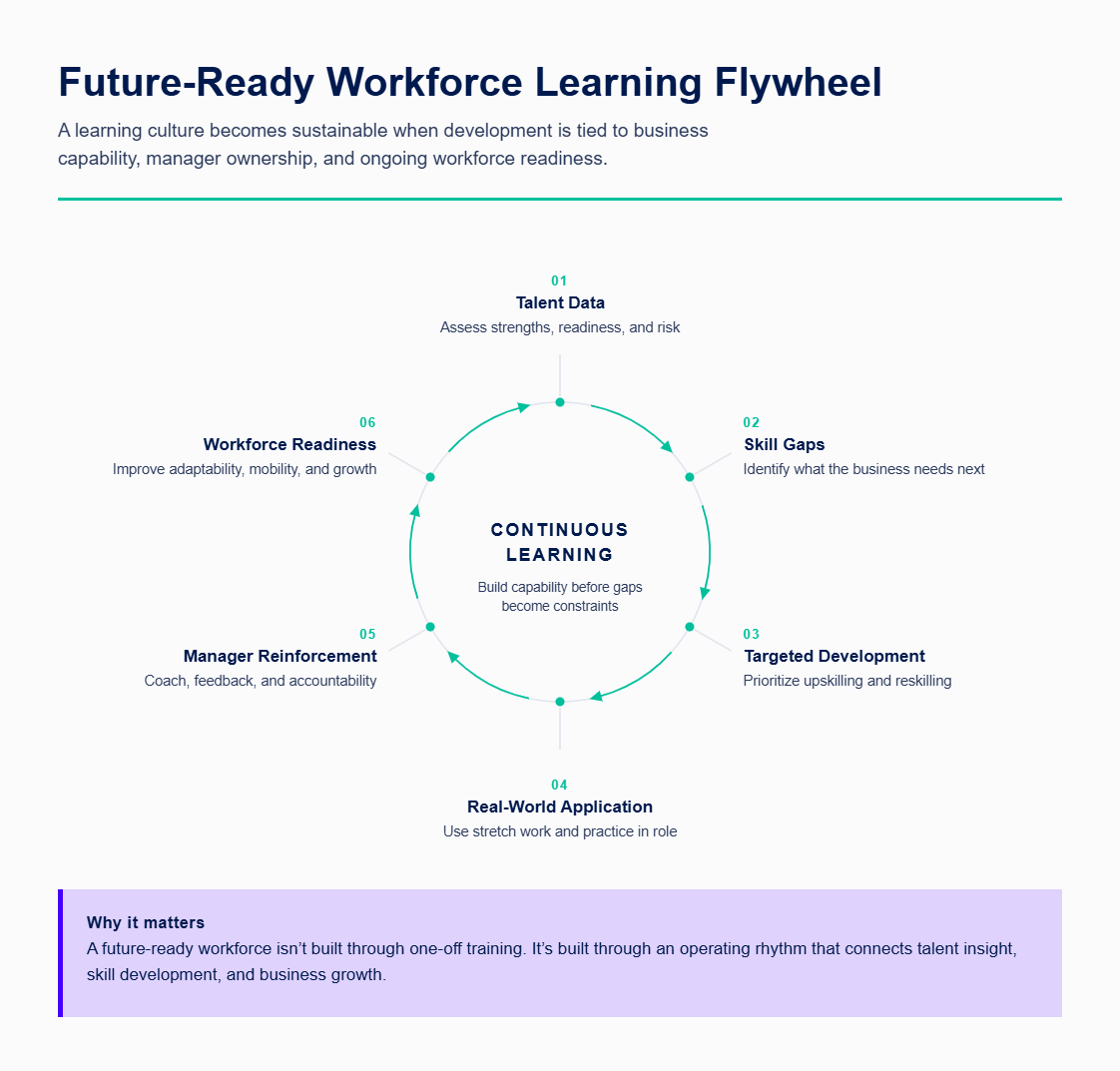
A future-ready workforce isn’t built by sending people to training once a year. It’s built by connecting learning to the capabilities the business will need next.
Why Continuous Learning Belongs in the Business Strategy
Continuous learning is often framed as an employee benefit. It is, but that’s only part of the story. Learning also affects retention, productivity, succession planning, internal mobility, transformation readiness, and leadership depth.
Deloitte’s 2025 Global Human Capital Trends research found that 66% of managers and executives say most recent hires weren’t fully prepared, with experience being the most common gap. For HR leaders, that’s a clear signal: companies can’t only hire their way into readiness. They need employee training and development systems that help people build experience, apply skills in context, and grow with the business.
That’s a business issue. If employees don’t see growth opportunities, they’re more likely to disengage or leave. If managers don’t develop, teams stall. If the company doesn’t build critical skills internally, it pays more to hire, outsource, or recover from the gap later.
A strong learning culture helps answer three questions leadership should care about:
|
Business Question |
Learning Culture Answer |
|---|---|
|
Can we execute the next stage of growth? |
Employees are building the skills the operating plan requires. |
|
Can we retain and develop key talent? |
People see growth opportunities for employees inside the company. |
|
Can we adapt when the business changes? |
Upskilling and reskilling are built into the rhythm of work. |
Upskilling and Reskilling Need a Clear Business Case
Upskilling and reskilling are not interchangeable.
- Upskilling helps employees build greater skills for their current or likely next role.
- Reskilling helps employees move into different roles as business needs change.
Both matter, but companies should use them intentionally.
For example, a company implementing new systems may need to upskill finance, HR, and operations teams so employees can use new workflows effectively. A company changing its service model may need to reskill employees whose current responsibilities are becoming less relevant. A company preparing for growth may need to build manager capability before span of control becomes a problem.
The best employee training and development investments start with the business need:
- What capability will the company need in the next 12 to 36 months?
- Which roles are most critical to that capability?
- Which employees have the potential to grow into those needs?
- What development opportunities will build the skill through real work?
- How will we know the investment is working?
This is how companies invest in long-term employee growth at scale. They don’t just buy a learning platform and hope people use it. They identify priority capabilities, build development into roles, equip managers, and measure whether skills are improving performance.
How to Improve Employee Growth and Development
Employee growth improves when organizations make development visible, practical, and connected to opportunity.
Randstad’s Workmonitor 2026 shows that employees are already responding to rapid changes in the workplace: 65% of employees recognize the need to upskill, and 52% are actively seeking opportunities to future-proof their skills on their own. The research also highlights the value of learning through the people around us. At least 78% of workers say they learn soft skills from older colleagues, while 72% say they learn technology and AI skills from Gen Z and Millennial coworkers.
That means development opportunities for employees shouldn’t be limited to formal courses. Cross-generational mentoring, stretch assignments, peer learning, coaching, and collaborative projects can all help companies embed learning into everyday work.
Practical development opportunities for employees may include:
- Stretch assignments tied to real business priorities
- Cross-functional projects that build broader business understanding
- Manager coaching and feedback rhythms
- Mentorship or sponsorship programs
- Role-based learning paths
- Job shadowing and internal mobility
- Certifications or technical skill development
- Leadership readiness assessments
The most effective programs don’t separate learning from work. They use work as the learning environment.
Talent Data Turns Learning Into a Growth Strategy
A learning culture becomes much stronger when talent data guides it.
Without data, development often goes to the loudest request, the most visible leader, or the most generic training need. With the right assessments, HR can identify where capability exists, where readiness is thin, and where the organization relies too heavily on a few individuals.
That matters because continuous learning should not be evenly distributed. Prioritize it based on business risk and growth potential.
Talent data also matters because leadership readiness is often thinner than companies realize. DDI’s Global Leadership Forecast 2025 found that only 20% of CHROs say they have leaders ready to fill their most critical roles. That makes assessments, succession visibility, and targeted development essential for building a future-ready workforce.
For example:
|
Talent Signal |
What It May Tell HR |
|---|---|
|
Low bench strength in critical roles |
Succession planning needs immediate attention. |
|
High manager strain |
Leadership development and role clarity may be needed. |
|
Low internal mobility |
Career paths may be unclear or underdeveloped. |
|
Skills gaps in growth areas |
Upskilling or reskilling should align with strategy. |
|
Engagement risk among high performers |
Growth opportunities may not be visible enough. |
This is where firms that help align workforce structure with future growth can create meaningful value. The work isn’t just training design. It’s understanding what the business is trying to become and whether the workforce structure, leadership capability, and talent pipeline can support that future.
For a related perspective, our article on Employee Well-Being as a Business Strategy explores how people strategy connects to performance, retention, and long-term value.
How Companies Invest in Long-Term Employee Growth at Scale
Scaling learning requires structure. Otherwise, employee training and development becomes fragmented, inconsistent, and hard to measure.
ManpowerGroup’s 2026 Talent Shortage Survey found that 72% of employers report difficulty filling roles, only slightly improved from 74% the prior year. That persistent hiring challenge is exactly why companies need to invest in long-term employee growth at scale. When external talent is hard to find, internal upskilling, reskilling, career pathing, and manager development become practical business strategies, not just HR programs.
The challenge is not whether companies believe development matters. The challenge is whether they can make it repeatable.
A scalable learning culture usually includes five building blocks:
1. A Clear Capability Map
HR and business leaders should define which capabilities the organization needs now and which ones it will need next. This helps avoid investing in training that feels useful but doesn’t support the business plan.
2. Manager Ownership
Managers drive day-to-day employee growth. If managers aren’t equipped to coach, give feedback, and connect people to opportunities, learning stays theoretical.
3. Embedded Learning
Employees need time and context to apply new skills. Project-based learning, stretch assignments, and workflow-based training often create better business connections than classroom learning alone.
4. Measurement That Matters
Attendance isn’t enough. HR leaders should measure learning through readiness, retention, internal mobility, productivity, quality, cycle time, engagement, or other business-relevant outcomes.
5. Executive Alignment
Continuous learning must be tied to strategy, budget, and workforce planning. If it isn’t, it will be one of the first things reduced when pressure rises.
Where Learning Cultures Break Down
Most organizations don’t struggle with learning because people dislike growth. They struggle because learning isn’t connected to how the business operates.
Common breakdowns include:
- Training is available, but employees don’t have time to use it.
- Managers support development in theory, but not in their weekly rhythms.
- Learning content isn’t tied to role expectations or career paths.
- HR lacks data on skill gaps, readiness, or bench strength.
- Development programs are measured by completion instead of business impact.
- Employees don’t see how learning creates real advancement.
That is why building a learning culture in the workplace takes more than content. It requires structure, expectations, and follow-through.
Build a Future-Ready Workforce Before Your Business Needs One
A future-ready workforce isn’t built at the moment your business realizes it has a skills gap. By then, your company is already reacting.
The better path is to build learning into the culture before the pressure hits. That means using talent data to understand readiness, investing in employee training and development that supports the business plan, creating growth opportunities for employees, and giving managers the tools to reinforce learning every day.
For CHROs and HR leaders, this is the real opportunity. Continuous learning can help your organization retain talent, build leadership depth, improve adaptability, support transformation, and align workforce structure with future growth.
Growth Operators helps companies make that work practical. Through Human Resources Advisory, Talent Intelligence® data, and workforce planning, we help organizations assess where they are, identify what capability they’ll need next, and build people strategies that actually support growth.
If your organization is ready to strengthen its learning culture and build a workforce that can keep pace with the business, connect with our HR Advisory team today to start the conversation.
What is the importance of continuous learning in the workplace?
Continuous learning helps organizations build the skills, adaptability, and leadership capacity they’ll need as business needs change. When learning is part of the culture, employees don’t wait for skill gaps to become urgent. They’re already building the capabilities needed to support growth, transformation, retention, and a future-ready workforce.
How can companies improve employee growth and development?
How do companies invest in long-term employee growth at scale?
What firms help align workforce structure with future growth?