The CFO’s Q4 Data Quality Audit: Why Bad Data Breaks Forecasting, AI, and Board Reporting
|
Share:


Dan is a finance and operations executive with over 20 years of experience in leading tech and SaaS companies. He has a broad range of domestic and international experience and is known for driving organic and acquisition growth. Dan began his career in large multinational corporations, holding a range of...
Q4 has a way of exposing every weakness in a finance function.
Forecasts are being challenged. Budgets are being finalized. Board materials need to be reconciled. Year-end close is approaching. And increasingly, CFOs are being asked whether AI can make all of those processes faster and smarter.
But before Finance adds another dashboard, planning platform, or AI use case, there’s a more basic question to answer:
Can you trust the data underneath it?
Key Takeaways
- A data quality audit tests whether financial and operational data is accurate, complete, consistent, timely, traceable, and owned before it feeds forecasts, board reports, or AI.
- Forecast accuracy depends on data quality. Inconsistent mappings, duplicate records, and untracked manual adjustments produce polished but unreliable forecasts.
- AI amplifies whatever data it is given. Finance leaders consistently name data quality as a top barrier to scaling AI.
- Private equity portfolio companies can use AI for variance analysis, rolling forecasts, reconciliation, and sponsor reporting once the data foundation is sound.
- Growth Operators’ point of view: fix the data first, then invest in AI, dashboards, and planning tools. Q4 is the natural time to run the audit.
What is a Data Quality Audit?
A data quality audit is a structured review of whether the information Finance relies on is accurate, complete, consistent, timely, traceable, and owned by the right people. For CFOs, that means testing the financial and operational data feeding forecasts, reports, analytics, and increasingly, AI. In practice, it’s the step that confirms financial data analysis is built on numbers leadership can defend.
A finance-focused data quality audit typically evaluates six dimensions:
- Accuracy: Do the numbers reflect what actually happened?
- Completeness: Are required fields, entities, and periods populated?
- Consistency: Do the same metrics mean the same thing across systems and business units?
- Timeliness: Is data refreshed quickly enough to support decisions?
- Traceability: Can a reported number be traced back to its source and every adjustment along the way?
- Ownership: Is a named person accountable for each critical data set and definition?
At Growth Operators, we recommend CFOs complete a data quality audit before approving new AI, dashboard, or planning investments. It is the fastest way to find out whether those tools will produce answers the business can act on.
That foundation matters more as Finance becomes more technology-dependent. Deloitte’s Finance Trends 2027 found that 46% of finance leaders plan to modernize core ERP platforms or unify finance, management, and tax data. Another 33% plan to increase their use of dynamic forecasting, scenario planning, and AI-generated insights.
Technology may accelerate the analysis, but it can’t make unreliable inputs reliable.
Bad data doesn’t become better because it moves faster. It just gives the organization the wrong answer sooner.
For finance leaders entering year-end, Q4 is an ideal time to find those weaknesses before they follow the business into next year.
Why Does Data Quality Matter in Financial Forecasting?
Short answer: Data quality matters in financial forecasting because every forecast is only as reliable as the historical actuals, drivers, and definitions it starts from. When those inputs are inconsistent or incomplete, forecast errors compound over each period, and leadership loses confidence in the plan.
Financial forecasting depends on a starting point everyone can trust.
If historical revenue is classified inconsistently, customer data is duplicated, operating metrics use different definitions across business units, or manual adjustments aren’t captured systematically, even a sophisticated forecast can produce misleading results.
That makes data quality a financial issue, not simply an IT issue.
Consider what happens when Finance is analyzing financial data with different versions of the truth:
|
Data Quality Problem |
Forecasting Impact |
|---|---|
|
Inconsistent account mapping |
Historical trends become difficult to compare |
|
Duplicate customer or vendor records |
Revenue, spend, or concentration can be overstated |
|
Missing operational data |
Forecast drivers rely on assumptions instead of evidence |
|
Late system updates |
Forecasts start from outdated actuals |
|
Different KPI definitions |
Business units appear comparable when they aren’t |
|
Untracked manual adjustments |
Forecast logic becomes hard to reproduce or explain |
The result may still be a polished model. It just won’t necessarily be a dependable one. Analyzing financial data starts with confirming the data deserves to be analyzed.
That’s especially important because improving forecast quality remains a CFO priority. Gartner recently reported that 51% of CFOs ranked improving financial forecast accuracy and quality among their top five priorities for 2026.
The better question, then, isn’t simply whether Finance has a more advanced forecasting tool. It’s whether the data feeding that tool supports confident decisions.
For more on the technology layer itself, see our Modern CFO’s Guide to Technology and Automation.
AI Raises the Stakes for Finance Data Quality
AI makes the data-quality conversation harder to ignore because AI can scale both good analysis and bad assumptions.
EY’s 2026 Global DNA of the CFO Survey found that 61% of CFOs cited data quality and bias as a top challenge when seeking investment for new AI tools. Only 21% described their finance teams as advanced or leading in their preparedness to use new AI applications to create enterprise value.
At the same time, there’s real upside when the foundation is strong.
KPMG’s 2026 Global AI in Finance research found that active AI use across finance had increased from 30% in 2024 to 75% in 2026. Among respondents, 64% reported improvements in forecast accuracy, 70% reported better decision quality, and 71% reported faster decisions. But 36% also identified data quality as their biggest barrier and opportunity for expanding AI in finance.
That’s the tension CFOs need to manage.
AI readiness isn’t only about choosing a model or use case. It’s about whether the underlying financial data is structured, governed, connected, and reliable enough for the model to use.
How Can a Private Equity Portfolio Company Use AI to Improve Financial Reporting and Forecasting?
Short answer: A private equity portfolio company can use AI to automate variance analysis, build driver-based rolling forecasts, reconcile data across entities and systems, and draft management and sponsor reporting commentary. The prerequisite is a trusted, governed data foundation, which is why Growth Operators starts PE engagements with a data quality assessment before deploying AI.
For a private equity portfolio company, AI can be especially useful where Finance is dealing with rapid growth, multiple entities, acquisitions, limited staff, and pressure for faster sponsor reporting.
Once the data foundation is sound, AI can support:
- Variance analysis: Flag unusual movements across accounts, entities, locations, customers, or products for Finance to investigate.
- Forecasting: Analyze historical drivers, operating trends, and changing assumptions to support rolling forecasts and scenario modeling.
- Management reporting: Accelerate recurring commentary, summarize performance drivers, and identify areas that need executive attention.
- Data reconciliation: Compare information across systems and surface mismatches for human review.
- Scenario analysis: Help Finance evaluate how changes in pricing, headcount, volume, costs, or working capital may affect future performance.
The goal isn’t to let AI replace financial judgment. It’s to reduce the time Finance spends finding, assembling, and reconciling information so the team can spend more time interpreting it. For PE-backed companies, that time savings shows up directly in faster month-end close, quicker sponsor reporting, and more credible value-creation updates.
Deloitte found that 42% of finance leaders say their agentic AI ambitions currently exceed their capabilities because stronger controls need to be established before scaling.
That should be a useful warning for PE-backed businesses moving quickly: don’t automate uncertainty!
Bad Data Eventually Reaches the Boardroom
Poor data quality rarely stays buried in the accounting system. Eventually, it appears in a forecast, KPI dashboard, lender report, board deck, or investment recommendation.
That’s when a data problem becomes a credibility problem.
A CFO should be able to explain where a board-level number came from, how it was calculated, who owns it, when it was refreshed, and whether the same definition is used throughout the organization.
If revenue in the board package doesn’t tie to management reporting, or a margin KPI changes because two departments calculate it differently, leaders begin debating the numbers instead of the business.
That’s why effective financial data analysis requires more than a visualization layer. It requires shared definitions, clear lineage, and accountable owners behind every number.
System Integration Isn’t Enough Without Data Ownership
CFOs sometimes approach a data problem as an integration problem:
Connect ERP to CRM. Connect payroll to Finance. Connect operating systems to the data warehouse.
Those connections matter. But connected systems can still produce inconsistent information if nobody owns the definitions and controls. That’s where master data ownership becomes important.
Master data includes relatively stable information such as:
- Chart of accounts
- Legal entities and business units
- Customers
- Vendors
- Products and services
- Locations
- Employees and departments
- Financial and operational KPI definitions
For each critical data set, Finance should know the system of record, the owner, the approval process for changes, and how downstream systems receive updates.
Deloitte’s 2027 research similarly found finance leaders emphasizing clearer data ownership and integration standards as they strengthen their technology foundations.
For organizations dealing with fragmented systems or integration challenges, Growth Operators’ Strategic IT Advisory can help connect technology decisions to the operating needs of the business.
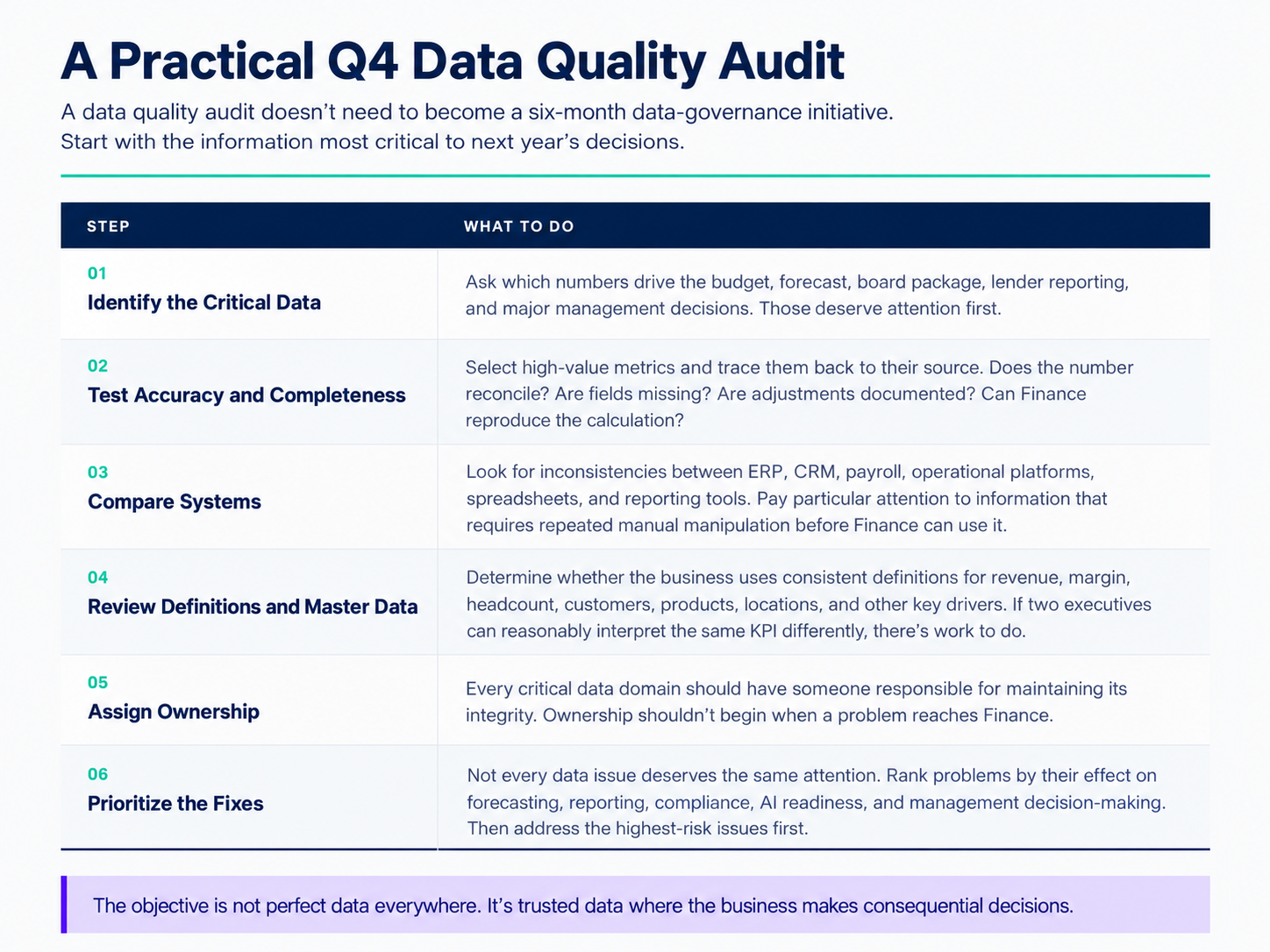
How to Run a Data Quality Audit: A Practical Q4 Checklist for CFOs
Growth Operators uses a straightforward framework to help finance teams assess data readiness before year-end planning and any new technology investment:
- Start with the decisions. List the forecasts, board metrics, lender covenants, and sponsor reports that matter most, then work backward to the data behind them.
- Map each number to its system of record. Document where each critical figure originates and every system, spreadsheet, or manual step it passes through.
- Test the six dimensions. Check accuracy, completeness, consistency, timeliness, traceability, and ownership for each priority data set.
- Reconcile across sources. Tie board-package figures to management reporting and the general ledger, and flag any number that cannot be tied out.
- Inventory manual adjustments. Identify recurring spreadsheet fixes and off-system adjustments that should be automated, controlled, or documented.
- Assign owners and definitions. Confirm a named owner and a single approved definition for each KPI and master data set.
- Prioritize remediation by business impact. Fix the issues that most affect forecasting, AI readiness, and board credibility first, then set a recurring review cadence.
The output should be a clear view of which data is ready for financial data analysis and AI, which needs remediation, and who is accountable for fixing it.
Build the Foundation Before Adding Another Layer
The CFO’s technology mandate is expanding. Deloitte found 54% of surveyed finance leaders now lead enterprise AI and technology capital-allocation decisions, while 48% oversee AI trust issues such as the reliability, accuracy, and explainability of outputs.
That makes data quality part of financial leadership.
Before approving the next AI initiative, forecasting application, or executive dashboard, Finance should know whether the underlying information can support it.
Growth Operators’ Finance & Accounting Advisory experts can help strengthen the reporting processes, controls, and financial infrastructure behind your numbers, while our Decision Intelligence & AI Advisory team helps turn that trusted data into faster, sharper decisions through analytics, automation, and AI.
If your business is ready to move from questioning the numbers to acting on them, Growth Operators can help build the foundation and put it to work. Talk to our team about a CFO data quality audit.
What is a data quality audit?
A data quality audit is a structured review of whether an organization’s data is accurate, complete, consistent, timely, traceable, and owned. For finance teams, it focuses on the data that feeds forecasts, management reporting, board materials, and AI tools. Growth Operators recommends that CFOs complete one before investing in new analytics or AI.
Why does data quality matter in financial forecasting?
How can a private equity portfolio company use AI to improve financial reporting and forecasting?
What should a CFO check before investing in AI for finance?
How often should a finance team perform a data quality audit?
What are common signs of poor financial data quality?
What is the difference between system integration and data governance in finance?
Who can help a CFO run a data quality audit?