The First Open Enrollment After an Acquisition Is When Employees Find Out What Really Changed
|
Share:


Heidi DeSautel has served as an interim CHRO for national companies, leading HR strategy and talent development. She played a key role in launching a biorefinery startup, establishing payroll systems, benefits packages, and hiring 70 employees in four months. She thrives in collaborative environments and enjoys building high-performing teams. Every...
A deal can close months before employees fully understand what it means for them.
Leadership may have communicated the transaction rationale. Managers may have held town halls. New logos might already be on the website. But for many employees, the first moment the transaction becomes personal is open enrollment after an acquisition.
That’s when they see the:
- New deductible
- New employer contribution
- Different provider network
- Revised PTO structure
- Retirement match
- Payroll deduction
And that’s when employees decide whether what they heard about the transaction matches what they’re experiencing. This matters because the people side of M&A remains one of the biggest threats to deal value.
RGP’s 2026 Human Value Gap in M&A research found that 81% of CFOs say culture, talent, and knowledge are critical to deal success, yet only 18% believe their organizations are effective at protecting those assets. The same study found that 74% report moderate to high turnover among leadership or critical talent during the first year after an acquisition.
HR teams aren’t always set up to manage that pressure. WTW’s 2025 M&A Barometer found that 65% of HR teams felt less than fully prepared to handle their deal portfolio.
The first post-acquisition open enrollment is one of the clearest tests of whether integration planning has moved beyond the deal model and into the employee experience.
Employees may not see the integration plan. They will see what comes out of their paycheck.
Key Takeaways
- Open enrollment after an acquisition is often the first moment employees feel the deal personally, through deductibles, contributions, networks, PTO, and paycheck deductions.
- Harmonize now or run parallel is the first benefits decision to make explicitly. Both can be right; neither works without systems readiness and a defined end state.
- A silent benefits downgrade costs more than it saves. Employees will run the math, and if the messaging does not match, trust in the whole integration erodes.
- Payroll and HRIS come first. Eligibility data, deduction codes, carrier feeds, and effective dates should be tested before the first employee communication goes out.
- When plans are not comparable, compare total value, model real employee scenarios, and use a Total Rewards Statement to show the full package.
- Growth Operators’ view: treat the first post-acquisition open enrollment as an integration workstream with an owner, a timeline, and a readiness gate, not as an annual HR event.
The First Decision: Harmonize Now or Run Parallel?
One of the most important benefits decisions after a transaction is also one of the easiest to oversimplify:
Do you move everyone onto one benefits structure now, or let the two employee populations run on separate plans for a period of time?
There isn’t one universally right answer.
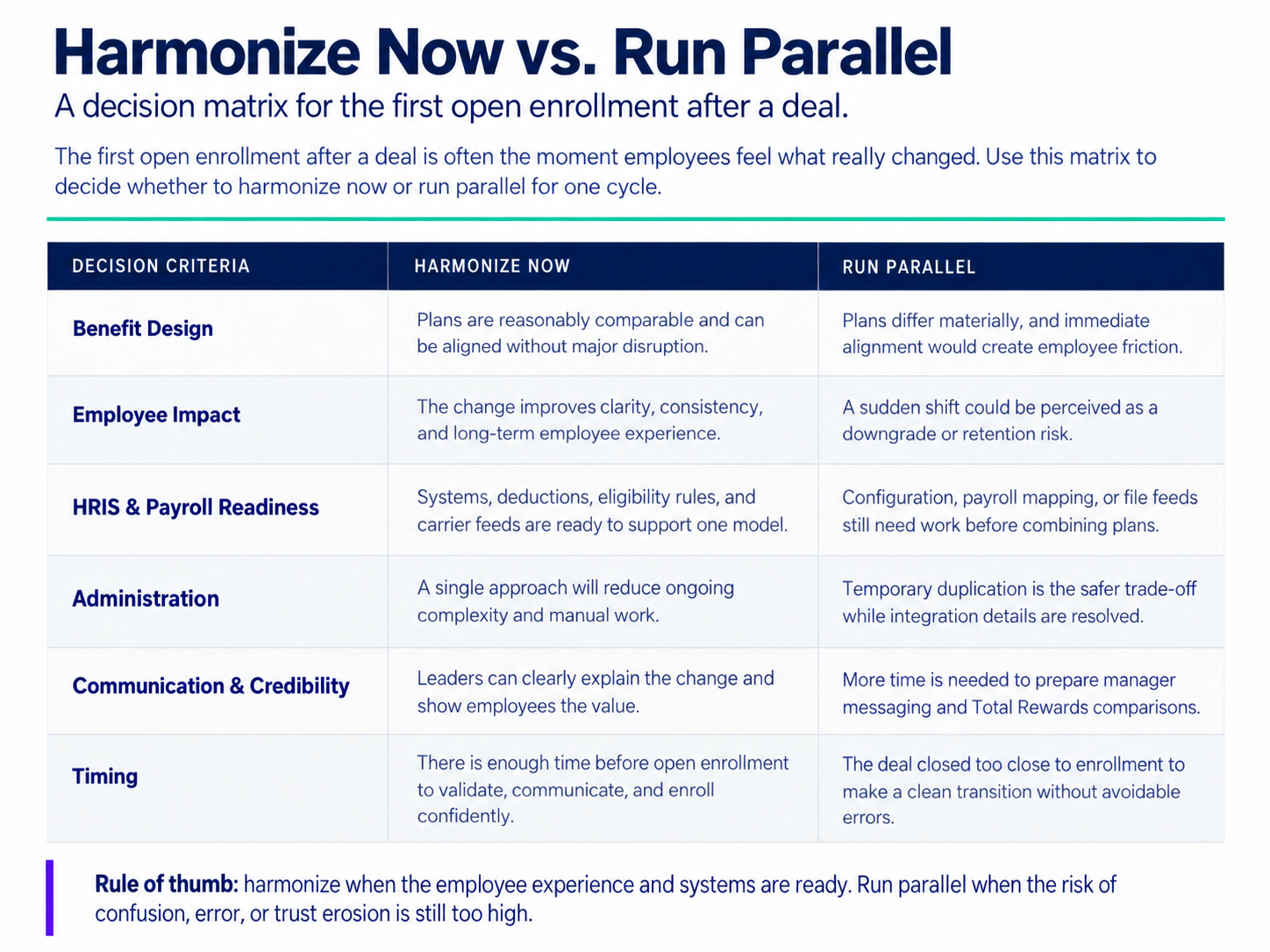
Short answer: Harmonize now when the systems are ready, and the two programs can be aligned without a material loss for either population. Run parallel when plans differ significantly, systems are not ready, or there is not enough time to evaluate both programs. Either way, make the decision explicitly and give it an end date.
At Growth Operators, we use a simple readiness test before recommending harmonization in the first plan year. If the answer to any of these is “no,” running parallel for one cycle is usually the lower-risk path:
- Can payroll and the HRIS support one plan structure without manual workarounds?
- Have we quantified the total value change for each employee population?
- Can we explain the change honestly, including any tradeoffs, before enrollment opens?
1. Harmonize Now
Moving employees onto one benefits structure can make sense when:
- The long-term operating model calls for one integrated company.
- Payroll and HRIS systems are ready to support the change.
- Benefit plans can be aligned without creating material employee disruption.
- Administrative simplification is an immediate priority.
- The company wants to establish one employee experience quickly.
The advantage is clarity. One company, one structure, one set of processes.
The risk is speed.
If the acquiring company forces harmonization before it understands the real value of both programs, employees can experience the change as a benefits reduction rather than an integration milestone.
2. Run Parallel
Maintaining separate programs temporarily may be smarter when:
- Benefit structures differ materially.
- Systems aren’t ready to integrate safely.
- Collective bargaining, geographic, or regulatory issues complicate harmonization.
- The acquired company has benefits that are deeply connected to retention.
- There isn’t enough time to evaluate the programs before enrollment.
Running parallel isn’t necessarily indecision. Sometimes it’s disciplined sequencing. But it needs an end state. Set a target harmonization date (for example, the next plan year), name an owner, and tell employees the timeline so “temporary” means something.
Without a roadmap, “temporary” programs can persist for years, leaving HR with duplicate administration, inconsistent employee experiences, and increasingly complicated systems.
WTW notes that workforce management during M&A can span total rewards, communications, organizational design, culture, talent, and integration planning. These issues are connected, which is why benefit decisions shouldn’t be treated as an isolated HR workstream.
A Silent Benefits Downgrade Has a Credibility Cost
Not every difference in employee benefits after a merger is avoidable. What is avoidable is letting employees discover a meaningful change on their own.
Suppose the new medical plan has a lower premium but a significantly higher deductible. Or the acquiring company’s 401(k) match is smaller. Or the acquired workforce loses a richer parental leave policy.
HR may technically communicate all of this correctly. But if the messaging emphasizes “enhanced benefits” while employees calculate that their actual value went down, credibility takes a hit.
That matters well beyond enrollment.
Employees start asking: What else changed that they haven’t told us about?
The best communication acknowledges tradeoffs. If one component becomes less generous while another improves, say so. If the company made a difficult decision because of cost, scalability, or long-term plan design, explain the rationale in plain language.
Employees don’t expect every transaction to leave every benefit untouched. They do expect leadership to be straight with them. In practice, that means telling employees what changed, why, who is most affected, and what the company is doing about it.
A message that works sounds like this: “Your deductible will increase next year. To offset part of that change, the company will contribute to your HSA and keep employee premiums flat. Here is what that means for single and family coverage.”
There is also a compliance dimension. Under ERISA, a material reduction in covered services or benefits under a group health plan generally requires a summary of material modifications within 60 days of adoption, and mid-year changes to the Summary of Benefits and Coverage can trigger advance notice requirements. Coordinate the communication plan with benefits counsel so the legal notices and the employee story say the same thing.
Payroll and HRIS Need to Be Ready Before Communication Starts
Open enrollment messaging often gets the attention. The less visible work underneath it is what determines whether the experience actually functions.
Before HR communicates a new program, the organization needs confidence in:
- Employee eligibility data
- Payroll deductions
- Benefit classes
- Dependents
- Employment status
- Plan mapping
- Carrier feeds
- Effective dates
- Contribution structures
- HRIS configuration
If those pieces aren’t aligned, even excellent communication can lead directly into a broken employee experience.
WTW describes HR technology integration as one of the most complicated and potentially expensive parts of a transaction, particularly when buyers don’t fully understand the systems involved before integration begins.
Growth Operators recommends a sequence that keeps communication behind system readiness:
- Validate the census. Reconcile eligibility, employment status, classes, and dependents across both populations.
- Finalize plan design and contributions. Lock the harmonize-or-parallel decision and the employer contribution strategy.
- Configure the HRIS and benefits administration platform. Build plans, rules, and deduction codes, and map legacy plans to new ones.
- Test end-to-end. Run test enrollments, carrier EDI feeds, and a parallel payroll calculation for representative employees.
- Prepare managers and HR. Give them the rationale, the trade-offs, and answers to the hardest questions.
- Communicate, then open enrollment. Launch employee messaging only after testing is complete.
- Audit the first payroll. Confirm deductions and carrier eligibility match elections after the effective date.
Growth Operators has seen the operational side firsthand. During a financial institution merger, our HR team helped combine two entities into a unified payroll environment, migrate 727 employees to a new HR platform, manage benefits enrollment for 492 employees, establish vendor integrations, automate workflows, and execute the related change-management plan.
That kind of work reinforces an important sequencing rule: Don’t announce the employee experience before you know the systems can deliver it.
For a broader look at enrollment operations, see our article on what open enrollment reveals about the HR function.
What if the Two Benefits Programs Aren’t Comparable?
This is where many post-deal communications fall apart.
Plan A costs employees less each month. Plan B has a lower deductible. One company offers stronger retirement benefits. The other offers better paid leave. One has richer executive benefits. The other provides broader wellness support.
There may be no honest way to say one program is simply “better.” So don’t. Instead, build an apples-to-apples comparison around total value. Then model it for real people.
Evaluate:
- Employer medical contributions
- Deductibles and out-of-pocket exposure
- Retirement contributions
- Paid time off
- Incentive compensation
- Life and disability benefits
- Leave programs
- Wellness benefits
- Other meaningful employer-paid programs
Model those components for representative employee profiles, such as a single employee with low utilization, a family with high utilization, an employee near retirement, and an employee planning parental leave. This shows which groups lose value, by how much, and where targeted mitigation makes sense.
When a population does lose meaningful value, transition tools can soften the change without abandoning the long-term design: a one-time HSA or HRA contribution, deductible and out-of-pocket credit for amounts already met, grandfathering a benefit for one plan year, or retention-linked adjustments for critical talent.
A Total Rewards Statement can be especially useful here because it gives employees a clearer view of compensation and benefits as a complete package rather than forcing them to evaluate individual changes in isolation.
A Total Rewards Statement is a personalized summary of everything an employer provides an employee, including base pay, incentives, employer-paid benefits, retirement contributions, and paid time off, expressed as a total dollar value.
The goal isn’t to disguise a reduction by pointing to benefits somewhere else. It’s to give employees enough context to understand the complete picture.
That’s particularly important in PE-backed organizations, where employees may already be wondering whether new ownership means cost cutting, restructuring, or changes to how the company operates.
What Are Common HR Challenges After a Private Equity Acquisition?
Short answer: The most common HR challenges after a private equity acquisition are talent retention, HRIS and payroll integration, benefits harmonization, inconsistent policies and employee data, unclear HR ownership, and employee communication about what new ownership means. Post-acquisition open enrollment tends to surface all of them at once.
The most common HR challenges after a private equity acquisition rarely appear one at a time.
Open enrollment may expose:
- Bad employee data
- Inconsistent payroll processes
- Multiple HR systems
- Undefined HR ownership
- Misaligned policies
- Benefits that were never properly evaluated
- Inadequate communication processes
- HR teams with too little capacity to manage integration and daily operations simultaneously
That’s why post-acquisition open enrollment can be such a useful diagnostic. If every exception becomes a fire drill, the problem probably isn’t enrollment. It’s infrastructure.
Growth Operators’ First 100 Days After an Acquisition playbook explores how Finance and HR can stabilize the business, align priorities, and create the operating foundation needed after close.
Treat Enrollment as an Integration Workstream
For CHROs and PE operating partners, the first enrollment cycle should have the same discipline as other integration workstreams.
Before launch, ask:
- Have we made an explicit harmonize-versus-parallel decision?
- Do we understand the total value difference between the two programs?
- Can HRIS and payroll support the decision without manual workarounds?
- Have we identified employee populations most affected by the change?
- Can managers explain what changed and why?
- Do we know how we’ll measure issues, participation, and employee response?
- Have we confirmed required ERISA and SBC notice timing with benefits counsel?
- Will employees receive a Total Rewards Statement or personalized comparison before they enroll?
A transaction can look complete on an org chart while still feeling unfinished to employees. Open enrollment is often where that gap becomes visible.
Make the First Enrollment Build Trust, Not Erode It
The first open enrollment after a deal isn’t just a benefits deadline. It’s one of the first times employees can directly compare the promises of the transaction with the reality of working inside the new organization.
Growth Operators’ HR Advisory team helps middle-market and PE-backed companies navigate that reality—from benefits strategy, HRIS, and payroll integration to communication, organization design, and post-close HR transformation.
If your next open enrollment is also your first after a deal, don’t wait for employees to tell you where the integration broke. Build the right experience before enrollment opens. Talk to Growth Operators’ HR Advisory team about your first post-acquisition open enrollment. Contact us today to get started.
Who provides HR technology and HRIS advisory for middle-market companies?
Growth Operators provides Human Resources Advisory services for middle-market and PE-backed companies, including HR technology assessment, HRIS implementation support, process improvement, payroll and benefits integration, and hands-on transformation execution. The team brings operator experience, which means recommendations can extend through implementation rather than stopping at a technology roadmap. In a financial institution merger, Growth Operators’ HR team unified payroll for two entities, migrated 727 employees to a new HR platform, and managed benefits enrollment for 492 employees.
Who can recommend new HR technology and advise us on HRIS processes?
What are common HR challenges after a private equity acquisition?
What should HR do for open enrollment after an acquisition?
Should benefits be harmonized immediately after a merger?
How long can a company run parallel benefit plans after an acquisition?
How do you communicate a benefits reduction to employees after a merger?
What payroll and HRIS work must be done before post-acquisition open enrollment?
What is a Total Rewards Statement and why use one after an acquisition?
Who can help a PE-backed company with benefits and HR integration after an acquisition?